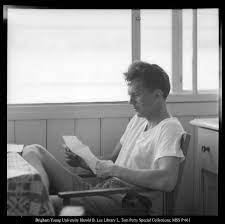
On a Young Hobo

Hobo is one of those words of which we have no clear etymology. However, the word is in our vernacular and has been since the 19th Century. During the Great Depression in the United States, the roads and railways were clogged with young men (and a few women) who were traveling around looking for work, food, direction. With almost 25% unemployment, it’s no wonder why. My uncle Bubba (his name was Melville Carr Baker; that’s why everyone called him Bubba) told his tales of riding the rails in the 1930s from town to town.

Another young man who did this was one Arnold Samuelson. From Scandinavian stock in the American Middle West, Arnold had finished his college work and was, like most men aged 22, uncertain about his future. That’s when he decided to stick his thumb out on the highway and travel the United States, to see what there was of the amazingly large nation. Eventually, Arnold found himself sitting on top of a boxcar as it made its way down the bridges from Miami into Key West, Florida, the southernmost point in the nation on the East Coast. When he arrived in Key West, it was almost summer, the time when people at that time left Florida to escape the heat and mosquitos.

That first night in Key West, Arnold slept on the dock; the sea breeze kept the bugs at bay. But the next night, a couple of local policemen said he couldn’t sleep in public and offered to put him in their holding cell for the night. One rule of being a hobo, at least according to Uncle Bubba, was that you never said “no” to the police. So, Arnold went with them. That started several days of walking around the town during the light and sleeping in the mosquito-filled jail cell at night.

On one of his walks about the town, Arnold found himself in front of a large, older, typical Key West house. He knocked on the door, and a burly, shirtless, mustachioed man came out and confronted him. Arnold stammered hello, and the man asked him, brusquely, “Waddaya want?” Arnold sketched out his tale to the man, and he could see that, the more he explained his situation, the more relaxed the man became. “So, you just want to chew the fat?” the man said with a smile. Arnold nodded. The man said that he was busy, to come back the next morning and they would sit on the porch of the man’s house and have a proper talk. Arnold agreed. That began several days of Arnold waking up in the jail, scratching his new bug bites, then coming to the man’s house and having deep, meaningful conversations about life, love, art, and Arnold’s favorite topic, writing. The man was quite knowledgeable about many topics and filled with good advice and helpful life-tips for the young hobo.

“If I wished to learn about writing and about life,” Arnold asked him one day, “what books should I read?” The man got up and got a piece of paper and a pencil. He made a list of books for Arnold to get and peruse. “Those’ll teach you about what you need to know,” he told Arnold. One day, the man gave Arnold the news that he had to take his boat up the coast. He asked Arnold to do him a favor. “Say,” he said, “would you want to come along? You can live on the boat and watch out for it when I’m not on it.” Arnold eagerly agreed. He couldn’t believe his good fortune. He ran back to the police station and grabbed his tattered bag, thanked the cops, and ran back to the man’s house. That was the beginning of a whole year of sailing on the Caribbean with the man and his fishing buddies and other assorted guests. The man paid him a dollar a day, and Arnold was deliriously happy.

Arnold never did become a famous writer, but he did publish an interesting book about his experience there.

It’s called, With Hemingway: A Year in Key West and Cuba.

On Three Jealous Lovers

Oh! beware, my lord, of jealousy; it is the green-eyed monster which doth mock the meat it feeds on.-Othello, Act 3, Scene 3, by William Shakespeare

Shakespeare knew that jealous was powerful and hungry and often incredibly dangerous. We feel jealousy’s threat with the Bard’s warning to “beware.” And history is filled with stories of jilted lovers and of people who have almost literally lost their minds over love. More recent news stories tell us that nothing has changed much over the millennia. Here are three of the more odd and drastic examples of the green-eyed monster rearing its ugly head.

Take the story in 2013 of a man in Saudi Arabia who loved and married the woman of his dreams. Social media’s prevalence has given the public many more opportunities to find out about people cheating on their significant others. This man discovered what he thought was evidence of proof of his wife’s infidelity online. That’s when this Saudi man, as we say, “lost it.” He confronted his wife over the post online that showed her kissing the cheek of a rather handsome fellow. How dare she, he said, when had been completely faithful to him. Of course, the wife protested. In fact, she literally laughed off her husband’s accusations at first. How could he be so ridiculous, she asked. She didn’t deny the post and didn’t deny the kiss. However, she said it was obvious that the kiss meant nothing to her other than a sign of friendly affection. He was not to be daunted. He filed for divorce, citing the online photo as evidence. Even though the photo didn’t prove anything, the court granted the man a divorce. And, while the divorce was final, even the court also had to laugh at the man’s irrational jealousy. The ex-wife wasn’t sorry about the divorce, either. She felt that the man’s irrationality should have been something she saw earlier in the relationship. You see, the photo definitely showed the kiss. But the object of the wife’s kiss was a beautiful Arabian horse.

In 2012, Lowell Turpin of Tennessee flew into a rage over a photo on his wife’s computer. Lowell didn’t have the best judgement in the first place, and he had a history of violence and jealousy towards his wife. If any man spoke to his wife, even a cashier or checkout person, Lowell would threaten the man with revenge. The photo Lowell found on his wife’s laptop was of an attractive man, a bit older than she was, with a chiseled jawline and a full head of hair with a touch of gray at the temples. And he had a winning smile to boot. Right on cue, Lowell flew into a rage and snatched the laptop from his wife’s hands. “You slut!” he kept screaming, over and over. He threw the computer against the wall, shattering the machine into dozens of pieces. “Tell me who he is!” His brow-beaten wife, right before she called the police and had Lowell arrested, obliged him. “That man,” she explained calmly, “is Mitt Romney.”

The last tale is one you probably remember from the news at the time. Lisa Nowak lost her mind in 2005, at least temporarily. She left her husband for another man, a co-worker, a few years before. To Lisa, the new guy became her obsession. An old adage says that if he’ll do it with you, he’ll do it to you, and, in this case, it was true. The man she left her husband for left her for another woman. And that’s when Lisa lost it. She drove almost 1000 miles to confront the woman she’d lost her lover to. Tracking and stalking the woman to the airport in Orlando, Florida, Lisa first accosted and harassed the woman before pepper spraying her through her open car window. When she was arrested, Lisa’s car revealed that she had been shadowing the woman and the former boyfriend for some time. In her defense, Lisa claimed a temporary breakdown, but the obsessive behavior was shown to have gone on longer than “temporarily.” Thus, Lisa Nowak became the first active-duty astronaut to be charged with a felony and dismissed from NASA and received a less-than-honorable discharge from the US Navy.

We often associate colors with moods and emotions. Cowardice is yellow. Sadness is blue. Anger is red. But the green of envy, the monster of jealousy, can be the most irrational at times as these three stories prove.