
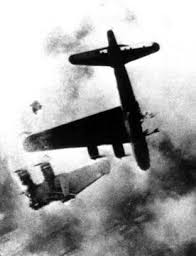
Nicholas Alkemade was a British man who fought in World War 2. His job during the war was not an enviable one–he was the tail gunner in a British bomber. That position was one that had a short life-span. Many of the men who were tail gunners never lived to tell the tales of what they experienced as the bombers flew miles above Germany during the war. You see, the tail gunner had a great responsibility. The German attack planes that were sent up to stop the bombers would usually attack the Allied bombers from below and from behind. Men like Nicholas had the difficult task of trying to fend off the attackers so that the bombers could carry out their tasks. But that also meant that they and their small, cramped nest at the rear of the plane were incredibly vulnerable. They were the first ones to see and sometimes even feel the bullets the Nazi airplanes spewed into the bombers. And, too often, the bombers retuned to England after the bombing raids with no tail gunner at all.
On March 24, 1944, Nicholas, who was 21 years old, and his bomber group were tasked with making a raid on Berlin, the German capital city. And the attack was scheduled, as many were, at night, when it would be more difficult for the enemy to see the bombers. Three hundred planes were sent on the mission. Now, once the bombers crossed the English Channel, they were over enemy territory and thus susceptible to anti-aircraft fire as well as the harassing German fighters, fighters that were much faster than the lumbering big bomber.
Nicholas’s plane, a British Lancaster bomber, had a crew of 7 men. They had dropped their bombs, and they turned for home. That’s when a small squadron of German Stukas, a heavily armed fighter/bomber, attacked. Nicholas and the other gunners tried to fend off the Stukas, but their plane was shot up badly. It caught fire. It began to spiral down towards the earth. There was nothing Nicholas could do but abandon the burning plane.
When he landed, Nicholas was quickly captured. He’d sprained his leg when he landed, so he had to be assisted by the German soldiers who captured him. The Lancaster had crashed nearby, and four of his fellow crewmates never made it out of the burning plane. Nicholas was taken to the local Gestapo (the Nazi secret police) headquarters for interrogation. That part was routine; the Nazis wanted to know the location of Nicholas’s airbase, what the number of planes were in his squadron, and other such information that might help them in the war. Of course, Nicholas didn’t reveal anything other than his name, rank, and serial number. Oh, and he told them about jumping out of the burning plane, of course.
And that’s when the Nazis began to doubt Nicholas’s story. How did he manage to jump out and survive when four of his fellow crewmembers didn’t, the Nazis wanted to know. His tale seemed too incredible to believe. The plane was at 18,000 feet (5,500 meters) above the German nation when Nicholas bailed out. Something didn’t add up about his story, the Nazis said. Yet, Nicholas insisted that his version of what happened was the truth.
The Nazis called him a liar. They made the injured man return with them to the crashed Lancaster. They forced him to show them where he was when he jumped. And then he pointed to his parachute. That’s when the Nazis shook their head in disbelief, but they had to admit that Nicholas was telling them the truth. You see, the charred parachute that Nicholas pointed to, the one that he was to use in case of the bomber being shot down, was still in the plane, still lying in the burned out wreckage of his tail gunner’s position.
And Nicholas Alkemade had somehow survived when he jumped 18,000 feet to earth without it.






 The Rest of the Story