
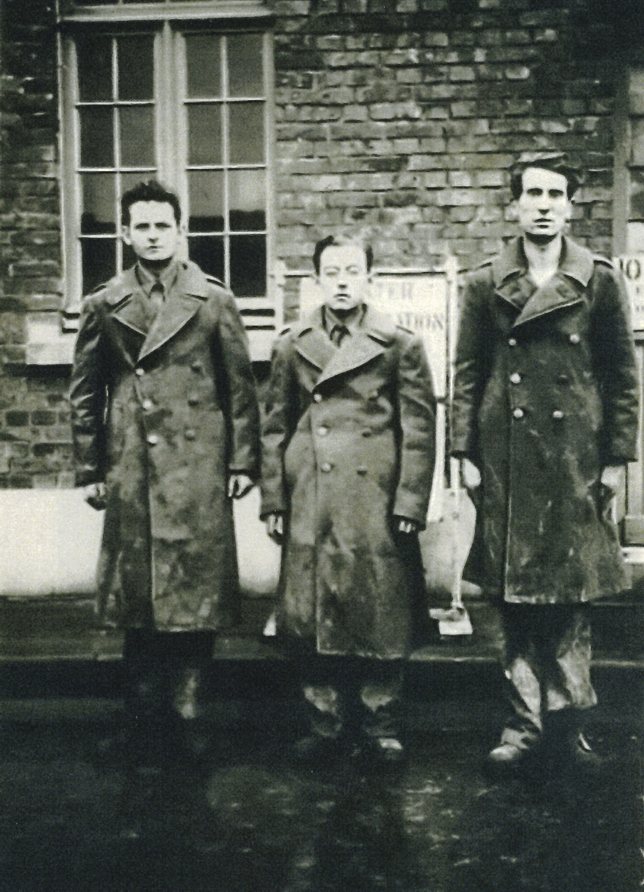
The World War 2 Battle of the Bulge marks the last major offensive of that war by the German Army. In December 1944, the Allies in the western theater of war felt that by that time the Germans lost the will to fight. The end of the war loomed, they believed. That’s when Hitler’s troops launched their surprise attack through the lightly defended sector of the Ardennes Forest, causing a retreat or bulge in that part of the Allied line, thus giving the battle its name.
The Germans had managed to hide the accumulation of the armament and men and supply/support staff needed to carry out the daring attack from the advancing Allies. If successful, the German advance would have split the Allied troops in two, and, while not changing the war’s eventual outcome, it could have prolonged the war by several months if not more.
Part of the plan involved sending German troops cleverly disguised as American and British troops behind Allied lines to create confusion and to cause as much havoc as they could. Hitler appointed Colonel Otto Skorzeny, the famous Nazi commando leader, to head the operation. The year before, Skorzeny had famously pulled off a daring raid to rescue Italian leader Beninto Mussolini from a moutaintop prison where anti-Fascists had taken him. Skorzeny assembled several hundred men who spoke good English and outfitted them with captured Allied uniforms, putting them in stolen American Jeeps, and sent them towards the advancing Allied troops.
You can imagine the chaos such a group would create. The disguised Germans sent Allied troops in the wrong directions, they were given access to Allied supplies (some of which they destroyed), and they changed road and village signs, making it much more difficult for the Allies to mount a successful counter-attack against the regular German advance. The Allies soon realized that they must find a way to ensure the troops wearing their uniforms were, in fact, their troops. In addition, the masquerading Germans had sown paranoia as well as confusion and chaos. American troops in that area had no idea whom they could trust anymore.
And, in typical American fashion, a fool-proof method of verifying American troops developed. They would create checkpoints and ask simple security questions that every true American boy would know but ones that an imposter would not possibly know.
So, orders went out from General Eisenhower’s office to ask these specific security questions to all when going through the checkpoints. Even if the papers of the soliders looked to be in good order, the real test, the real security check was if the person knew the answers to specific questions. If the person couldn’t answer a particular question, that person was immediately arrested. And the security checks worked. The disguised Germans, realizing that they couldn’t teach their operatives the answers to the questions, quietly made their way back to the German lines. But the checkpoints remained on the Allied side, just to make sure.
One checkpoint managed to find an officer who seemed ok at first glance–oh, the Jeep looked right, the papers were in order, the uniform was perfect–but the man stammered when asked the security question. His eyes widend when he realized he couldn’t verify his loyalty because he didn’t know the answer. The guard at the checkpoint lowered his machine gun to point it at the officer in the Jeep, and the man raised his hands, outraged, and bellowed that this was a ridiculous way to verify him. “I showed you my papers, Goddam it!” the officer sputtered. “That’s exactly what a Kraut would say,” the young corporal calmly replied.
“Do you know who I am?” the officer yelled. The corporal grinned but kept the gun pointed at the officer. “I know who you say you are…sir. Now, keep your hands where I can see them.”
And so, in the Ardennes Forest, in the middle of World War 2, a young corporal held Brigadier General Bruce C. Clark–the real General Clark, the head of Patton’s Third Army Fourth Armored Division–at gunpoint for over 15 minutes until he could be verified because he didn’t know which professional baseball league the Chicago Cubs played in.





 The Rest of the Story