On a Beautiful Village

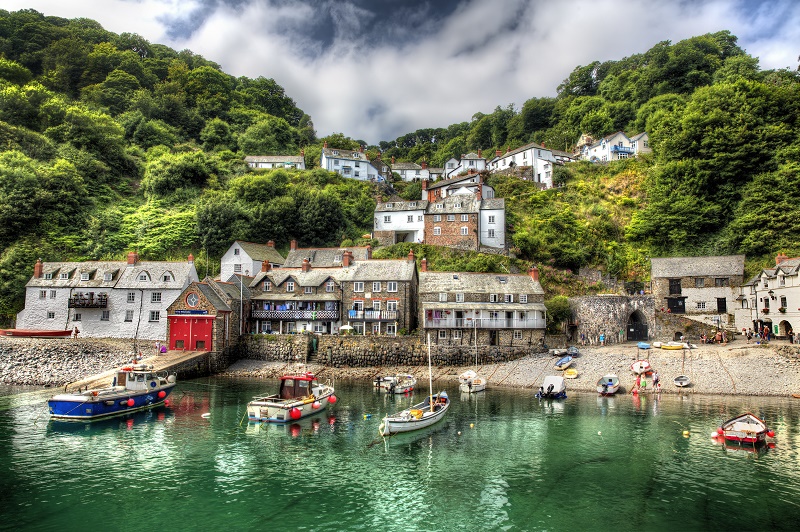
Clovelly. The name of this English village itself contains the word “lovely,” and that’s a perfect description for this quaint fishing settlement on the north coast of the lower left (west) leg of England, almost directly north of Plymouth. If you’ve ever seen a puzzle box that features those brightly painted small fishing boats resting in a quiet little harbor with neatly kept character English houses lining the seafront behind them, well, then, you’ve probably seen Clovelly. There are several interesting things about the village that makes it unique in England and, in many ways, the world.

Take, for instance, that the village is built on a steep hill that ends at the waterfront. The streets of the town are still made of cobblestones–many of them the original ones. Slightly fewer than 500 souls live in the village’s 80 houses today. The population of Clovelly love the village. Most say they wouldn’t live anywhere else even if given the chance. Not that everything is easy in the village, because it’s not. For example, to take, well, anything up or down the hill, the villager can’t rely on cars because cars aren’t allowed in Clovelly. No, to take groceries, mail, supplies, or even a refrigerator up the hill from the harbor, the village has relied on sledges–almost every house has at least one–and these sledges are often pulled by donkeys. Now, this isn’t a description of life a few hundred years ago, but it is the reality of life for the Clovellites today. So, no cars are allowed. And, by the way, visitors to the village must pay the equivalent of $10 to enter. You’d think that would keep tourists away, but you’d be wrong. Clovelly is one of the most popular villages to visit in England, and it’s been labelled the prettiest village in Devon. Social media type have even given Clovelly the title of England’s Most Instagrammable Village.

Shortly after taking England in 1066, William the Conqueror “relieved” the Saxon lord who owned the village of his title, and William gave the village to his wife as a gift. Since then, only three families have owned the land that William originally took. That was in the day when the local lord owned all the land and only allowed the workers or peasants to live and work on it. Today, the most recent family (for the past few hundred years) who have lived in the lord’s house have been the Hamlyn Family. But it was the Cary Family who, in the 1600s, spent considerable money at that time to create a breakwater just off the coast to make a harbor. And harbor protected and sustained a fishing fleet that the village has maintained and used consistently make its livelihood from the sea. While fishing is still a mainstay of the population in Clovelly, now, of course, the main trade is tourism.

And then, there’s the houses and shops of the village itself. The Hamlyns will gladly pay for the residents to repair their habitations, but there’s a catch to the family footing the repair bill. The house must be kept to original specifications and, if possible, as close to the original materials as possible. That means the only exterior materials must be either stone (the newer dwellings) or cob (the older houses). Obviously, modern conveniences are in Clovelly, but people can’t make radical changes to the buildings. That’s because, in part, that the entire village is listed as a historic site. The result is that the whole place, according to one source, is like stepping into a time machine. You can walk down (or up) the main street and easily imagine you’re back in the 1700s rather than the 2000s.

And the Hamlyns prefer it that way. In fact, they insist. You see, the reason the Hamlyns insist on paying for repairs to the houses in the village is because they own the village. And the houses. And the surrounding land. All of it. Every inch. Clovelly is, today, the most picturesque of the last dozen privately owned villages in England.

And the happy people of Clovelly are fine with that.
On a Pogrom

I want to speak about a country where Jews had been persecuted for centuries for being, well, different. Their religion and traditions, their clothing, and their lifestyle; these already marked them in Europe as being the “other” for as long as people could remember. And we know how things go for groups marked as being different. So, when the government of this particular nation ordered that Jews would have to wear a badge signifying their ethnicity and religion, well, in many ways such an order was superfluous. People knew who the Jews were in their community. And, over the years, propaganda spread about Jews being carriers of diseases (but they themselves being immune because they were in league with the Devil, you understand) and being hunters of children for their blood. Jews had been persecuted for being dishonest moneylenders when the Catholic Church condemned them for the charging of interest in lending the money. And so on.

We know that the nation’s history was already littered with accounts of pogroms against Jewish people. In fact, we have records that the houses that had Jewish populations in them were burned in times of plague or famine, because, after all, you have to blame somebody for the bad things that were happening, and who better than the “other” to pin the blame on? Churches preached sermons on blaming Jews for things like floods and earthquakes, saying that these things were happening because God was angry that the Jews had killed Jesus.

But back to this particular period of persecution, specifically how the authorities first marked Jews for persecution. The government, in ordering that the badge be worn, mandated that it be yellow and that it be of specific size and shape. To be a Jew and be caught without wearing the badge in public meant prison or worse. The government decreed that (in fact, promoted the fact that) average citizens could make such accusations. Rewards were offered for turning in Jews who ignored the law. Other laws quickly followed. Of course, one of the first things that the government mandated was that all synagogues were to be immediately shuttered. Then, in an effort to push the Jews out of the economy, extremely heavy taxes were imposed. That shut down several of the smaller businesses immediately. Then, where Jews could travel was limited. What amounted to the establishment of ghettos resulted from laws forcing Jews to live in certain areas of towns. And then, as we know, Jews were systematically rounded up and removed by the authorities.

We should read descriptions like these and redouble our resolve that such events should never happen again. Yet, we see history repeating itself over and over as hatred is allowed to go unchallenged and unchecked. Some people actually deny that these things and others like them ever took place at all. Media even go to great lengths to give credence and platforms for people who actively practice such denial. Many simply say that to deny that these events happened is merely another opinion or even “alternate facts.”

And to think that these events described above occurred in England in the late 1200s makes all of it even more astonishing.

On an Impending Invasion

You probably know that during the war, England was under threat of immediate invasion for many months. And being an island country, England had a lot of coast line to defend.

Where would the enemy strike? The obvious place would of course be across the English Channel, the shortest spot across from Europe. The enemy landing troops in the south eastern corner would begin marching north and west, attacking the capital, and fighting its way inland.

So the king and his advisers and the government set up a system of early warning systems to let everyone know if any amphibious attack was pending. Meanwhile, the army could not ignore the possibility that an attack might come from any side, really.

There were even rumblings that the enemy might even attack from the west, the Ireland side of the island. That posed an entirely different and other threat. So the army made preparations to strengthen a fairly spread out defensive perimeter as far along the coasts as possible.

Luckily for England, the island is difficult to attack. It had been so many years since any enemy had successfully subdued the place. Even as far back as the Romans, conquering Britain was considered to be an amazing military accomplishment. The English Channel is notorious for rough weather and dangerous seas. It has always been a dictum that the true first line of defense for the land was the sea itself.

Once any potential enemy landed, the equivalent of a loose national guard would swing into action. These locally led and organized units worked closely with the army to prepare for any possible invasion contingency. Yes, and entire network of local fighters would make any invasion that much more difficult. In this way, the actual force of the army was several times its professional strength. The keys would be supplying these local militias and getting everyone turned out as soon as an invasion appeared to be imminent.

Thus, as the war began and potential allies fell one after another under the heel of the enemy, Britain stood alone. She knew that the enemy had more men, better (and more modern) equipment, and momentum–a string of recent impressive victories. Yet, England had an indomitable spirit, and most people felt united under the bravery of their leadership.

What most people don’t know is that an invasion force did try to attack from enemy-occupied Norway in the autumn of the war’s first year. But England won a decisive victory and turned the invaders away.

The king celebrated the victory, but he knew it came at the cost of troops he could not spare. In fact, The pyrrhic victory in the northeast may have been one of the major reasons King Harold of England was defeated by William the Conqueror at the Battle of Hastings in 1066.