On a Polite Man

March 4, 1889, was a cold and rainy day in Washington, D.C. The newly elected Benjamin Harrison was due to be sworn in that day as the 23rd President of the United States. Harrison, a Republican, had been elected in an incredibly close and sometimes bitter election, defeating the Democratic incumbent, Grover Cleveland. In fact, Harrison had lost the popular vote the previous November, and he won the electoral college vote because he had narrowly won the state of New York despite Cleveland’s workings with the Tammany Hall political machine there.

No matter. Harrison was the man of the moment, and he felt the hand of destiny upon him. He was the grandson of a previous resident of the White House, one William Henry Harrison, known as “Old Tippecanoe” for his victories in wars against first nations more than half a century before. And he had been a senator from his adopted state of Indiana and served that state well in the US Senate. Also, Harrison had seen a great deal of action in the American Civil War, working with General William T. Sherman to split the Confederacy in half in the war’s last full year. So, all of that background led him to the inaugural day, and the rainstorm that beset the capital that day.

Interestingly, Harrison’s grandfather has the distinction of serving as president for only one month. It was during his ancestor’s inauguration during a winter storm that Old Tippecanoe had spoken for over an hour, and, as a result, he caught pneumonia that eventually led to his death and the rise of his Vice-President John Tyler to the office. Benjamin Harrison was well aware of his grandfather’s legacy, and his planned remarks were purposefully short. He wanted to touch on several key issues, however, in his speech. After such a contentious election, he felt that the occasion called for extending an olive branch to the Democrats and to the southern states that still stung from the defeat in the war that was still fresh in many minds down there.

In many ways, the election was a choice between personalities, as many elections are. Cleveland had raised some eyebrows during his term by marrying a young girl barely out of college for whom he had been appointed a guardian after her father had died. Harrison, on the other hand, was seen as a steady, solid, traditional candidate in sharp contrast to that type of “unseemly” behavior. Much muck had been thrown during the campaign over Cleveland’s unusual marital choice, and that had also caused some harsh feelings between the two campaigns.

But Harrison wanted to rise above all that electioneering. After the oath of office, and as he stood to read his prepared speech in the pouring rain, it quickly became obvious that there was no way Harrison could read what was quickly becoming a smeary sheaf of papers in his hand. It was then that a man emerged from the crowd on the platform behind Harrison, a man who quickly stepped up and held his umbrella over the head of the new president and kept it there while he finished his inauguration address.

When Harrison finished, he looked up to see who the kind man was who had allowed himself to get soaked so that the new Chief Executive could read his remarks on that historic occasion.

Harrison smiled and nodded when he realized that the polite man who had held the umbrella was none other than Grover Cleveland.

On a Sucker

Marvin Stone is one of those clever American inventors of the 1800s who came up with something so simple and so commonplace that we can’t imagine that anyone had to come up with it at all. Marvin was born in 1842 in Ohio, and his father was also an inventor. The boy grew up working with his father in the workshop, learning how to approach a problem from a mechanical engineering perspective. He began Oberlin College but his studies were interrupted by the outbreak of the American Civil War in 1861.

Marvin served in the United States Army with distinction during the war, fighting in such battles as Lookout Mountain in Tennessee (where he was injured) and also served in an administrative position in Washington, D.C. After the war, Marvin was restless, first thinking about pursuing a theology career and also working for a time as a newspaper reporter. But the years growing up at his father’s side in the workshop called to him, and he returned to his roots as an inventor.

He soon made a contract with the Duke Tobacco Company in D.C. He is credited with inventing one of the first machines that rolled cigarettes. The Civil War had seen the decline of pipe smoking and the beginning of soldiers and the public turning to rolling cigarettes. Marvin’s invention made that process consistent and mechanized. Duke paid Marvin’s firm to make the rollers which they took and sold to the public. Soon, he built a factory to handle the demand for the cigarette roller. It made Marvin a comfortable living. He married a woman named Jennie Platt and settled down in the Washington area.

Marvin was generous with his new wealth. He built lodgings for the single female employees of his factory, for example, gave his workers with healthcare, and provided them with access to libraries and education in their off hours at a time when such a thing was unheard of. In addition, after seeing the deplorable living conditions of some minority residents of Washington, Marvin spearheaded efforts to build better housing for those residents at his own expense. For his efforts, his fellow manufacturing tycoons made fun of Marvin. He was one of those soft touches, they said, a real sucker. But Marvin knew that it was the right thing to do.

One hot summer afternoon, Jennie and Marvin were enjoying some drinks on their front porch. The drinks were mint juleps, if you must know. And while the drinks were refreshing on the stifling Washington day, while sipping them, Marvin had an epiphany. He began to do some research on his idea. What Marvin found was that his idea wasn’t new, and that disappointed him. Turns out, both the ancient Sumerians and Egyptians as well as the first civilizations of South America had come up with the idea. However, not all of his research was negative. It seemed that no new technology had been developed since the olden days, and that told Marvin that he could make a new version of what those old civilizations had first developed.

Soon, Marvin developed a prototype. It was 8 1/2 inches (22cm) long, made of paper and coated with wax. And it worked. Marvin patented the product in 1888. Cheap to mass produce, Marvin soon re-tooled a part of his factory to begin to produce the new product. Within a few months, Marvin began making more money from the sale of his new invention than he did from the cigarette rollers. Sadly, Marvin didn’t live to see how popular his creation became, how universal his invention was to be to the modern world of the 20th Century. He died after a long illness in 1899, leaving Jennie with a sizeable inheritance. And he left you and me a legacy that we enjoy today, when you go to a fast food place and get a drink or stop at a Buc-ee’s for a soda. Yes, we should think of that sucker, Marvin Stone, every time we take a sip of our drinks through his most important invention.

The straw.

On a Bureau Chief

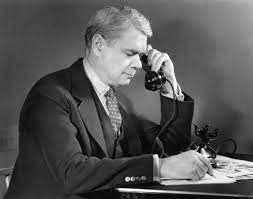
The Chicago Tribune was historically a conservative paper in a fairly moderate to liberal town. Run by the McCormick family, the paper reflected the conservative American values of that family. And practically none of the paper’s reporters was the best embodiment of those values than the firm’s Washington bureau chief, a man named Arthur Henning. Over the course of almost half a century, Arthur Sears Henning reported back to Chicago all the news that the conservative slant of that esteemed newspaper could print.

Henning began reporting from Washington for the Tribune back in 1907, during the William Howard Taft administration. Back then, and up until Teddy Roosevelt a couple of years earlier, most presidents of the United States never held press conferences where reporters could ask questions. No, any time the Chief Executive wished to convey a message to the press, he would call certain reporters to the White House for a meeting. Henning was one of the few that Taft favored, and he was a frequent guest for White House sit-downs with the president. That gave the Tribune many scoops over the years. And it also gave Henning unique insight into the workings of the White House. He got to know the next several presidents well as reporting on what he saw and learned from them.

Woodrow Wilson, he said, was not patient with unintelligent people. Calvin Coolidge, a man notoriously taciturn, would “talk your ear off,” if given a chance. Taft, a large, jovial man, was remembered by Henning as laughing and making his large belly shake like Santa when he told jokes. But Henning had little use for Franklin Roosevelt. The McCormicks were completely against FDR and his New Deal plan for dealing with the Great Depression. And Arthur Henning wasn’t writing anti-Roosevelt news stories simply to please his boss; according to a colleague, Henning was a True Believer. He actually agreed that the policies of the Democrats was tantamount to socialism. Henning would be more at home today on some right-wing media show. Which was interesting, because he had the reputation of being a fun-loving, kindly man who was often generous with his friends.

But that’s not why we remember Arthur Henning. You know about him because of only one story he wrote and for no other. In fact, we can narrow it down even more to three words he penned that you have most likely heard or at least seen. You see, when Roosevelt died near the end of World War 2, the nation worried that the new president, Harry Truman, might not be able to lead the nation like FDR had for over 12 years of first the Depression and then the prosecution of the war. But Truman brought the war to a successful conclusion in the months after assuming the office mostly by following Roosevelt’s blueprint. The peace that followed, however, proved daunting. Inflation, the re-absorption of the millions of service men and women into both the economy and society, the housing crisis, and the rise of communism after the war tested Mr. Truman’s mettle. As 1948 rolled around, it seemed that Truman might suffer an ignominious defeat in the election that year. After all, in the UK, Winston Churchill himself had been ousted after the war ended because people wanted a fresh start.

Henning reported throughout the summer of 1948 about the state of the election. He wrote stories for the Tribune detailing how unpopular Truman was to a wide swath of Americans. So it was no surprise that when election night rolled around, Arthur Henning turned in a story that everyone, including this experienced Washington bureau chief, expected.

The story’s headline?

Dewey Defeats Truman.

On an Inspection

The 1950s and early ’60 were a time in white middle class America when gender roles and rules of social decorum were fairly strictly defined and generally observed. Women wore hats and gloves to church and, often, even to the store; men wore suits to dinner and even to the movie theater. The reason some people watch reruns of the old TV show Leave It to Beaver today is to see what was the reality for many families at the time–a nostalgia for a period when the men worked while the woman stayed home and raised the kids, and people lived in nice suburban comfort. All of that changed, of course, in the 1960s beginning with such things as John Kennedy not wearing hats and the emergence of the counter culture that followed in the wake of the Civil Rights and Vietnam War protests. Allow all of that to serve as the societal background to the meeting of two women when one was moving into a new home in 1961.

Now, the two had met before because their husbands were in the same business although there were a generation apart. The occasion was that the younger woman’s husband had recently received a promotion, and an upgrade in the family’s living situation was in order. The older woman, the one who had been living in the home, was not happy that this younger woman and her husband and children were moving in to the place she and her husband had called home for almost a decade. But, social custom demanded that she take the younger woman on a tour of the house, an inspection of sorts. And it was no secret that the older woman disliked this younger woman.

To be fair, the older woman was, to be somewhat impolitic, frumpy. Not that she didn’t follow the social norms, because she did. In fact, she was, in many ways, the quintessential representative of that stolid, solid, middle class that represented much of white America. But the contrast between her and the younger woman was so, well, drastic. This younger woman followed the latest fashion. She had model good looks. And she spoke French! You could hardly find a greater difference between two women despite the fact that they both conformed to the social norms in every other way. And that included the prerequisite inspection of the home.

The younger woman, only two weeks away from a cesarean section and the birth of a boy, was still in a great amount of pain and discomfort. She had asked that the home inspection be postponed because of this, but the older woman insisted. Whether this was out of spite or out of jealousy or even simple lack of empathy is unknown. And when the younger woman came to the house, the older woman waited for her in a hallway. Rather than come towards the woman who was in obvious discomfort, the older woman simply stuck out her hand in unsmiling welcome and forced the younger woman to walk to her to shake it. She then led the hurting younger woman through the entire house, walking quickly, almost intentionally it seemed, so that, by the end of the one hour tour, the younger woman was almost in tears of pain.

As I said, the older woman really didn’t wish to leave the house. It wasn’t her choice, of course. Her husband was retiring, you see, and it was time for them to downsize. And perhaps that was part of the jealousy the older woman felt. Her husband’s useful work life was largely over, while this younger woman’s husband’s period of fruitful work was only then coming into season. We do know, for a fact, that the older one referred to the lovely and elegant younger woman snidely as “That College Girl.”

But we don’t know, for sure, why Mamie Eisenhower disliked Jackie Kennedy so much.

On a Hot Dog Stand

Would you believe me if I told you that, during the Cold War, the Soviet Union had nuclear weapons targeting a simple hotdog stand? Apparently, that’s true. Now, the location of the stand is key, here, as you can imagine. It was sited in a courtyard, as you probably suspect, a courtyard located in the heart of the United States government near Washington DC. Now, to be sure, it was a rather large hotdog stand, but a hotdog stand nonetheless.

But the Soviets were convinced that the hotdog stand was either a cover for a much more important building beneath it, sort of a bunker or some kind of operations center, or it was a top-secret planning headquarters for the US military. Some Russian analysts believed that the structure was at the heart of the US military establishment. As a result, Russia spent, millions of rubles and countless man hours trying to get close enough to this hotdog stand so they could figure out what was going on inside the small building, possibly underneath it. They never succeeded in finding out the truth.

So, just to be sure, that’s why they had not one, but two of the nuclear warheads targeting this  Hot dog sand. Now, what the Soviets didn’t know and couldn’t confirm was that this particular hotdog stand was well, really only a hotdog stand. It wasn’t masquerading as something else. It wasn’t a front for anything. And you might be wondering why the Soviets would target this particular and seemingly innocent hotdog stand , instead of one of the countless other hotdog stands in the US. And the reason is because of the clientele.

You see, the Soviets were able to easily ascertain that most of the people who went to get hotdogs there were people associated with the upper echelon of the US military. That was curious to the Russians. It’s not that the Soviets were paranoid, although they were. Of course, perhaps these military members were simply stopping there to get a hotdog because it was lunch time, and they were hungry. But the Soviets didn’t see it that way. It’s just that if, in the spy game, you see behavior being repeated, that indicates a trend or a “tell”, and a trend can be a tip off for something deeper, something that requires more analysis. And the stakes of the Cold War were simply too high for the Soviets to ignore this trend.

Interestingly, this hotdog stand outlived the Soviet Union. It was torn down in 2006, and a new structure was put in its place. I wish this story had a surprise ending for you. But it really doesn’t. The Soviets were wrong. It was, ultimately, simply a hotdog stand.

Of course, the courtyard in which the hotdog stand stood was located in the exact center of the Pentagon.

On a Same Sex Relationship

Historically in the United States, same sex relationships have been against the law from a legal standpoint, sin from a religious standpoint, and an unspeakable offense and/or a mental derangement in the social realm. Yet, all of that never stopped same sex couples from existing and even flourishing throughout American History.

Now, of course, these were not relationships that were generally out in the open; there was no flaunting of sexual orientation because of the backlash such behavior would cause in the law, church, and society at large. And people created euphemisms for men who lived with men and women who lived with women. If two women were life-partners, many times that was referred to as a Boston Marriage. Wellesley College near Boston was where women of the upper middle and upper class would go to receive an education. Being women of some means, these Wellesley students weren’t as dependent on men for their livelihoods and preferred the company of other women. So, they would cohabitate, and that’s where the sobriquet sprang from. Now, to be fair, some of those Boston Marriages were not sexual in nature, but the living arrangement certainly went against the norm for that time period. For men, the euphemisms were a bit more subtle. Up until the past few decades, if a gay man died, his obituary would often list a “friend” or say that he was “a life-long bachelor” or “he never married,” and those in the know would be able to read between the lines.

Let’s take the case of a devoted couple who lived not too far outside of Baltimore, Maryland, about 175 years ago. Let’s call them Aunt Fancy and Miss Nancy, because that’s what people who knew them called them. The pair lived together for some years, and they would be seen at social functions together, even at gatherings where it was understood that the spouse or significant other was supposed to make an appearance. They also managed to work in an occupation that would normally not be acceptable for people with same sex attraction–the government. And that work often separated the two. The letters we have found (most were destroyed by their embarrassed family members after the couple died) that the pair exchanged were long and expressed, passionately, how the other one was terribly, terribly missed.

It’s rather interesting that Nancy and Fancy would’ve gotten together in the first place. Nancy was from Pennsylvania originally, while Fancy hailed from the Cotton Belt of Alabama. It was amazing that they ever got together at all. Nancy had even been engaged once, but the wedding was called off when the fiancé died suddenly–much to Nancy’s relief, a later letter would admit. And, like the examples of other couples as in the Boston Marriages, they both came from money. But their personalities were different; Fancy was, well, fancy; a quiet and refined gentility oozed from every pore and hair. Nancy was loud and boisterous and enjoyed a bit of a drink every now and then where frivolity would ensue. Yet, the relationship worked for many years. Writing to a relative while waiting for Fancy’s return, Nancy confessed, “I am now solitary & alone, having no companion in the house with me. I have gone a wooing to several gentlemen, but have not succeeded with any one of them.”

Sadly, Fancy died in 1853 of tuberculosis. Nancy would follow 15 years later. Oh, and their names? Those were the names that they were called in derision, first given to them by none other than Andrew Jackson. While we don’t know for sure if the nature of the relationship between the two was sexual, we do know that some of their contemporaries and political foes and even friends certainly thought so. You see, you know Aunt Fancy as William Rufus King, who was the Vice-President under Franklin Pierce, and you know Miss Nancy as President James Buchanan himself.

On a Bequeathing

James Louis Macie was born out of wedlock in 1765 to Hugh Percy, a man who was a duke in Britain, and a widow named Elizabeth Macie. When James was about 35, his mother died, and he took his father’s last name, but we’ll talk more about that in a bit. Despite his ignoble birth, James was able to parlay his father’s connections into schooling at Oxford. His university degree in hand, James decided to spend his life traveling about Europe, to experience the culture, to see the sights, to learn the history and art.

He chose an interesting time to be a nomad in Europe. Due to this propensity for travel, James found himself in Paris when the French Revolution began. He witnessed the Napoleonic Wars, even being held as a prisoner (and possible spy?) during that conflict. Again, James played the “dad card” and used that influence to gain his freedom from the French.

Meanwhile, his mother managed to gain an inheritance from an estate. When James’s mother died, he split the estate proceeds with a half-brother. Now, he had money on his own. And James proceeded to use the money to perform things like scientific experiments in metallurgy and chemistry. He discovered a new way to produce brass, for example.

For a seeming half-wastrel, James had a good head on his shoulders. He appears to be the first person to use the word “silicates” in a scientific paper. Some of his work in minerals debunked religious beliefs regarding the idea of a Noahic world-wide flood. He made a steady income doing research for others including glassmakers across England.

James never married, and he had no recorded children. His will left his fortune to a nephew, one James Dickenson. So, when James died in 1829 in Genoa, Italy (on one of his excursions), Dickenson received the inheritance. However, there was a codicil to the will. It specified that if the nephew died childless, then the money would go elsewhere. And that elsewhere is why we remember James.

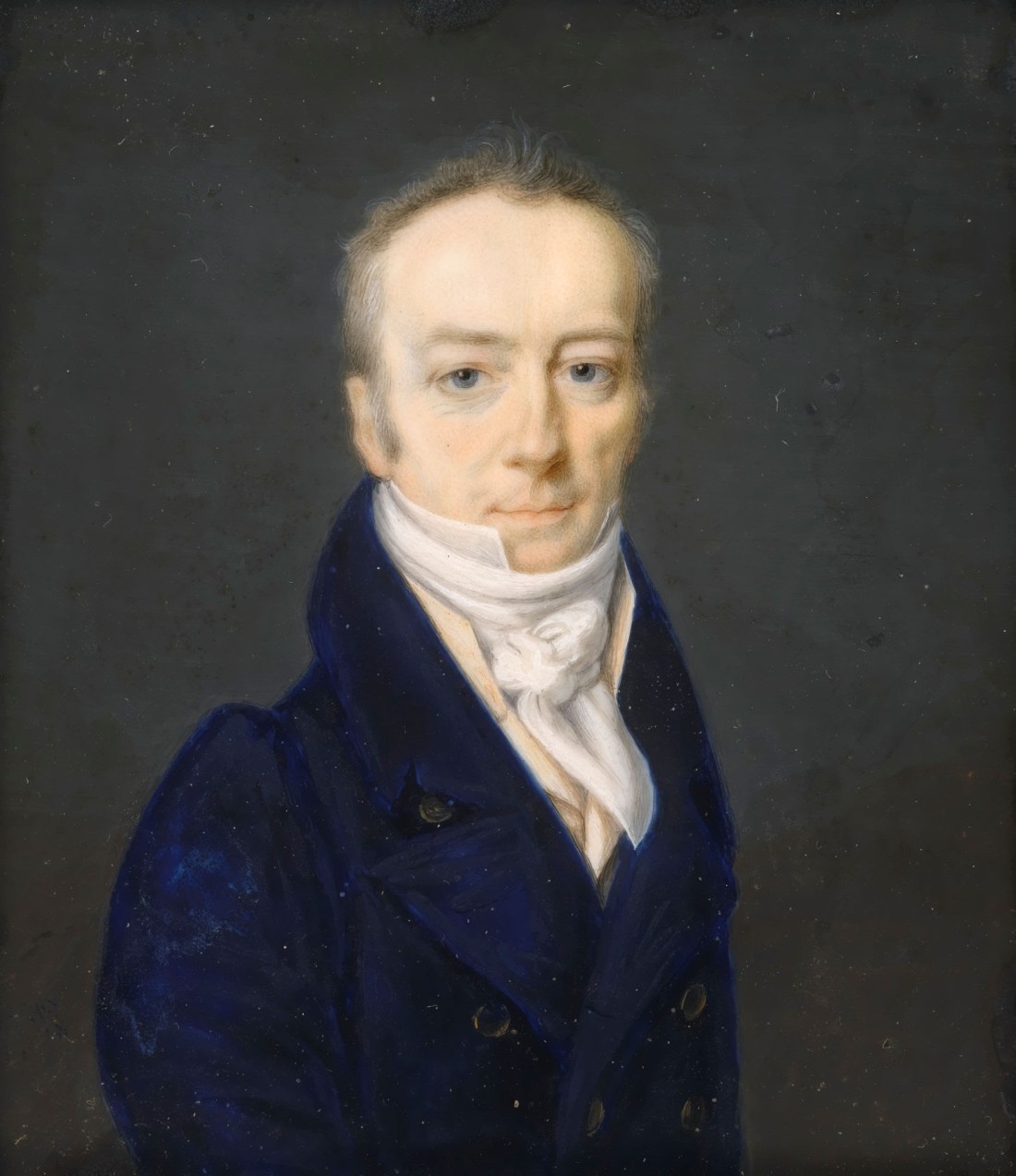
In all his travels, James never made it to the United States. However, he always admired the young nation, and his will said that, if no other heir was to be found, that the US would receive his money. You see, when he took his father’s last name, Hugh Percy had changed his last name to Smithson. And James Smithson’s fortune was used in Washington, D.C. to establish, as he put it, a place “for the increase and diffusion of knowledge among men.”

We call it the Smithsonian.

On the Building of Washington, D.C.

You’re probably aware that George Washington is the only US President who never lived in Washington, D.C., during his time in office. While the Father of His Country did lay the cornerstone to what would become the White House (wearing his Masonic apron, no less), the first President to live there was John (and his wife, Abigail) Adams who stayed in the unfinished and freezing cold mansion a short time before the newly-elected Thomas Jefferson took office. And every Chief Executive since then has resided there.

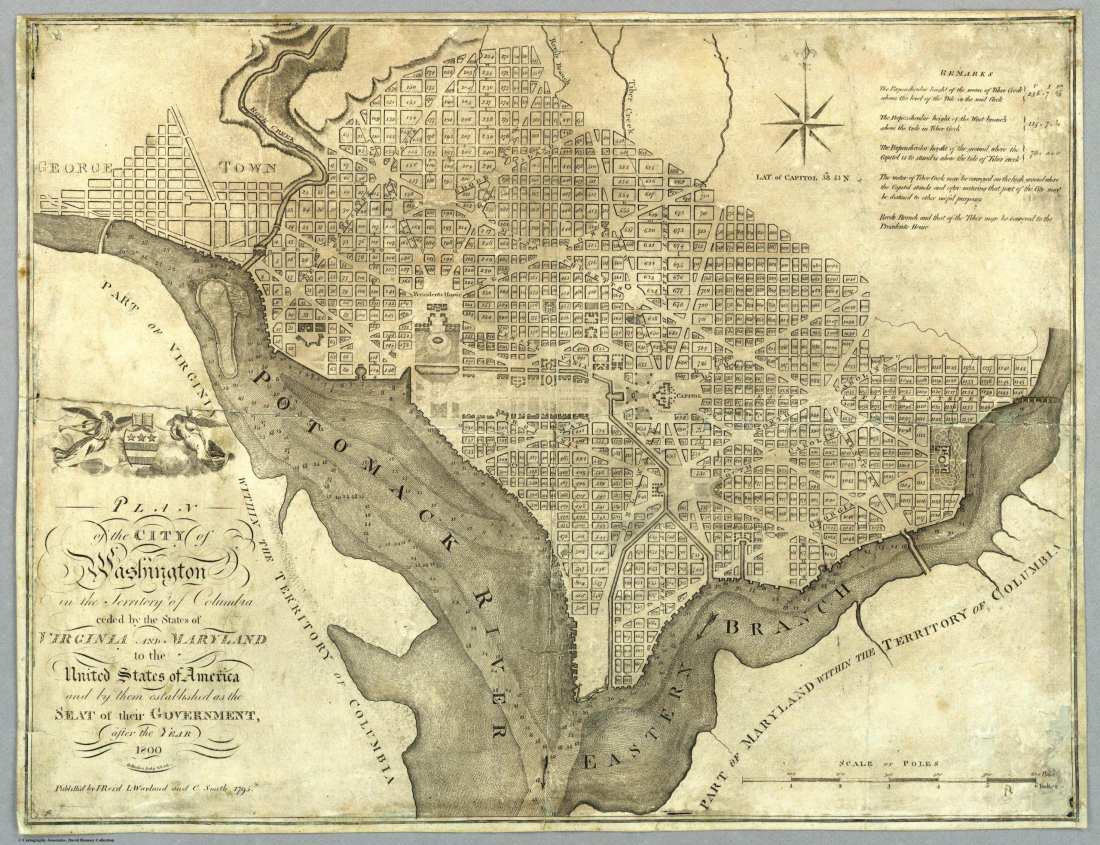
The story of the building of the city is as interesting as it is long. We won’t delve into that in this format, but you should know that the plan to build a permanent and new capital city for the new nation was approved while Washington was still in office. The next step after the approval of the (swampy) land was the design. Thomas Jefferson, ever the designer/architect and Washington’s Secretary of State, put in his two cents regarding building design, but it was a French military officer who had fought with the Americans against the British over a decade earlier who conceived not only of a general style for the architecture of the buildings but also of the overall plan for the city as a whole. His name is Pierre L’Enfant.

L’Enfant’s plan has undergone several changes over the past 220+ years, but the essential heart of the city’s layout and building design is his. As far as cities built as national capitals go, the capital city of the United States remains one of the most beautiful and beautifully designed. The nations of Brazil (Brasilia), Myanmar (Naypyidaw), and Pakistan (Islamabad) all have purpose-build capital cities with varying levels of beauty and livability. Washington remains one of the most beautiful (St. Petersburg, Russia, was also purpose-built as Peter the Great’s capital city, and it is absolutely beautiful, but the Soviets moved the capital to Moscow).

But there’s an irony to the building of the US capital city as you will soon see. L’Enfant’s plan called for the use of sandstone, a plentiful, nearby, and (relatively) easy to manipulate stone building material. While later builders in the city used marble and other stones, much of the original construction of the major buildings of Washington were made of sandstone. The stone was cut, shaped, loaded, hauled, unloaded, shaped again, and then laid to construct the buildings we know so well today. Many of the masons who did the laying stonework were Scots. Scottish stone masons are famed for their craft, and some were “imported” to the United States just for this purpose. However, the Scots, as important and as skilled as they were, did not do the heavy lifting.

No, the backbreaking work of building Washington, D.C., the capital of a nation built, as Abraham Lincoln would say several decades later, on the proposition that all men are created equal, was largely performed by African slaves. It is said to have grieved the abolitionist Adams to see enslaved persons working on liberty’s capital, specifically the executive mansion.

Interesting, isn’t it? For a nation where many people attempt to define what it means to be an American by having been born here or by displaying a certain cultural, ethnic, or linguistic identity, to have the capital city of that nation designed and built by people from Africa, France, and Scotland (among other places).

So, to argue that foreigners and immigrants built this nation, it is true–and literally in the case of the nation’s capital city.