On a Trade Good

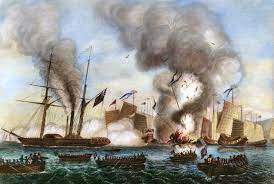
Of the thousands of lost and forgotten wars over the centuries of humankind, only a few of them have had an impact on the modern world as much as he one that took place between Britain and China in the 1840s. While we don’t think about China as being a powerful nation until the past 70 years or so, the fact is that the Chinese Empire was a powerful regional presence in Asia. Then, economic and social upheaval caused the country to become weak at the beginning of the 20th century. Also, in part, the spread of European colonialism carved up the nation’s sphere of influence.

European trade money had flowed into China for centuries, giving that government the ability to raise large armies, navies, and control a large area of land in Asia. Japan was really their only rival, and that was mostly later in the 19th century. But back to the war I mentioned at the start. In exchange for the Europeans’ silver, China sent tea, porcelain, silk, and other desirable trade goods to Britain. But the largest British import from China became the subject of an export ban by the Chinese government.

This trade ban outraged Britain so. The anger against China banning this particular product became so great that voices in Britain’s Parliament and across the country called for a declaration of war to force China to once again sell them the trade good. For China’s part, they felt the product was detrimental to their society. They begged Britain to reconsider. China had even sent a letter to the newly-enthroned Queen Victoria, asking her to please allow them to no longer sell this trade good. Young Victoria didn’t even bother to read the letter.

British desire for the product was so great that British sailors began violent confrontations with Chinese merchants in Chinese ports when they realized that the item was no longer for sale. And, so, Britain decided to go to war to force another country to sell them a product that the producing country did not wish to sell. And, of course, despite the money that China had, the technological advantages of the British Carronades (short-nosed naval guns) on their war ships made short work of the Chinese fleet.

China was forced to sign a treaty in 1842 conceding that they would once again allow Britain to purchase the trade good. In addition, Britain was granted control over five harbors on the Chinese coast, including Shanghai. The jewel of the treaty that ended the war was, of course, Hong Kong. Britain was granted absolute control over the city. For China to relinquish sovereignty over their own port cities–that’s how overwhelming the British victory was and how strong Britain’s desire for this trade good was..

And so, Britain followed the Golden Rule: They who have the gold make the rules. The British corollary of that is they who rule the waves, wave the rules. And Britain did both. Of course, you know what the product was, the trade good that Britain was so desperate to get their hands on that they were willing to go to war over it, the product that allowed them to control important coastal cities in China up until the past few years, right?

Opium.
On a War

Zanzibar. You have no idea where it is, right? Would you believe me if I said it was in northeast Asia, off the coast of Korea? See? You don’t even know if that’s true. The truth is that Zanzibar is off the coast of southeast Africa, just off shore from Tanzania, and it is a semi-autonomous province of that nation. For real. The purpose of this little joke is that Zanzibar isn’t on anyone’s radar, so why would Britain go to war with Zanzibar in 1896? Well, it seems that wars during the Victorian Era was what Britain did. To be somewhat fair, the archipelago was on one of Britain’s shipping lanes from Suez down the east coast of Africa to Britain’s colonies in the southern part of the continent.

While Britain didn’t officially colonize or take over Zanzibar, it did determine who ruled the small nation. And, when the hand-picked ruler of Zanzibar died in 1896, a ruler emerged in the country that wasn’t as friendly to British interests as the one they themselves had chosen. According to a deal of “protection” between Zanzibar and Britain, any potential Sultan of Zanzibar was required to receive British approval. The new Sultan, the nephew of the previous ruler, didn’t do that. And, so, the British representative in Zanzibar issued an ultimatum: Relinquish power or the British would force him out. Well, the new Sultan called Britain’s bluff. He sent a message saying, in effect, you guys wouldn’t dare remove me.

Apparently, this man hadn’t learned the rule that he who rules the waves waves the rules. And, in the late 1890s, Britain’s navy was the world’s most powerful. It was British policy that their navy would be the size of the next two navies in the world combined in an effort to protect Britain’s vast empire and insure the flow of trade goods to and from Britain. And, when the new Sultan of Zanzibar rebuffed Britain’s demands to step down from power, the Royal Navy sent ships to deal with the situation. Britain, the world’s largest empire at the time, declared war on tiny Zanzibar.

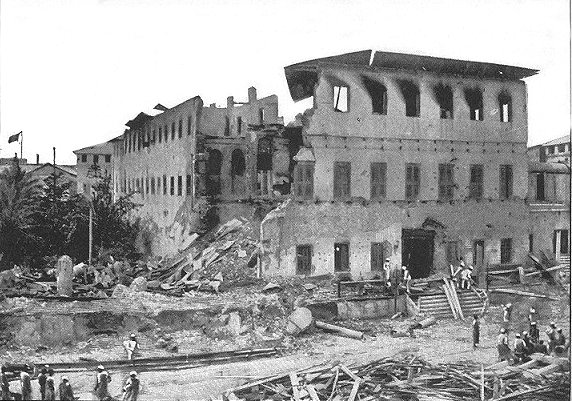
The war started with the naval vessels bombarding the Sultan’s palace. Several members of the Sultan’s household were killed, and the mostly wooden structure caught fire. The fire spread quickly, and the palace was largely destroyed. The fire reached a cache of cannonballs and gunpowder, and the ammo dump exploded, thereby almost completely eliminating the Zanzibarian supply of ordinance. Meanwhile, the only ship in Zanzibar’s navy, a retired British ship gifted to the previous Sultan, tried to fire on the British ships, but it was quickly sunk by a British salvo in the shallow harbor, its top masts still sticking out of the water for several months afterward. The incredibly accurate and experienced British ships used their naval superiority to quickly disable the stationary guns Zanzibar had aimed at the harbor where the British ships lay.

Needless to say, the British won what is now called the Anglo-Zanzibar War. The Sultan was whisked away from the scene by the German consulate to the coast of what was then the German colony of Tanzania. Britain quickly installed a Sultan that they approved and one who would continue the mutually beneficial relationship (well, more beneficial to Britain, but still). The British rebuilt the royal residence into a better and more stable building. Order was restored.

And the Anglo-Zanzibar War, lasting all of 38 minutes, is known as the shortest war in history.