On an Unwelcomed House Guest

In 1847, a young would-be writer from Denmark visited London. On this trip, he had the fortune to meet the famous British author, Charles Dickens. At the time the two men met, Dickens was already a celebrated author, known for his stories such as Oliver Twist, Nicholas Nickelby, and A Christmas Carol.

Dickens thought the angular young Dane to be eccentric but interesting. After their brief meeting, the young man wrote in his diary, “I was so happy to see and speak to England’s now greatest living writer, whom I love the most.” And, when he returned to his native Denmark at the end of his trip, he wrote a letter to his new acquaintance. “Dear Mr. Dickens,” the letter began, “the next time I am in London, I would wish to come spend some time with you if you would agree.“ Dickens wrote a short note back, acknowledging receipt of the letter and said that yes, sometime in the future, a visit from the young man would be welcome. It seems that Dickens answered more out of a formality and courtesy rather than truly extending an invitation.

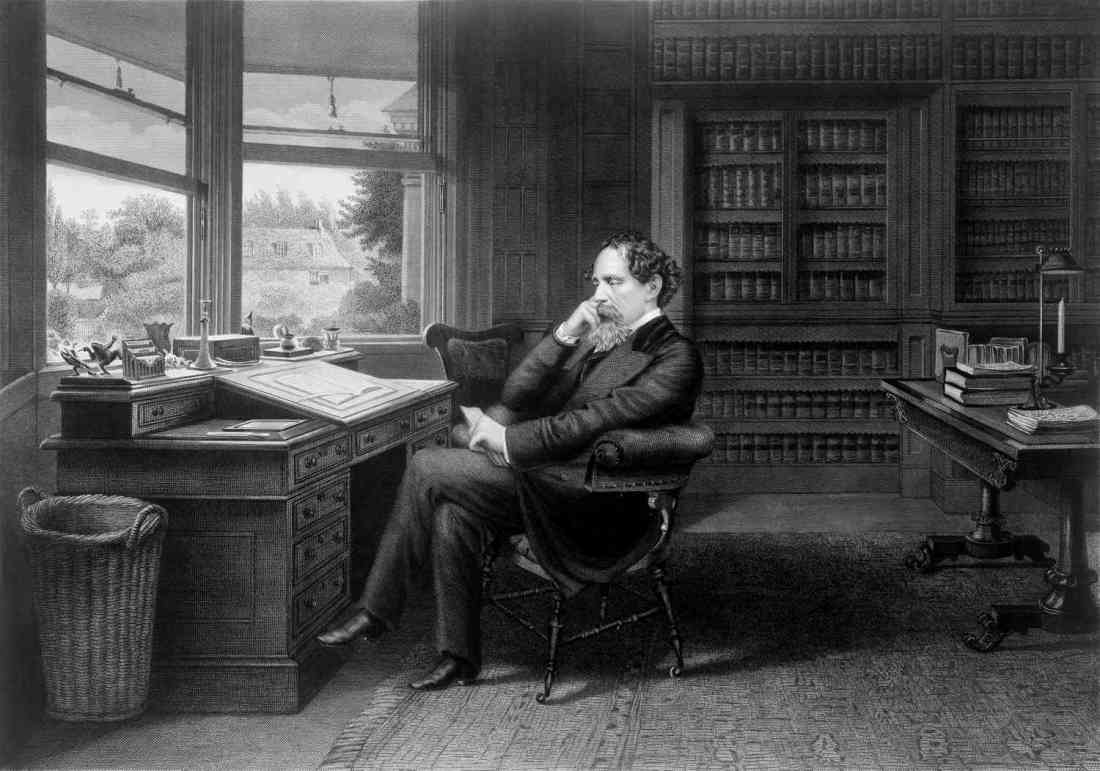
Much to Dickens’ surprise, the young man showed up, unannounced, at his house…in 1857. And he brought with him enough luggage to stay for an extended visit. Unfortunately, the guest’s arrival could not have come at a worse time for Dickens. The celebrated author was in the middle of working on a play in London, and his marriage was going through a difficult phase. Nevertheless, Dickens and his family did the best they could to make the odd, thin Dane feel welcome in their home.

Immediately that were problems. It turned out that he did not have a good grasp of English. Dickens noted that his French was even worse. But the language difficulty was the least of the issues. He had a habit of sleeping until almost noon every day. When he finally woke up and came downstairs, he seemed flummoxed that breakfast, which had been cleared away hours before, was not made available to him. He would take long walks in the woods and fields surrounding the Dickens house. When he was with the family, he would get a pair of scissors and made elaborate and oddly strange cut outs from any paper he could find. These amused Dickens’s children at first, but soon they grew tired of the game.

The most bizarre part of the stay was when he requested that Dickens’s oldest son, for whom the young man seems to have grown inordinately fond, be made to shave him every morning. This was something that Dickens would absolutely not allow. Thus, the young man was visibly upset that he was now forced to go into town to be shaved by a barber. Soon, he would spend most of his time in town, shopping or walking the streets. The entire household was soon in an uproar. Everyone in the family and even the servants devised elaborate plans to avoid having to interact with him.

How do you tell an unwelcome houseguest that he has overstayed his welcome? Dickens found a way, and, after five long weeks, the visitor from Denmark left the Dickens household. After he arrived back in Denmark, the man wrote to Dickens and offered an apology and asked Dickens’s forgiveness for any breach of etiquette. Even though he never completely understood why he’d been asked to leave, he must have realized the tumult he brought to the household, and he tried to repair the damage done to the relationship. Dickens didn’t reply. The two never saw or spoke to each other again. And, shortly after the Dane had vacated the household, Charles Dickens pinned a note to the door of bedroom the unwelcomed houseguest had used.

The note said, “Hans Christian Andersen slept in this room for five weeks, but, to the household, it seemed like an eternity.

On a Trade Good

Of the thousands of lost and forgotten wars over the centuries of humankind, only a few of them have had an impact on the modern world as much as he one that took place between Britain and China in the 1840s. While we don’t think about China as being a powerful nation until the past 70 years or so, the fact is that the Chinese Empire was a powerful regional presence in Asia. Then, economic and social upheaval caused the country to become weak at the beginning of the 20th century. Also, in part, the spread of European colonialism carved up the nation’s sphere of influence.

European trade money had flowed into China for centuries, giving that government the ability to raise large armies, navies, and control a large area of land in Asia. Japan was really their only rival, and that was mostly later in the 19th century. But back to the war I mentioned at the start. In exchange for the Europeans’ silver, China sent tea, porcelain, silk, and other desirable trade goods to Britain. But the largest British import from China became the subject of an export ban by the Chinese government.

This trade ban outraged Britain so. The anger against China banning this particular product became so great that voices in Britain’s Parliament and across the country called for a declaration of war to force China to once again sell them the trade good. For China’s part, they felt the product was detrimental to their society. They begged Britain to reconsider. China had even sent a letter to the newly-enthroned Queen Victoria, asking her to please allow them to no longer sell this trade good. Young Victoria didn’t even bother to read the letter.

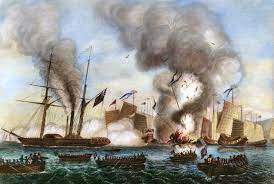
British desire for the product was so great that British sailors began violent confrontations with Chinese merchants in Chinese ports when they realized that the item was no longer for sale. And, so, Britain decided to go to war to force another country to sell them a product that the producing country did not wish to sell. And, of course, despite the money that China had, the technological advantages of the British Carronades (short-nosed naval guns) on their war ships made short work of the Chinese fleet.

China was forced to sign a treaty in 1842 conceding that they would once again allow Britain to purchase the trade good. In addition, Britain was granted control over five harbors on the Chinese coast, including Shanghai. The jewel of the treaty that ended the war was, of course, Hong Kong. Britain was granted absolute control over the city. For China to relinquish sovereignty over their own port cities–that’s how overwhelming the British victory was and how strong Britain’s desire for this trade good was..

And so, Britain followed the Golden Rule: They who have the gold make the rules. The British corollary of that is they who rule the waves, wave the rules. And Britain did both. Of course, you know what the product was, the trade good that Britain was so desperate to get their hands on that they were willing to go to war over it, the product that allowed them to control important coastal cities in China up until the past few years, right?

Opium.

On Two Failed Medical Careers

Robert wanted his son to be a doctor, a physician, like he was. In fact, he wanted both of his sons, Ras (short for Erasmus) and Charlie to study medicine. So, in the autumn of 1825, Robert sent the pair of young men to the most prestigious medical school in the United Kingdom and, in fact, also Robert’s own alma mater: The University of Edinburgh. The reputation of the school was beyond dispute. Almost all of the modern medical world passed through the medical school in the Scottish capital city. And Robert wished that his sons would have the best education possible–as he himself had.

So, the brothers (Ras was a few years older than Charlie) took some rooms only a few steps away from the medical college on what was then Lothian Street, south of the Royal Mile and near what is today the Scottish National Museum. The rooms, the boys found were bright and airy and not at all stuffy as much of the student rooms in Edinburgh tended to be. At first, all seemed well; the boys loved Edinburgh, and they attended their lectures and classes and conducted themselves like the young, gentlemanly students they were.

However, as I mentioned, Ras was older than Charlie, and he had already been studying medicine at Cambridge in England for some time. By the time the spring of 1826 rolled around, Ras was pretty much finished with the Edinburgh part of his training. It was time for him to go to London to complete his medical education at the anatomy school there. That left Charlie alone in the Scottish city. And it was that spring that Charlie decided he didn’t like the study of medicine. Writing to one of his sisters, he complained that the lectures were boring him to the point of madness. He stopped attending his required beginning anatomy labs. He began hanging out in the natural sciences departments of the university, and he started to learn about botany and what today we would call earth science.

All of this disappointed Charlie’s father. The hopes he had for his son to follow in his footsteps as a physician were fading, fast. Now, it didn’t help that Robert’s youngest son was only 16 when he left home to go to university and then was a still-young 17 when Ras left him alone in Edinburgh. So, it quite possible that homesickness played a part in Charlie’s decision to quit the medical school at Edinburgh after less than two years there. He talked often of going into the clergy as his family had a long history of ministers as well as physicians. Ras, for his part, was a sickly young man most of the time; his delicate constitution proved too fragile for medicine. Thus, it was with great sadness on his father’s part that Ras also quit his medical studies at the precise moment that he was about to finish them. Neither son, then, followed in Robert’s footsteps.

Of course, Charlie wouldn’t become a minister, either. No, the interest he found in the natural sciences at university soon put Charles Darwin aboard the ship The Beagle and on the way to changing how we view our natural world.