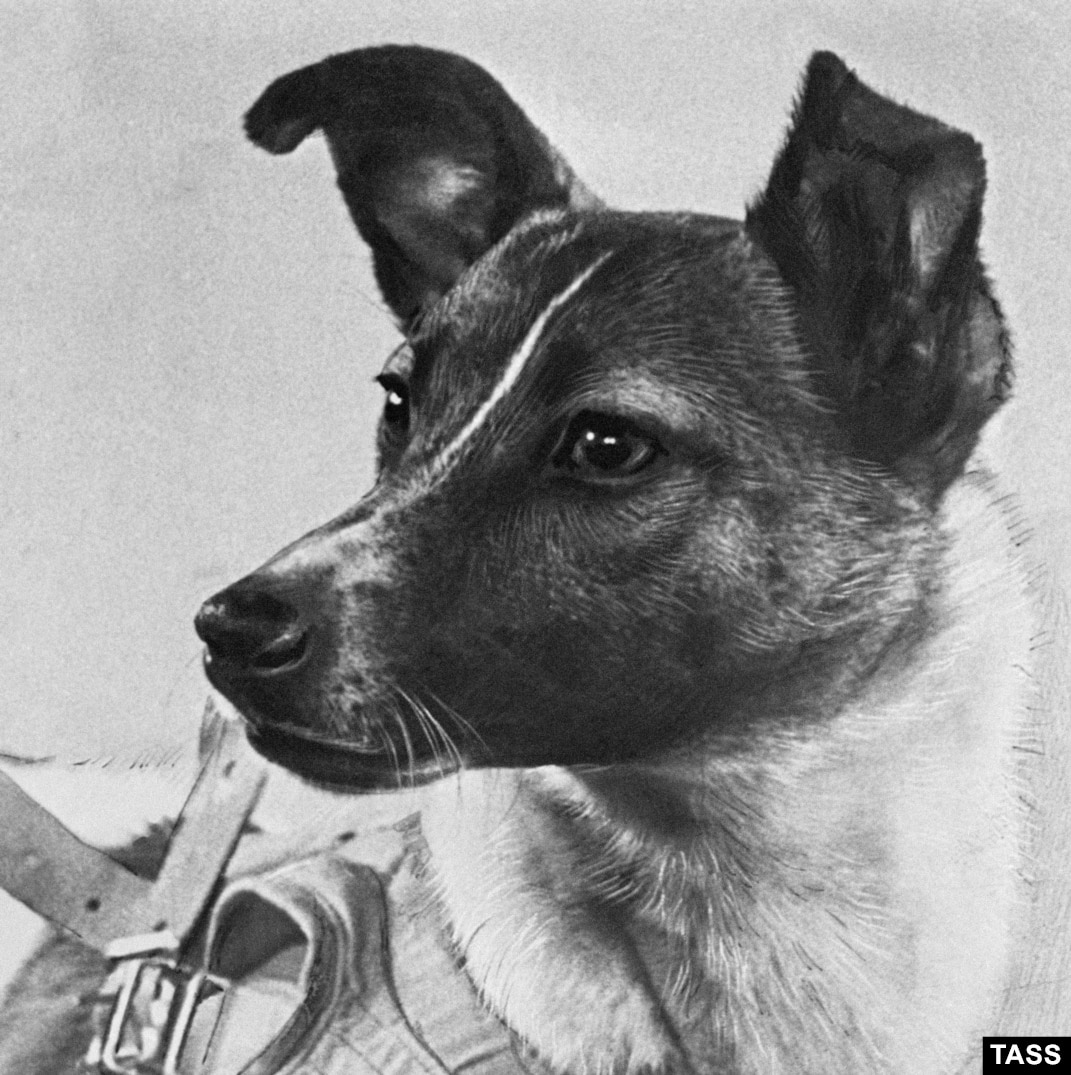
The scientists named her Barker.
She was found wandering the streets of the city and was quite obviously a stray. She was also quite obviously a mutt. Oh, she had some physical characteristics of a Samoyed, and some of a Husky, and there was definitely a bit of Terrier in there as well. Ah, but she was a tiny thing. She weighed only about 12 pounds.
And that’s why it was somewhat comical that such loud barking yelps came from a girl this small. Of course, they had to name her Barker. The best that the scientists could determine, Barker was about three years old. Her ears stood straight up, except at the top tips which folded down. Ah, she was a real cutie.
The scientists liked using stray dogs from the city streets because they felt that those dogs had been conditioned to extremes of temperature and of hunger. Their experiments needed dogs that could withstand both. Now, as an animal lover, I will go on record as being against the use of animals in scientific experiments on principle. However, this was the mid-1950s, and the use of animals in scientific experimentation was commonplace. Sadly, the experiments that were being performed on the street dogs would end up killing them.
One of the scientists who was conducting the experiments developed a soft spot for Barker. He would scratch her ears and whisper to her so that the other scientists could not hear his sweet nothings. He would put his head on hers and quietly say that, in another life, he would love to have her at his house to play with his children, and to watch her grow up with them. In fact, on the evening before the experiment that would lead to her death, he did, indeed, take Barker home. She and the kids had a wonderful time, running and playing throughout the house. Of course, the kids were giggling, and Barker was, well, barking. “She was so charming,“ he would say later. Knowing her fate, the scientist wanted to do something nice for her.
I wish this story had a happier ending. It is true that all stories involving dogs end sadly. When you bring a puppy into your life, the result is going to be heartache because nothing is forever.
The next day, Barker began the experiment that would take her life. And because of that experiment, she would go down in history. Or, in this case, perhaps, up.
You see, Barker is what her name is in English.
You know her better by her Russian name, Laika, and as the first animal from earth to go into space.
Tag: USSR
On the End of an Empire
Empires come and go. They have done so since the beginning of history. It is the way of the world, isn’t it? The mighty Assyrian, Egyptian, Babylonian, Persian, Greek, Roman, Mongol, Turk, Spanish, French, and English empires all saw the sun set on them. Those who feel that this fate could not possibly happen to their empire are in for a rude historical awakening.
Such a fate befell the empire of the Soviet Union, the world’s largest at the time. As I write this, we have passed the 30 year anniversary of the dissolution of that empire. The story began in August of 1991…well, it actually began much earlier when Mikhail Gorbachev came into power in the USSR and introduced openness and restructuring to Soviet society. The communist party structure that held power was shaken to its core as Gorby’s reforms began to rumble through the 16 republics that made up the empire. The leader wanted to bring true democracy (or, at least, a semblance of it) to the people and those lands. Opposing the communist bureaucratic power structure were grass-roots calls for reform and a desire on the part of many of the republics (specifically the Baltic states of Estonia, Latvia, and Lithuania) for independence from the Soviet state.
In August, 1991, as most Europeans did, Gorbachev went on vacation. That’s when the coup plotters decided to act. The problem was that both sides seemed to choose that moment when the leader was out of town to make their moves. The hard-core communists sought to overthrow Gorbachev and roll back his progressive agenda. The change agents and anti-Soviet groups also decided that it was the perfect time to declare their independence from the USSR. A third party, Moscow Mayor Boris Yeltsin, also stepped in when both of these opposite parties struck.
Meanwhile, Vassily* continued his job at the Kremlin, the Soviet government building complex, because no one told him not to do so. Every day, he made sure that the task he was assigned was carried out. His salary was still paid, so, he really didn’t care what the government was. He had one job, he took it seriously, and he did it well, day in and day out. Oh, when he arrived home during that hot, tumultuous August, he watched the official government news channel as everyone did, but, again, none of that affected his job. Common people like Vassily and his family are often only pawns in the rises and falls of empires, and this case was no exception.
And no one told him to stop what he was doing. Throughout that autumn, when the republics began to leave the Soviet Union, no one advised Vassily to not come to work or to change his job in any way. No one seemed to know what to tell him to do differently. When Yeltsin climbed on the tanks and spoke to the people of Moscow, he kept on with his work. Day in, day out. When Gorbachev returned to the capital and to a crumbling empire, Vassily still did his job.
Finally, in December, 1991, Gorbachev realized that he was the leader of an empire that no longer existed, and he resigned as the last leader of the once-mighty Soviet Union–a gesture that seemed completely empty in one sense. That is when Vassily’s job changed in one major aspect.
That night, December 25, 1991, as the Moscow church bells tolled the end of the Soviet Union, Vassily Pavlichenko climbed the stairs, as he did every day, to the rooftop of the Kremlin, and, for the last time, he lowered the red flag of the Soviet Union that had flown there since 1917.
In its place, he raised the white, blue, and red flag of the nation of Russia.
*Not his real name
On a Young Man from Georgia
Soso was born in Georgia in the last quarter of the 19th Century. His dad worked in a shoe store, and his mom cleaned houses. At school, the lad was bright and eager but got into trouble a lot, as boys often do. His mother was very religious while his father drank religiously. Soso decided he wanted to enter the ministry, so he found a local benefactor who agreed to finance his education, and he went to a theology school when he was old enough. Again, his sharp intellect was reflected in the fact that he wrote poems and plays while he studied the ministry; he had a good voice and sang in the choir at church. Some of his poems were even good enough to be published, and some found inclusion in a state anthology of poetry. We’re talking about a young man who, despite his working-class background, was going to make something of himself.
But then something changed, and, to this day, no one is sure what happened or why. He suddenly lost interest in his religious studies. He stopped writing his poems and plays. Without any communication with his benefactor, he stopped his religious studies. He started reading political books, and we are talking about radical political ideology here. In April, 1899, Soso left the seminary and never returned.
Because he was so smart, by October of that same year he had obtained work as a meteorologist at a local weather observatory. He began holding secret classes, indoctrinating anyone who would listen to his radical ideas about politics. You have to remember that this was Georgia during a time when that area was traditional and conservative. Soso had to carry out his political education classes surreptitiously for fear of attracting attention and possibly getting arrested. In a time and place that labor unions were considered to be the opposite of everything Georgia stood for, here he was organizing labor strikes in factories in his area.
Sure enough, his activities roused the attention of the local constabulary. Sure enough, he was arrested and thrown into jail for his political activities. That did not stop him, however. Even in jail, he was preaching his gospel of political equality for the working class of Georgia. Miraculously, he managed to escape prison.
He made it to a place where he could start a newspaper and managed to assume a new identity. There, Soso married a nice girl, and the couple soon had a son, which they named Jacob. Maybe you’re wondering what happened to this smart, driven former seminary student turned political activist from Georgia and why you’ve never heard about him. Well, you have. The Georgia in question is not the U.S. state, but, rather, the nation on the Black Sea. You see, Soso joined up with some other people who believed the same things he did, and, together, they led a major revolution that changed history.
Yes, his family called him Soso, short for Joseph.
Joseph Stalin.