On a Perfectionist

One of the best bosses I have had across my various jobs was a woman named Kay Tyler. She taught me two valuable lessons. One was to thing things through. What will happen each step of process? What effect will those things have on all involved and on the pursuit of the goal? The other lesson was to have not only a Plan B but also at least have an idea of Plans C-F or so. Those lessons have stayed with me and helped me be a better administrator and even a better person. Ms. Kay was a perfectionist, and she was one of those who backed up what she taught with a lifestyle to match. Another such perfectionist who is about the same age as Kay Tyler is a programmer and code writer named Margaret Hamilton.

Margaret wrote computer code for M.I.T. back in the days when writing code was literal writing–by hand–each line of code on paper. Those codes told the computer what function to do next in a process. Like Kay Tyler’s advice, Margaret also had to think things through, and she definitely had multiple back up plans just in case. People would ask her, “In case of what?” Margaret would smile and answer, “Exactly!” In her capacity as a code writer, people’s lives were on the line; the decisions her code made could make the difference between life and death for some. There’s a story that, one night during a work party, it struck Margaret that one line of her code was incorrect. With her apologies, she rushed out of the soiree and returned to her office. Sure enough, one small part of a line of code was in error. Margaret realized that even something so small could make a world of difference in the right situation. So, Margaret became a perfectionist out of a sense of responsibility and ownership of her work–concepts that are becoming more and more foreign to some in the workplace today.

And remember that, during the 1950s and ’60s, it was rare for women to be in the workplace compared with today. And Margaret was also a mother. People at the time would ask her nosy questions like, “How can you work and have a child?” and “Don’t you love your family?” Yes, those were the types of things people thought about working mothers 60 years ago (not that some don’t still feel that way). Yet, despite knowing that her work was important, Margaret still felt some societal pressure to conform to the middle-class expectations of a woman being a wife and mother first.

So, often, Margaret would bring her daughter to work at M.I.T. with her. And that seemingly little thing led to something amazing. One night, while her daughter was with her in the office, Margaret allowed the child to play with one of the machines she had written the code for. The child, in her innocence, tasked the machine to perform a function for which Margaret had not written code. That piqued Margaret’s attention. What would happen, she wondered, thinking things through, what would happen if someone using her code would accidently make the same input that he daughter had done? Would that cause a catastrophic failure of the system? Should she write code that would keep the machine from even performing that operation at all, even it would be accidental? Better safe than sorry, she reasoned. So, Margaret wrote the code.

Turns out that when the code was finally used in the real world, someone indeed accidently made the same input that Margaret’s daughter had done. However, because of her sense of perfectionism, Margaret was ready for it. And, in the final analysis, it was that mentality that perhaps saved lives.

What you don’t know, most likely, is that Margaret Hamilton wrote code that produced the modern coding systems we use today. In the same way that the invention of the telegraph led to modern cell phones, Margaret’s code is the grandparent of the code used on the device you’re using to read this blog right now. At the time, of course, Margaret’s code was groundbreaking and revolutionary. And, it’s true, her code saved people’s lives.

You see, Margaret wrote all the code for NASA that sent humans to the moon.

On Meeting an Enemy

Staff Sergeant Erwin Meier of the German Luftwaffe was a highly decorated pilot during World War 2. Unlike most air forces of today, the Germans allowed non-commissioned officer to be pilots, and Meier was one of the best the Germans had. Flying his Messerschmitt Bf-109 machine, Meier had recorded double digit kills on the difficult Eastern Front of the war by 1942. For his service and skill, the pilot was awarded medals and other air awards. And that’s why, when he was shot down by a Russian pilot, he was somewhat surprised.

The time was September, 1942, and the decisive Battle of Stalingrad had finally begun to turn to the Soviets’ way. However, the end of the struggle was still undecided, and establishing air superiority was still important to both sides. While the Germans had their faster and more maneuverable Messerschmitts, the Russians were able to counter with their own fast and nimble Yaks. However, unlike the German crates, the speed of the Yaks was because they were made of wood and that made them much more vulnerable to enemy fire.

It was a clear day when a squad of four Yaks spotted some German bombers and their fighter escorts headed for the Russian lines around Stalingrad, and the Russians closed in for an attack. Meier saw the Russians at distance, and he peeled away from his group and looped back around to come in on the Russians from behind. Now, the pursuer became the pursued. Meier’s tactic was so bold and smart that he managed to gain an advantageous position on the rear of the Russian squad leader, a man named Major Danilov. As he was squeezing off some machine gun rounds into the now-splintering tail of the Russian’s plane, Meier felt a violent jolt. Somehow, a Russian pilot had managed to come in on his tail, and his Messerschmitt was being pelted with rounds. Several Russian rounds found his engine, and the German ace realized that his plane was doomed. He veered off from his attack on the Russian major and tried to keep his craft steady while he unlatched and then pushed back the glass covering over his head. He checked his horizon and then bailed out of the doomed aircraft, deploying his parachute after he was sure he had cleared the plane.

As he gently fell to earth under the canopy of white silk, Meier cursed himself for being so careless. How could he not have seen the pilot that snuck up on him from behind? That guy must be a good pilot, Meier thought. And, when he reached the safety of the ground, a squad of Russian soldiers were there to quickly take him captive. Meier thought he knew the names of the best Russian pilots he was facing daily in the skies above Stalingrad; he had studied their tactics and their tendencies, and, in his mind as he was being questioned and moved to a POW camp, Meier ran through the list of who he thought might have been the one who shot him down using such a good maneuver.

“Would it be possible to meet the pilot who shot me down?” he asked his questioners through the interpreter. Sure, came the answer back. The Russians were happy to oblige him because they realized that a meeting between their own pilot and the German hero would make for good publicity and would boost morale in the Soviet press, good news for a people hungry for any victory in the war, no matter what the size of it. So, Meier was taken to the makeshift airfield where Major Danilov’s squadron was based. And he was introduced to Lieutenant Litvyak, a 21 year old blond Russian who looked like someone you’d meet in a school yard rather than in a deadly air duel. But Meier thought the Russians were kidding him, trying to embarrass him. Surely, this kid couldn’t’ve been the expert pilot who got the drop on him and shot him down so expertly. Still incredulous, Meier asked Litvyak to describe how the short battle unfolded. The Russian described the encounter to a tee. Meier became convinced that this, this, this child had bested him in combat. The Russians, of course, were gleeful. For his part, Major Danilov acknowledged that Lt. Litvyak had saved his life, that he was probably doomed if Meier had been able to finish him off. What made it worse in Meier’s mind was that the young Russian pilot had only been on the front for less than a week and already been credited with three “kills” including Meier. The brave and skilled Lt. Litvyak would soon be promoted to command a squadron of Russian planes and be credited with dozens of sorties and several more kills before being shot down and killed in August of the next year.

But that was long after the Soviet propaganda machine made a big deal out of the fact that the German ace Erwin Meier had been bested in combat by a girl.

On a Returning War Prisoner

Andras Toma had been a 20 year old Hungarian soldier when he was captured by the Soviets near the end of World War 2 in 1945. Toma was taken to a POW camp near what is now St Petersburg, Russia. The German soldiers and their allies, including captured Hungarians, often had to trek across hundreds of miles of countryside by foot when the war ended and they were released from custody in order to return to their homelands. I have some friends in Western Germany, near Cologne, who had their ancestor show up unannounced at the front door of the family homestead in 1947, fully two years after the war ended. They thought he was dead. That wasn’t an unusual event. Toma, too, had to stay some years in Soviet custody before his release, and his family had long since though him deceased in the war.

But Toma had survived. After the POW camp, an illness saw the young Hungarian transferred to another facility, a Soviet hospital, still deeper in the Russian interior. He languished there for several months, and then he was transferred to yet another facility, and that’s when he lost track of time. He didn’t realize how long it had been since he was put in the facilities. Back home, since he didn’t return after the war, his family had him declared dead. Again, this wasn’t unusual for families whose sons, husbands, brothers and other relatives didn’t come back.

Meanwhile, Toma was having trouble communicating with the doctors and the staff of the medical facility. Hungarian is a rich language, but it’s also one of the most difficult languages to learn. Besides, it’s not spoken much outside of Hungary. And Toma knew no Russian. So, when the doctors made their rounds and the nurses brought him his food and checked on him, there was almost no interaction between Toma and them. Apparently, he had no conversations with them at all while he was there.

Then, a doctor in the hospital who was from Czechoslovakia noticed the man. the doctor soon realized that, because of his name, Toma was most likely Hungarian. The man, curious as to what seemed to be a patient with no obvious or visible issue by that time, arranged for a records check on the Toma, and the entire story came to light. It seems that, for some unknown reason, Toma had ultimately been placed in a Soviet mental institution. His inability to speak Russian (and the Russians’ lack of Hungarian language skills) had allowed him to stay in the mental facility for an inordinate amount of time both unchallenged and unchecked.

And that’s how Andras Toma finally made it home to his family in Hungary after the war. He was given a hero’s welcome, and he was awarded back pay for all his time in the service, even though the war had ended some time earlier. The joyful reunion between Toma and his family occurred on August 11, 2000.

Because he didn’t speak Russian, Toma had been a POW for over 55 years.

On a Nuclear Threat

We have lived with the distinct possibility of wide-spread nuclear war as a species for 70-some-odd years. The Cold War split the world into two camps, Us and Them, and then the dissolution of the Soviet Union and then the end of that Cold War found nuclear weapons had made their way into the hands of many nations. Today, at least 9 nations boast nuclear capability. But, at the height of the period of tension between the US and the USSR, each side had hundreds if not thousands of nuclear bombs that pretty much guaranteed the planet’s destruction.

The United States developed a strategy of splitting their nuclear arsenal into three areas, known at the Nuclear Triad: Land-based missiles (in silos scattered across the US), bombs on large air bombers, and missiles placed on submarines. This made the US arsenal a bit more “secure” than the Soviet’s almost complete reliance on land-based missiles because, if the Soviets destroyed one of the US’s triad branch, the other two would still be able to carry out attacks. So, the US and the USSR faced each other with nuclear guns pointed at the other’s head for decades. And the men and women who were trained in these nuclear weapons were under tremendous pressure to protect their respective homelands and ways of living.

Take Stan. He was a nuclear technician in the military who monitored the missiles of the other side. The time was September, 1983, and tensions were especially high because the Soviet Union had recently shot down a Korean air liner that had flown over Soviet airspace. Both sides ordered their monitors to be on high alert. Stan was an officer, and his duty was to make sure that his superiors received adequate notification if and when any possible attack was taking place.

And that’s what happened. Stan was watching his team’s monitoring screens when he noticed that a missile had been fired from the central area of the enemy’s territory. Soon, four other missiles were seen to have been fired. Now, you might think that five nuclear bombs would be not so many, but please remember that these were missiles–not the bombs themselves. Each missile had something called MIRVs–Multiple Independently (targetable) Re-entry Vehicles–meaning that, when the missile reached the edge of space and began its descent over the opponent’s land, 10-15 different, individual, and large-scale hydrogen bombs would be released from the missile and hit a different target. Thus, five missiles meant at least 50 nuclear bombs, each of which used a Hiroshima-sized bomb as a detonator.

Protocol–in fact, direct orders–said that Stan was required to report the launching of the missiles to his superior. But something made Stan take a closer look. His training had taught him that the enemy, if he were to launch a nuclear attack, wouldn’t merely launch 5 missiles at first. No, conventional wisdom said that the first-strike by either side would be designed to take out the entirety of the other side. Five missiles? It must be an error at best or an accident at worst, Stan reasoned. And, so, he failed to trigger the early warning system that was in place.

Sure enough, not only was the missile launch a mistake, but it was also not a missile launch at all. Come to find out, sunlight, reflecting on high-altitude clouds over the missile silos, gave a “false positive” reading to Stan’s launch monitors. By disobeying his orders, Stan may have saved the world from a nuclear war. But he was in a bit of a pickle. While his superiors praised him for his restraint in not kicking the false missile launch up the chain of command, they were also worried that admitting that their system couldn’t tell the difference between sunlight reflection and missile launches would make them look as if their much ballyhooed missile defense system was garbage.

So, privately, Stan was applauded by the military, but it would be years later, after the Soviet Union fell, that Lt. Col. Stanislav Petrov of the Soviet Red Army would receive credit for stopping a nuclear war.

On a Hot Dog Stand

Would you believe me if I told you that, during the Cold War, the Soviet Union had nuclear weapons targeting a simple hotdog stand? Apparently, that’s true. Now, the location of the stand is key, here, as you can imagine. It was sited in a courtyard, as you probably suspect, a courtyard located in the heart of the United States government near Washington DC. Now, to be sure, it was a rather large hotdog stand, but a hotdog stand nonetheless.

But the Soviets were convinced that the hotdog stand was either a cover for a much more important building beneath it, sort of a bunker or some kind of operations center, or it was a top-secret planning headquarters for the US military. Some Russian analysts believed that the structure was at the heart of the US military establishment. As a result, Russia spent, millions of rubles and countless man hours trying to get close enough to this hotdog stand so they could figure out what was going on inside the small building, possibly underneath it. They never succeeded in finding out the truth.

So, just to be sure, that’s why they had not one, but two of the nuclear warheads targeting this  Hot dog sand. Now, what the Soviets didn’t know and couldn’t confirm was that this particular hotdog stand was well, really only a hotdog stand. It wasn’t masquerading as something else. It wasn’t a front for anything. And you might be wondering why the Soviets would target this particular and seemingly innocent hotdog stand , instead of one of the countless other hotdog stands in the US. And the reason is because of the clientele.

You see, the Soviets were able to easily ascertain that most of the people who went to get hotdogs there were people associated with the upper echelon of the US military. That was curious to the Russians. It’s not that the Soviets were paranoid, although they were. Of course, perhaps these military members were simply stopping there to get a hotdog because it was lunch time, and they were hungry. But the Soviets didn’t see it that way. It’s just that if, in the spy game, you see behavior being repeated, that indicates a trend or a “tell”, and a trend can be a tip off for something deeper, something that requires more analysis. And the stakes of the Cold War were simply too high for the Soviets to ignore this trend.

Interestingly, this hotdog stand outlived the Soviet Union. It was torn down in 2006, and a new structure was put in its place. I wish this story had a surprise ending for you. But it really doesn’t. The Soviets were wrong. It was, ultimately, simply a hotdog stand.

Of course, the courtyard in which the hotdog stand stood was located in the exact center of the Pentagon.

On Leaving It All Behind

In 1975, the USSR sent some geologists on a scouting mission to an isolated section of the Russian Taiga. The group traveled by helicopter because of the complete absence of roads or even any human knowledge of the area. Now, you should know that the Taiga is a vast section of conifers, lakes, swamps, and mountains that is home to, well, practically nobody. And that’s why, when the helicopter was flying a couple of hours away from any semblance of a settlement, that the geologists onboard were amazed to see a collection of buildings and farmland in an area where no one was supposed to be living.

The chopper found a suitable flat and clear space to land, and they touched down not too far from the group of wooden buildings. After setting up their camp, the group of scientists decided to check out the small settlement they’d seen from the air. It took them a short hike because of the terrain, but they managed to reach the place. As they approached, an elderly man came out of one of the log houses and nodded acknowledgement to the geologists but he said nothing. In an effort to make the old man feel more at ease, one of the geologists said, “Greetings, grandfather; we’ve come for a visit!”

Well, that broke the ice. The old man waved the small group into his cabin and and said, “Since you’ve come this far, you could come inside!” Once their eyes had adjusted to the dim light of the low-ceilinged cabin, they men saw that the place was very simply decorated and sparsely furnished. The man was getting glasses for the men so that they could share a drink together, and that’s when the geologists decided to ask about why the old guy was there. And the story he told was amazing.

Turns out that the man and his family had lived there off the grid for some time. He introduced the men to his family, his wife and children, and especially to his daughter, Agafia. She helped her father get some food for the men as her dad got the drinks. As they settled down around the crude table to drink, the group was told that the man’s name was Karp Lykov. It seems that, years before, the family had left civilization because they were unwilling to give up their religious beliefs when confronted by Soviet pressure to do so. Rather than change or even pretend to change, Karp and his family decided to quietly and simply drop out of Soviet society by moving deep within the Taiga. The place they’d found was over 160 miles from the nearest settlement.

The scientists were confused. How could they survive off the grid–and out of the reach of the Soviet authorities–for so long? Remember, this was 1975, and the Soviet Union’s ability to control their citizens was beyond question. How an entire (and not small) family group could simply drop out was, well, incomprehensible. The Lykov children began asking questions of the men; what was it like in the outside world? How were things in civilization? The men tried to explain the latest news, but the family looked puzzled. They had no frame of reference for what the men were telling them.

Karp told them that he had seen stars moving rapidly and asked about them. Now, it was the geologists’ turn to look puzzled. “Do you mean satellites?” one man asked Karp. The old man’s eyes widened with curiosity. “Hold on a minute,” one of the scientists said. “When was the last time you all have been to a town? When did you all leave civilization to live out here?”

Karp looked up at the low log ceiling above him in thought. The men could see he was figuring the time in his head. “This is 1975, right?” he asked, finally. The men nodded assent

“We left your world in 1936.”

On a Business Deal

During the Cold War, one of the not-so-secret secrets was that, despite embargoes on many goods in the Soviet Union, western companies tried desperately to enter the Soviet market. And western consumer goods were in high demand despite the communist rhetoric about the evils of capitalism. One American corporation that desperately desired to enter the Russian market was PepsiCo, the food and soft drink conglomerate.

Long the number two cola company behind Coca-Cola, Pepsi knew that if they could somehow leverage an entre into the USSR, the fiscal reward would be substantial. Besides, there would be the tremendous free publicity that such a news event would generate for the company as the first and only American company in the communist country. Pepsi, after tense and lengthy negotiations, finally was able to enter the USSR market in 1972. Within a very short period, the company was making upwards of half a billion dollars a year in Russia; the drink was incredibly popular (and had the cache of being a “forbidden” decadent western company) with no rival, giving Pepsi a monopoly in the market.

But there was a major catch. Rubles, the Russian currency, was not tradable or usable in the US or most western banks, especially in the amounts Pepsi was making them in Russia. Besides, the country didn’t allow their currency to leave the USSR in such large amounts. So, another round of fierce negotiations followed, and a comprise of sorts was reached. Where there’s money to be made, it is interesting how creative solutions can be found. And that’s what happened here. The leadership of the USSR offered to pay Pepsi not in rubles but, rather in trade goods. Pepsi could then take the trade goods, sell them in the west, and take the profits. While the extra step was not ideal, the amount of money the company was making (and would continue to make as the monopoly) proved to be more important than having to basically become a middle man for Russian trade goods.

The first round of Russian goods to be swapped for Pepsi products was, you guessed it, vodka. And that worked for a while; Pepsi simply opened a liquor branch of the company and sold the vodka in the US and other western nations. This worked for a while, but then the United States and its allies began a boycott of all Soviet goods because of the Russian continued invasion and occupation of Afghanistan in the 1980s. Pepsi then had no way of turning their soda profits into raw cash anymore. The company then approached the Soviet hierarchy and asked if they had any other products that they could trade that Pepsi could then turn and sell to recoup their money.

And, of course, the Soviets did. And they traded these products throughout the 1980s and early ’90s, and Pepsi managed to turn the trade goods into cash…eventually. By the way, Russia is still PepsiCo’s second largest market after the United States. Of course, today, with the collapse of the Soviet Union and the communist system, Pepsi is paid in cash. But, for a time, because of the unusual circumstances, the company received metal that they, in turn, sold as scrap. And that metal was in the form of old Soviet warships and submarines.

As a result, for a time in the early 1990s, PepsiCo had the 6th largest navy in the world.

On a Nervous Singer

The room began to fill with partygoers, and the sight of all those happy people coming into the union hall gave Ethel the shakes. “Why?” she said to herself; “why would I agree to sing at a New Year’s Eve party in front of total strangers?” The 18 year old girl retreated to a corner of the hall in an attempt to steel her nerves.

A young man with a pencil-thin mustache noticed her sitting in the corner, twisting her handbag in obvious distress. He approached her and asked, “What’s going on with you then?” Ethel looked up quickly. “Hmm?” she asked. He repeated his inquiry. “What’s going on?” Ethel glanced around the young man and pointed to the incoming crowd of revelers. “That. Them. Those people. That’s what’s going on. I agreed to sing tonight, but now, I’m not so sure.”

“Well, can you sing at all?” the young man asked. Ethel looked up at him a bit surprised. “Well, yes. A bit,” she said. “Then, what’s the trouble?” he wondered, and he pulled up a chair and sat next to Ethel.

She looked at him closely. He was somewhat handsome, she thought, with kind eyes behind his round eyeglasses, and he wore a nice smile. “I guess it’s nerves,” Ethel explained. “This’ll be the largest crowd I’ve ever performed for.

It was New Year’s Eve, 1935, and the Union Hall in New York City was buzzing with excitement. The Great Depression had put a damper on such celebrations in recent years, but the Roosevelt New Deal programs had begun to have a positive effect in some segments of American society by that point. The Union Hall was where what we today might refer to as socialists would meet to discuss how they could help affect even more change in the capitalist system. As they saw it, the moneyed interests represented the biggest culprit in the crushing of the American worker underfoot in recent years. The hall that night was filled with other, young and idealistic young people who put economic theory on the backburner for one moment and wanted simply to have a good time and welcome in what they hoped would be a better year to come for their cause.

And Ethel had agreed to sing. And now she was having second thoughts.

Well, the young man calmed her down. He politely excused himself and returned in moment with a drink that Ethel gladly accepted. She gulped it down, and he smiled at her. “Say, let’s go there (he pointed at this point to a nearby room), and you can sing to me to practice. It might also calm you down some.” Ethel smiled and agreed.

And it worked. Ethel sang that night, but she was singing to her new friend, the young man with the nice smile and the kind eyes and the round glasses and the dapper mustache. And he was waiting for her when she came off the stage to a nice round of applause.

“What’s your name?” he said over the clapping. “Ethel,” she answered, “Ethel Greenglass. And what’s yours?”

The man who would become her husband three years later, the man who would become the father of her two sons, and the man who would seal her fate, answered.

“Good to meet you. I’m Julius Rosenberg.”

On a Solo Trip

Valentina was 26 years old when the Soviet Union chose her to take a trip alone for the first time. The girl was known in her town for her confidence and her perseverance. Born in Russia in 1936, she lost her father in the first year of World War 2 and was raised by her mother along with two sisters.

The hardship that family of women faced is difficult for us to imagine today. We think today of having a wide range of opportunities and choices, but those multiple options weren’t readily available to Valentina. No, the young girl determined that she would have to work to make any opportunities in life.

And so she did. Without telling anyone, the teen took classes, training, and even got a job her mother didn’t even know about. At her regular school, Valentina excelled at almost every subject. She finished her primary and secondary education in only 7 years. Besides, working, schooling, and training, Valentina enrolled in correspondence courses in a technical school and received a diploma there as well.

But Valentina had other secrets as well. The biggest one was that she learned to skydive. Her love of that sport led her to enter skydiving competitions in the area around their town. And she was good at it. Her sense of competition and her drive to excel attracted the notice of the local communist party leadership. Like most of the young people in her area, Valentina joined the communist party, signing up in 1962. The local party big-wigs sent messages to Moscow about the determined, smart, and competitive Valentina, the hard-working girl who secretly learned to parachute, and they recommended her for higher things in the party.

That led Valentina to be sent on the trip alone at age 26 for the first time. The trip involved a parachute jump, and that’s why the party chose her. Another girl was also chosen to go, but it was decided at the last that only Valentina should travel and make the jump. So, on the morning of June 16, 1963, Valentina said goodbye to her friends and family and left on her trip.

She was gone for three days by herself.

When she came home, she told people that the journey had made her a little sick and that the jump was one of the most difficult she’d ever experienced. She’d felt nauseated and had to fight a strong wind on the descent. But everyone said she’d done so well despite the conditions. Her training and her determination saw her through.

Yes, as Valentina Tereshkova parachuted out of the Vostok space capsule four miles above the earth’s surface, she returned home a hero as having been the first woman in space.

On a Systematic Starvation

History since 1945 has winked at the fact that Joseph Stalin was responsible for more deaths in his own nation than any other dictator before or since. We have largely overlooked Stalin’s killings and mass incarcerations, the building of the gulags and the forced large-scale relocations, because Stalin was the ally of the United States during World War 2. The US has a difficult time (as many nations do) of admitting that we made a deal with a devil (Stalin) in order to defeat another devil (Hitler).

Holod means “hunger,” and “mor” means extermination. Thus, the word Holodmor comes to us from a period when Stalin purposely starved an entire area of the Soviet Union in order to replace an ethnic and cultural population there with Russians. This part of the USSR had been occupied by the same group of people for centuries. Like most of that part of the world, the system of land ownership and food production had followed a centuries-old system of large land owners and vassals or serfs who worked the land. While it was an inherently abusive system, it had managed to provide enough food for the people to have enough to eat for generations.

Stalin imposed a new system of land ownership where the land was collectivized and soviet supervisors replaced the land owners. The produce of the land, rather than going to the land owner and the peasants who worked the land, went instead to the state. It’s easy to see that this system would, obviously, cause hunger for people who had adequate but not an overabundance of food. The people of this fertile area of the USSR did not sit for this outrage. They rose against the machine, taking arms against Stalin and his soviet administrators.

As you can imagine, Stalin did not take kindly to any disagreement with his policies, much less one that involved an armed insurrection. He crushed the rebellion with the force of the soviet army. And then he got revenge. Apparently, one rule of the dictator game is that you want to make sure not one tries to do something like that again by making an object lesson out of the people you’re punishing. Part of Stalin’s anger also seems to have been that this particular region of the USSR had fought against the soviet revolution and with the Czar’s army (the so-called White Army against the soviet Red Army) a few years before. Stalin’s memory was long, and he never forgot what he considered to be disloyalty from this region. He would make them pay.

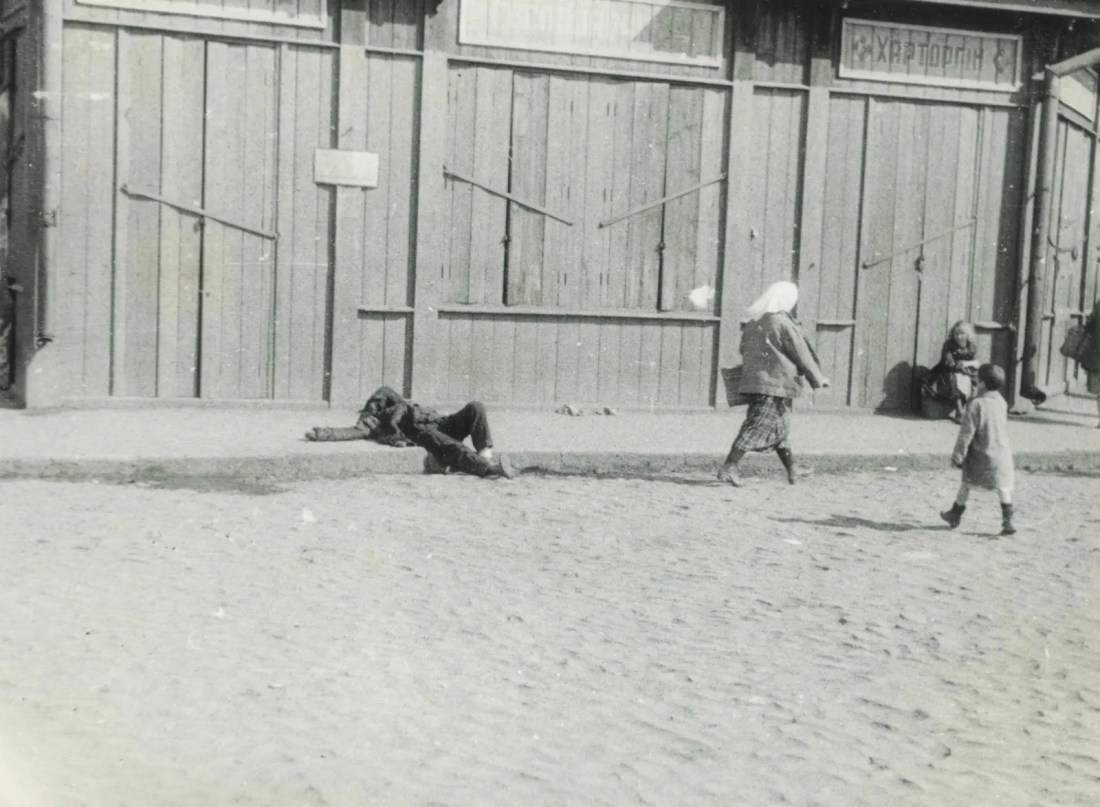
To punish the people there, Stalin ordered that the state-controlled food distribution system purposely stop sending food to this area. Further, he closed the borders, effectively insuring that the people there could not leave the area to search for food in other regions. The final blow came in the winter of 1932-1933. Stalin sent the soviet secret police door-to-door in cities and villages to confiscate what food had been stored or hoarded there. He even mandated that pets be taken in case the starving people turned to eating their cats and dogs. It’s not difficult to see what the results of these policies would be.

Holodomor.

Almost 4 million people in this area died from starvation within a couple of years. It became usual to find bodies in the streets of the cities. Mass graves became commonplace. Meanwhile, Stalin began quietly removing the ethnic and cultural leaders of the people and sending them to gulags in the far east. He replaced all government administrators with Russians. Finally, he ordered all government records that might have recorded the Holodomor, such as census records that would show the mass deaths, to be suppressed or changed. In other words, he erased all physical evidence of the horror these people endured.

Except Stalin could not erase the memory of the Holodomor in the minds of the people. The people–they never forgot. And they still do not forget what the Russians did to them. It motivates them to this day, in fact.

You know them as the brave people of Ukraine.