On a Young Officer

Like many young men of that time, John Clem wanted to join up in the Union Army at the start of the Civil War. He believed deeply in the cause of preserving the fragile union that had been forged almost “four score and seven years” earlier during the time of the American Revolution. However, he felt torn because his parents doted on him as an only and beloved child. Then, in a tragic accident, his mother died in a train crash. Well, that was all John needed to make his mind up. After his mother’s funeral, he left home and joined up with the 22nd Michigan Regiment.

The 22nd Michigan saw their fair share of fighting in the Tennessee theater of war, showing great bravery at the battle of Chickamauga on the Georgia-Tennessee border. In the battle, one of the bloodiest of the entire war, a Confederate officer yelled to a group of the Michigan men to surrender. In response, John fired at the officer and hit him, causing his fellow Union soldiers in the vicinity to rally around him and mount a counter-attack. For his courage and his heroism, John was promoted to the rank of sergeant.

Later in the war, John was captured with some other soldiers as they guarded a train. The Confederate soldiers who captured him took his kepi cap from him and discovered it had three distinct bullet holes in it–a cap that John took great pride in. After a short stay in a rebel POW camp, John was part of a prisoner exchange and soon found himself back with his old comrades. He went on to suffer two wounds in battle and further distinguish himself before being discharged in late 1864.

In that sense, John was much like many of the other soldiers in that war. They did their duties and fought like men to defend the principles they held dear. John’s army service actually continued after the war; he managed to rise through the ranks to become a commissioned officer. He managed to also serve during the Spanish-American war less than 30 years later and even be in the active military when World War 1 broke out. He died in San Antonio, Texas, in 1937, at the age of 85, a true hero of the United States Army.

If you’re doing the math, you’ll see why John is an interesting example of a Civil War soldier. 1851 is the year he was born. You see, John ran away from home to join the army…at age 9. He was still quite young when he shot that rebel officer. And John Clem became the youngest non-commissioned officer in the history of the United States Army…at age 12.
On a Small Soldier

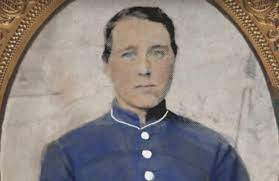
When President Abraham Lincoln put out the call for soldiers from the northern states to volunteer for the Union Army, an 18 year old enlisted in the 95th Illinois Regiment under the name of Albert Cashier. As a private in that regiment, Albert joined the Army of the Tennessee (Union armies were named after rivers) under the leadership of General Ulysses S. Grant. Albert saw service throughout the south during the war. Though small in stature, Albert’s fellow soldiers testified to the bravery and spirit they saw in the private. It wasn’t uncommon for teenagers to enlist; courageous boys as young as ten saw duty as drummers for some regiments.

Albert kept to himself, mostly, as many soldiers did. When people asked, Albert told them about immigrating from Ireland at an early age and becoming a farmhand in Illinois. With the others in the regiment, Albert performed the usual duties of standing guard and even going on scouting missions. During a reconnaissance patrol, Albert was captured by the Confederates and held as a prisoner of war. Somehow, though, Albert escaped and managed to rejoin the regiment. But then, a crippling case of dysentery put Albert in the hospital during the siege of Vicksburg, Mississippi in 1863. There, Albert received the first real rest in more than 16 months in the army.

More battles followed. Albert participated in more than 40 of them and never wavered, never ran, never panicked. Albert’s coolness under fire was how most of the others in the regiment recalled the youngster. It is estimated that Albert and the 95th Regiment marched over 9,000 miles during the course of the war, following the retreating Confederates from Nashville through Chattanooga and down into Georgia.

When the war ended, Albert, along with the rest of the regiment, was discharged and sent home with the gratitude of a nation for having defended the Union and the ideals upon which it was founded. Returning home, Albert lived a quiet life as a town handyman, caretaker of the local church grounds, and sometime store employee. In 1907, Albert applied for an received a well-deserved pension for the time in the service.

Then, in 1911, a car hit Albert and the resulting injuries required hospitalization. Some of Albert’s fellow old soldiers from the regiment visited their fellow small soldier in the hospital. Sadly, Albert would never fully recover from the accident. Death followed not too shortly afterward. However, it was in the hospital that the attendants and physicians who cared for Albert made a remarkable discovery. This person who had fought bravely for the Union, worked for years in the town, was known by many people for honesty and prudence, was not who he said he was.

In fact, it was discovered that the person who had lived for over 50 years as Albert Cashier was actually a she.