
Thomas Corbett was born in England in the 1830s and, with his family, emigrated to the United States when he was 8 years old. The family moved to Troy, New York, and young Thomas apprenticed to a hat maker in the village. It would be a job he’d hold off and on throughout his life. When he became of age, Thomas found a woman he fancied, and the pair got married. But his wife and her baby died in childbirth, and that sent Thomas over the edge.
Thomas cursed God and decided to spend the next few years as a homeless drunk for the most part. One night, he found himself in Boston, Massachusetts, and got rip-roaring drunk as usual. It was during his intoxication that he crossed paths with a minister who was standing outside of a local bar and preaching to all those who came out of the establishment, drunk to the gills. Something the minister said resonated with the young grieving widower, and he gave up drinking on the spot. As fervent as he was as a drunk, Thomas became equally as resolute as a Christian. In fact, he even changed his name to represent the “new birth” he felt he’d received upon his baptism; he became Boston Corbett.
Now, we should note at this point that this young man was somewhat unstable mentally. He had exhibited odd behavior even before he experienced his remarkable conversion, but he became increasingly odd afterward. He would stop people on the street and pray for them–people who were complete strangers. He would verbally berate anyone whom he heard using what he considered to be swear words. And he had a habit of stopping traffic in the street and preaching to all within earshot. All of these behaviors caused those around him to question his sanity.
When the Civil War broke out, Corbett enlisted in the Union Army. There, he soon got into trouble for refusing to follow orders he felt were against God’s law (such as marching or fighting on the Sabbath). He faced disciplinary action on many occasions, including one court martial. After one battle in Virginia, Corbett was captured by the Confederates. He was sent to the infamous Andersonville Prison Camp in Georgia, staying there until released in a prisoner swap. When he eventually rejoined his unit, he found himself near Washington D.C. as the war ended.
Like all of the other soldiers in the army, Corbett was incensed that the man he saw as God’s avenging instrument, Abraham Lincoln, was gunned down by the Confederate sympathizer, John Wilkes Booth, a few days after the war ended. Corbett and his company were part of the group who pursued the fugitive Booth. When Booth was found hiding in a barn a few days later, it was Boston Corbett who shot Booth as he hid–shooting the man who was supposed to have been captured alive. You see, Corbett didn’t listen to the orders of men, no; he had a Higher calling.
And the event made him a hero.
After his service, Boston Corbett returned to hat making. He suffered increasing bouts of strange behavior for the remainder of his life. It is supposed that he died in fire in Minnesota a few years later after being a lay preacher for many years in addition to making hats.
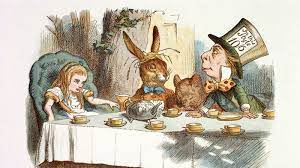
What we know now is that Thomas “Boston” Corbett was crazy, but there was a reason for his being that way. You see, at that time, the fur used in making hats such as the tall, beaver pelt hats of the day, was treated with a compound that included mercury. Years of inhaling that poison affected Corbett’s brain and caused his madness.
And it’s why we say that someone is “as mad as a hatter,” because, for Boston Corbett, the avenger of Abraham Lincoln, that was his job.
 The Rest of the Story