On a Poor Boy

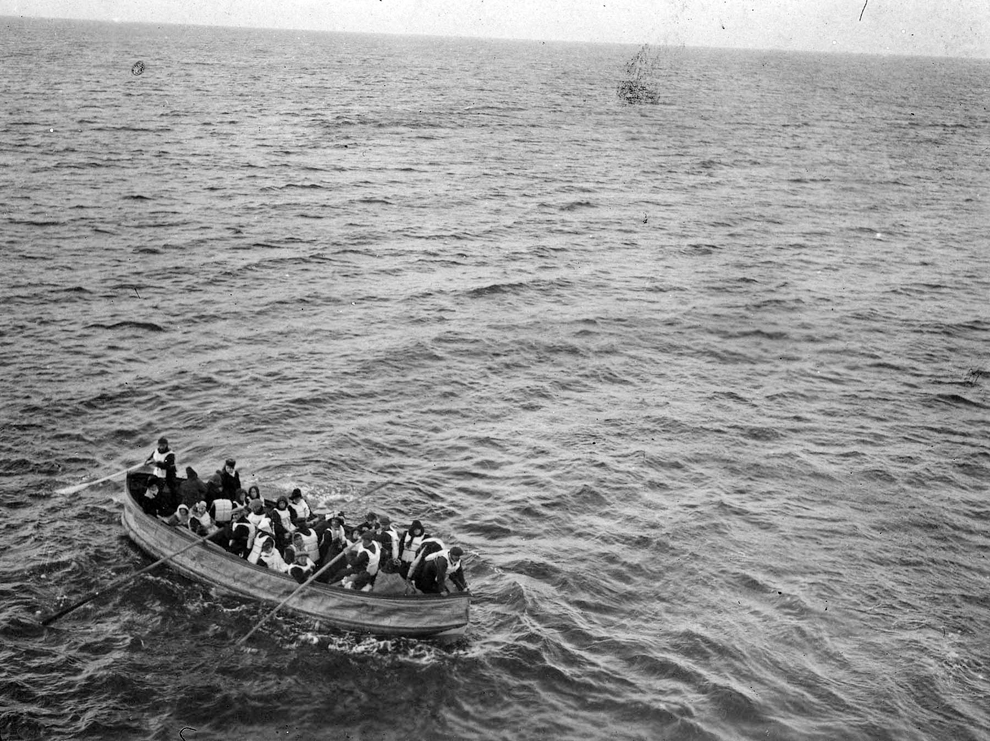
706 people survived the sinking of the luxury liner, the Titanic, in April 1912. One of those survivors was a young woman named Maddie. She was a the second, young wife of an older man, a man who put Maddie into one of the sinking ship’s lifeboats and reassured her that he would be on one of the other lifeboats. Don’t worry, he said. I’ll be right behind you, he said. Well, it’s not hard to guess that Maddie’s husband didn’t make it off the ship.

That left the young woman a young widow. And five months pregnant with her first child, technically making the actual number of survivors 707. That baby, a boy born in August of that year in New York City, came into the world with the specter of the doomed Titanic hanging around him. His mom called him Jakey, after his father’s name of John. As he grew up, people looked on Jakey with pity; poor boy, they said, born without a dad. The Titanic baby they said. His mother Maddie, not wanting to be alone, met and married a man less than four years after her first husband had died. That marriage didn’t last, but the man did help to raise Jakey. And, the union did produce a brother for Jakey, another boy, and the two step-brothers remained close all their lives. However, the same year she divorced husband number two, Maddie met and married another man, a young Italian boxer.

Jakey liked the first man her mom married after his dad died, but he loathed the boxer. That guy was not much older than Jakey by the time Maddie married him, and Jakey didn’t understand what his mom saw in him. For his part, the boxer picked on Maddie’s oldest boy, saying that bullying him would toughen him up for what life had in store for him. Poor Jakey! But things got worse.

After managing to leave the home at age 21, Jakey met a woman in 1934 and fell in love with her. But the woman said that the young man was too immature for marriage, and, even though they were engaged, she broke off the relationship. Turns out that her parents had convinced her that he was strange, Jakey was. He was, after all, that guy who had been the Titanic baby. Jakey was heartbroken. So, he decided to get on a ship and go away for a while. When he came back, he quickly found another woman and fell in love with her. This woman was the best friend of his first fiancé, oddly enough. The couple married. They divorced 8 years later. Then, Jakey married another woman in 1944. He divorced her a decade later. That even was then followed by two more marriages. Poor Jakey was cursed in life and love, he felt.

Yet, the four marriages produced two children for him, a boy and a girl. Like his love life, Jakey never really settled on a career, either. And, when he died in 1992 at age 79, of course his obituary mentioned that he was born as that poor Titanic baby. And you may sort of know him already, in fact. You see, in 1953, Warren Kremer and Alfred Harvey, the creators of Harvey Comics, created a character loosely based on Jakey.

I mentioned earlier that Jakey’s father’s name was John, and that was also Jakey’s name; his full name was, of course, John Jacob Astor VI, and he was one of the heirs to the Astor Family fortune. But because of his life of seemingly bad luck, beginning before he was born, he was known all his life as the Poor Little Rich Boy, like the comic book character, Richie Rich.

On Two Radiomen

Yes, I’m old enough to be able to use the phrase, “Back in my day…” to describe things that young whipper-snappers of today can’t relate to. In this case, what they can’t relate to is that broadcast radio used to be the domain of a few people. If you were on the radio as an announcer, you had to study for, take, and pass licensing tests. There were different levels or classes of licensing as well–2nd and 1st class licenses, for example. As someone who wanted to get into radio (and did so, for a short time), I managed to get a provisional license and then get a 2nd class license. 1st class eluded me.

All that was said to say my struggles with radio licensing were nothing compared to what it took to operate a radio (also known as a wireless) back a the beginning of the last century. The Marconi Company, founded by the man of the same name who is credited with inventing and perfecting wireless radio transmissions, had the corner on the market of the new industry. Marconi wireless training schools controlled who could operate their technology and who could not. Young men (and a few women) trained at these schools for jobs on land and on sea.

Harold Bride and Harold Cottam were a pair of plucky British young men who took the Marconi school’s 6 month training course at different times, and both excelled at the new system. Despite Harold C. being a few months younger than Harold B., he had started his training in radios earlier and had advanced a bit more in the industry than Harold B. had. Harold C. had managed a job with the British Royal Mail, and it was there that he met other wireless operators (as one does) who came and went over the months and years. Harold B. came in one day and introduced himself, and the two became great friends. By 1909, Harold C.’s skill as a wireless operator caused the Marconi Company to hire him for themselves, and then they dispatched him to work for a shipping company in 1912. Harold B., on the other hand, went straight to sea as an assistant operator after his training.

Marconi had convinced the British admiralty that they were the only ones who could adequately train shipboard wireless operators, and the company had the exclusive contract to provide radiomen for British sailing vessels. Not only did Marconi train people to operate their instruments, but their training also included repair and maintenance of the equipment. Thus, both Harolds, while each working for Marconi, found themselves aboard different ships operated by other companies.

Being a radio operator on a ship like a passenger liner was less of a glamourous job than it sounds. You were little more than a glorified page boy. Most of the time, your job consisted of people onboard radioing other people on land to tell them, “Hey, I’m on a ship!” or something as inane. Sure, occasionally, ships would radio each other things like storm warnings or positioning, but most of the job was catering to the whims of wealthier patrons.

Then, in April of 1912, fate would bring the two Harolds together. Harold B. and Harold C. found themselves on the same ship due to a quirk in history. The pair were ecstatic to see each other; the friends embraced warmly. Then, immediately the pair took turns at the radio sending the usual messages for passengers, with most of the passengers’ messages stating, again, that they were simply fine and dandy. Except this time, those usually inane messages had a more serious tone. This trip, the passenger messages were telling friends and loved ones that they were alive.

What I didn’t tell you is that Harold B. had been brought aboard Harold C.’s ship, the Carpathia, after his own ship had sunk.

You see, Harold B had been the assistant radio operator onboard the Titanic.