
On an Imagined Email

If email had existed years ago, here’s a possible, mostly historically accurate, but completely imagined inter-office communique:

To: Senior Staff

From: JM

Date; 20 May, ’92

RE: The Boss

He’s talking about retirement again. We are at a juncture where such a move would prove disastrous for our little enterprise. In talking with him at length in his office this morning, the following items were brought up as the major reasons for leaving.

1.) He’s tired. The years of strain of being an exec have taken their toll, he says. He feels that he’s done all he can do to get us off the ground and on as stable a footing as he can given how little time we’ve been in operation, but he argues that he’s got nothing left to give. He talks about staying home, working in the garden, taking walks along the river, and playing with the dogs. Can you believe it? The dogs, for Chrissakes. And he says his wife is tired of him not being home after so many years of work. He says he’s old–but he’s only 60! For those of us who’ve been here since before the start, he’s always seemed older, but he’s never seemed old to us. We’ve got to remind him that he’s young, that he has many productive years left, and then say things about how his color is good or how he’s looking well.

2.) He’s fed up with the interoffice politics among senior staff. That’s why this email if for your eyes only. It would do no one any good to learn about infighting among the senior-level employees. Keep this to yourselves. But he’s looking specifically at Al and Tom. You guys have your issues, we know, but you’ve got to keep that stuff out of the office. No arguing in front of him, in the halls, or anywhere on the property. If you guys have something to say to each other, say it out of earshot of anyone having to do with this office. The Boss says he’s tired of having to play referee for your infighting. And he worries that staff as a whole will choose sides between you two, leading to division within our group, and possible dissolution of what we have all (especially he) have worked for so hard for so long. He is aware that there will be fighting over who will replace him among us, but he still is wishing to step down.

3.) Finally, he’s worried that if he stays any longer in the leadership position, people in and out of the organization will soon not be able to separate him from the role. In other words, his concern is that the man will become synonymous with the position, and anyone who follows him will forever be considered and seen as the “not him.” That’s a valid position to a degree, granted, but, again, we are at a critical point in our existence. We have to assure him that if he decides to step down now, there may be no role for anyone to assume after he leaves.

We have to have a united front on this. Remember: Stay positive in his presence. Tell him how good he looks and how young. No infighting (can’t be stressed enough). Remind him how vital he is to what we are trying to do here.

Everything depends on President Washington being re-elected in November and staying in office for at least four more years.

–Madison
On A Sneak Attack

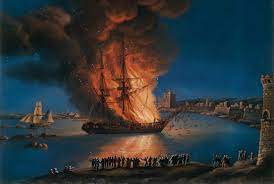
The American warship, the frigate USS Philadelphia, lay in harbor in the north African town of Tripoli. The year was 1804, and the young nation of the United States was still feeling her way in international relations. The Mediterranean coast of Africa was awash in pirating, and the US, wanting to expand trade to the lucrative markets of the Italian peninsula and on to the Turkish coasts, was taking a serious hit to their shipping. What we today call the Barbary Pirates were taking American cargoes and the ships that carried them. President Thomas Jefferson ordered American frigates like the Philadelphia into African waters to stop this pirating threat.

What no one in the harbor–and certainly no one onboard the Philadelphia–knew was that a band of saboteurs had plans to destroy the warship as it rested at anchor there. According to the story, about 80 men disguised their boat with a square sail that mimicked local ships. They chose for their attack a night when the moon was new. No one seemed to notice much as the disguised vessel drew alongside the Philadelphia. In Arabic, one of the men on the ship asked if they could tie up to the American warship because they had lost their anchor. Permission was granted for them to do so.

Suddenly, a loud order was given, and about 60 of the men jumped onboard the Philadelphia. Within ten minutes, the ship was seized. The attackers had lost no casualties in the short skirmish. Now, the intent was for the marauders to sail the American ship out to sea and, in effect, steal it. But the ship was soon discovered to not be seaworthy. As a last resort, in order for the enemy to not be able to use it, the commander of the attackers ordered that the ship be burned. They put incendiary devices all around the large ship, and they set it ablaze. The commander then ordered all the attackers to return to their boat.

As the Philadelphia began to burn, the gunpowder began to ignite as well. Explosions rocked the harbor. In the confusion and fear caused by the burning vessel, the attackers were able to barely escape and made their way to the open sea, their mission happily accomplished. The fact that this feat could be accomplished without a single loss of life was amazing. This commander was lauded for his audacity and bravery. None less than British Admiral Lord Nelson is reported to have called the raid, “The most bold and daring act of the age.” Even the Pope at the time commented on how daring and bold the attack was.

It might surprise you to learn that, when the news of the destruction of the Philadelphia reached the United States, there was great rejoicing. Yes, this act was lauded by both press and public. And it might further surprise you to learn that the leader of this daring raid was actually an American naval captain named Stephen Decatur. And the party Decatur led was made up mostly of United States Marines. You see, the Philadelphia had been captured by the pirates, and Decatur had orders to take it back or, if that were not possible, to destroy it so the Barbary Pirates couldn’t use it.

And so he did.

That’s also why, in the Marine Corps Hymn, they sing, “From the Halls of Montezuma to the shores of Tripoli…”