On an Unlucky Inventor

Walter Hunt is one of the greatest inventive minds produced by the 19th Century in the United States. Remember that the same century produced Thomas Edison, Eli Whitney, Cyrus McCormick, and other creative geniuses who changed society as the world knew it. And I’m arguing that Walter Hunt holds his place among those giants of ingenuity.

That’s what makes the fact that you don’t know him or recognize his name so frustrating to some industrial historians. This mystery inventor was born one of 13 siblings in rural New York State at the close of the 18th Century, and he learned as much as he could at the local one-room schoolhouse. Eventually, he went to what we today would call an A&M college and received a degree in masonry. He liked tinkering in his barn. It was while he traveled to New York City in search of financing for some of his ideas that he conceived of his first important invention. He witnessed a street car accident in which a young girl was struck and killed. Walter then developed one of the first warning bells on streetcars to warn pedestrians of the approaching car. He sold his invention to the largest streetcar company in the county, and soon, his invention was used on streetcars everywhere.

And that story was repeated throughout Walter’s life. He would invent something and immediately sell it. As a result, he never really made the big money that other inventors did during that time. For example, Edison kept the rights to his creations and either became the manufacturer or licensed the rights to them to other industries. Thus, while we know about Walter’s inventions, we really don’t know about the man behind the inventions. His name was erased from his creations the moment he accepted (usually low amounts of) money for them. Instead, we know the companies that produced his inventions rather than their creator.

Home knife sharpener? Yep, that was Walter. Restaurant steam table? Ditto. The fountain pen? Well, Walter created the prototype of the ones we use even today. Rotary brush street sweeper? Better oil lamps? Paper shirt collar? Reusable bottle stopper? Prototype repeater rifle? An ice-breaker for ships? All of those and more came from the fertile imagination of Walter Hunt. And all of them sold for much, much less than they would make for the people or companies who purchased those inventions from him. However, he did manage to save enough money to open a machine shop in New York City in Greenwich Village. And it was there that he created one of his most valuable inventions.

Up until that time, all sewing was performed by seamstresses in what amounted to sweat shops in the cities. Walter invented and built the first practical sewing machine, and it sewed faster than humans with the same accuracy and with even greater consistency of stitch. His wife and family were largely against his marketing or selling of this invention because of the number of seamstresses the machine would potentially render unemployed. Yet, he sold half interest in the machine to a man who promised to take the machine national but he…did absolutely nothing with it. Instead, the man changed the shape of the machine but left Walter’s stitching mechanism in place and pretended that he, not Walter, was the inventor of the apparatus. Later, a different man, Elias Howe, applied for the patent for the sewing machine. Walter began proceedings against Howe. The court found that while Walter’s machine predated Howe’s, Walter had failed to file proper patent paperwork and awarded the patent to Howe. Again, Walter didn’t gain wealth or recognition for something that he had created. Such was his luck. He died in 1859 of pneumonia, and almost no one noticed.

We still haven’t brought up the most significant invention by Walter. That one is, interestingly, both the most universal and the most simple of all of his creations. It was the one that would go on to make the most money world-wide. Of course, in typical Walter fashion, he sold the rights to it for the equivalent of $14,000 today. It was also one of the inventions he thought little of. Yet, if you know Walter at all, you know him for this. In fact, you probably have one or several of them in your house right now, thanks to Walter Hunt.

It’s the safety pin.

On Some Happy Campers

Getting back to nature and going camping has appealed to people ever since cities began housing more people that the countryside did. We campers see retreating to the outdoors as getting back in touch with our collective past, a simpler (and perhaps, happier) time. And the invention and proliferation of the automobile made those remote and rural areas much more accessible.

Take the case of a group of four chums in the 1910s. During the week, they were workaholics, dedicated to their various careers and businesses, but, on occasion, they would tear themselves away and go, by the fairly new automobile, to the woods. There, they would camp–after a fashion. Some people today would call what this group of mature men did glamping–the idea of camping but with some of the creature comforts from “civilization” in tow. And I get that. The older I get, the more I want a nice bed, even if it’s under the stars. I want good food and not gorp or MREs. However, this group went a bit farther than that. They loaded their cars with folding tables and even had batteries rigged up for electric lights. Now, remember, these guys were doing this in the 1910s. But they insisted on the creature comforts because, well, they were, as I stated, more mature men.

The four friends labeled themselves The Vagabonds because of their camping excursions. Jack, Hank, Tommy, and Harve enjoyed their trips together. They’d smoke cigars around a large fire and swap tales and even brag about their business exploits or even (and these were secrets) their conquests in love. Sometimes, other business types would join the group, but the four Vagabonds were always the core.

And the group documented their trips. They kept journals about what they did. They took photographs. And one of them even brought an early movie camera and made some 1910s version of home movies about their exploits “roughing it” in the “wilderness” of wherever it was they were on that particular trip.

Now, remember, at that time, there wasn’t the extensive highway system that we have today. There weren’t the typical tourist and traveler comforts like common gas stations or rest stops. So, in that sense, the Vagabonds were indeed roughing it after a sort. But not so much. They were, in fact, rather happy campers.

But then, Jack died. It didn’t seem the same after that. The last trip the group made together was in 1921 before he passed. The remaining three tried to carry on, but they knew the magic period had passed. Besides, word was getting out about what they were doing, and other people were copying their methods and style.

Yet, today, we can still look at the pictures of what famous naturalist John Burroughs, inventor Thomas Edison, industrialist Henry Ford, and rubber magnate Harvey Firestone did on their trips to the wilderness.

On a Scientific Exhibition

Edouard Scott was a printer, writer, and inventor in Paris. He lived from 1817 to 1879. He liked to tinker with things and ideas in his shop.
In 1878, Paris celebrated the nation’s recovery from the Franco-Prussian War by hosting one of the first world’s fair. The Paris Exhibition drew international interest from inventors and investors as well as the public, all eager to see what new creations the modern world had created. An early prototype of a monoplane was brought to the fair, Graham Bell’s telephone had a booth there, and the French proudly displayed the head of a giant statue they planned to gift to the Americans–it is known today as the Statue of Liberty. Paris, the City of Lights, even electrified its streets in the area surrounding the exhibition to provide visitors with a nice glow well into the nights. Painting exhibits, music competitions, and dance routines were also shown. International committees on copyright laws and even organizations regarding rights of blind and deaf people convened and set standards for their groups that lasted decades.
download
But most people concentrated on the new inventions hall. One exhibit that caused great excitement was by the American inventor, Thomas Edison. The machine Edison put on display purported to show how sound could be captured and reproduced. The concept intrigued Edouard Scott, and he eagerly made his way to the exhibition hall to see the phenomenon for himself.
Sure enough, there it was. The Edison machine had a cone-like projection that captured the sound and put it on a tin foil roll. The exhibition of the new Edison invention, which he called the phonograph, caused a stir among the scientific community in France. Scott was suitably impressed. He asked pointed questions of the curators of the exhibition, showing a good grasp of the technology involved.
The public loved the machine. Edison, ever the capitalist and cocksure of the impact his new invention would have on the public, had even contracted with a local French manufacturer to put his hand-cranked tinfoil voice recording machine on sale.
Scott walked around the Edison exhibit and became more and more depressed. He made his way home slowly. Entering the hallway of his house, he took off his hat and made an announcement to his family.
“It’s my machine.”
You see, Scott invented something similar…20 years earlier in his shop. Instead of tinfoil, Scott’s contraption used charcoal and a stylus to record his own voice singing and talking (1860) and to record a cornet playing a scale (1857). These are the earliest recordings in history.
The design for his machine still sits in the patent office in Paris today. Researchers have found some of his recordings on the old charcoal sheets in the archives of the patent office and have digitally remastered them and found them to be similar in quality to the early Edison efforts.
Heartbroken that his own efforts had been overlooked, Scott died a year later.
His body lies today in an unmarked grave.
Scott had named his machine the Phonautograph.
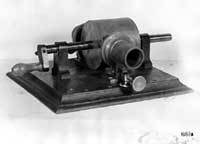
Take a look for yourself. Here’s Edison’s contraption:
tinfoilsm
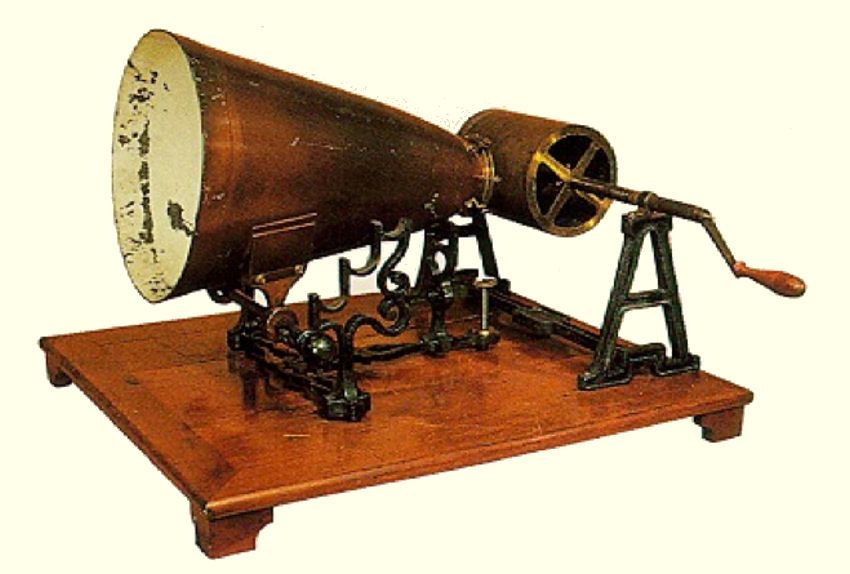
And here’s Scott’s:
phonautograph
Only in recent years has Edouard Scott begun to be recognized for what he should be: The real inventor of sound recording.