
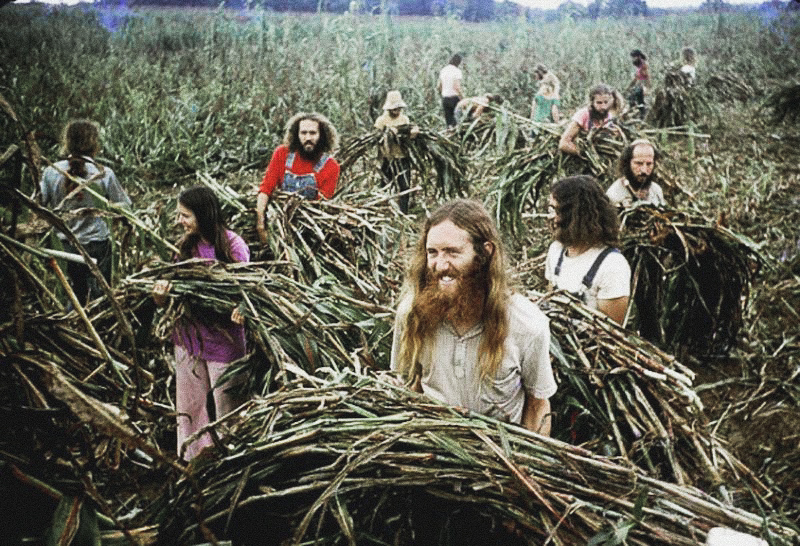
The hippies of the 1960s and early ’70s were wildly idealistic youth by and large. However, the emphasis on “getting back to the land” by some of them–a rejection of an urban or suburban, consumerist society–is laudable to me. Almost 60 years later, there are still some vestiges of that movement in the form of communes in various parts of the United States and Britain (The Farm in Summertown, Tennessee, comes to mind). The idea of people sharing common ground and working for the betterment of the group isn’t new, of course. In fact, another group tried remarkably similar experiments in communal living back in the ’40s.
That group was in England. It was during the war, and prices for food were high; harvests and weather had also been poor. So, a group in Surrey decided to band together to, in their words, provide food and sustenance to any and all who wanted to help them. They found some empty land on a hillside, and they cleared it and began planting on what they said was common cropland. They collectively built storage sheds and even some houses in which they could stay while they worked. The spirit among those who worked was one of great comraderie and cooperation. Their numbers grew quickly. People were excited to have land on which to grow fresh, well, whatever they could get their hands on. The members of the group reported no infighting, no jealousies, and no rancor. Everyone was happy and willing to share.
Well, as you can imagine, some people outside of the commune, specifically people who owned some of the land this growing group was “borrowing,” began to complain. And it’s not that the landowners wanted to use the land. It was going mostly unused. But it seems that the major objection to the group was that they had decided to collaborate. And any time the people in power feel even an iota of a fraction of a micron of loss of power–real or imagined–they usually react negatively. That seems to be what happened here. And part of it was that people in power often want to be the source of things like food and sustenance for people who are needy; they don’t want the people to help themselves. So, the people who owned the land and had money and power began a systematic reprisal against the members of the group–at least the ones they could identify. Some of the group were attacked and beaten. One case of arson was reported in one of the communal storage sheds.
Finally, one of the landowners took the group to court claiming that their free gardening commune was a encroachment on private land and amounted to theft. At the trial, the group was not allowed to mount a defense. They were found guilty in what amounted to a kangaroo court and ordered to destroy their buildings and remove all trace of their communal garden. If they failed to comply, the court said that the landowners could use the army–the army–to forcibly remove the group. Luckily but also sadly, the the commune peacefully abandoned the land. They indeed removed the building they’d erected, and they pulled up all their crops.
But today, the members of the commune–which came to be known as The Diggers–are considered to be the forebears of the modern agrarian socialism movement that influenced generations to come. Indeed, the hippies of the 1960s certainly found inspiration in that group of intrepid communal farmers.
After all, who could have guessed that a group from the 1640s would cast such a large shadow?
 The Rest of the Story