On a Canal

Ferdinand de Lesseps is a name you don’t recognize most likely, but you definitely know his work and his impact on the world. de Lesseps was a French diplomat and civil servant who led the French organization that built the Suez Canal in the 1800s. The canal was a modern phenomenon at the time since the desire for a connection by sea from the Mediterranean to the Red Sea is as old as history. Over the millennia, many civilizations tried but failed to cut a channel between Africa and Asia, and it was mostly the organizational work of de Lesseps that accomplished what no one else had been able to do. As a result, the man became a major hero to the French Republic and an international celebrity.

Thus, it made perfect sense for him to be the one to lead the next effort to build an important canal, this time across Central America. Such a canal would connect the Atlantic and Pacific Oceans. If built, the channel would save over 8,000 miles of sea travel by saving ship traffic from having to go all the way around the tip of South America to get to the other side. The potential savings of time and money were astronomical. All that de Lesseps had to do was to carve a ditch of about 50 miles across one of the most narrow points in Central America, across the isthmus of Panama.

It was with great fanfare, therefore, that the great canal builder de Lesseps was on hand in Panama to be the one to turn the first shovel of dirt, symbolizing the start of work on the project when construction began. But conditions in building the canal in Panama were remarkably different than those in the Suez. To start with, the construction was met with what seemed like insurmountable difficulties. Their equipment was good and modern, but it was mostly too small to do the task. One excavator said it was like digging a well with a teaspoon. The equipment would have been fine for the sands of the Suez, but, faced with the rock and mud of the Panamanian jungle, the machines bogged down quickly. There were landslides because of the rainy season when water poured down the hillsides of the construction sites. And when it wasn’t raining, it was scorchingly hot.

And then there were the tropical diseases, specifically the twin evils of yellow fever and malaria. Remember that this was in the late 1800s, in the period before vaccines and any types of proper treatment of scourges. Yet, despite these impediments and setbacks, the effort eventually removed more than 75 million cubic yards of dirt and rock. de Lesseps visited the construction sites and encouraged the workers that they were making good progress and that their efforts would be remembered forever in history.

de Lesseps local guide and on-site project manager was a man named Philippe Bunau-Varilla. Bunau-Varilla would become the most important Panamanian involved in building the canal. He was the one who organized the local workers and made all the arrangements for the logistical necessities like food, shelter, and facilities. And he was the mediator between the local/federal authorities in Columbia (who owned the land at the time )and the foreigners who were financing and overseeing the process of building the canal. Importantly, and unlike de Lesseps, Bunau-Varilla was an engineer. He disagreed with de Lesseps’s concept of making the canal a sea-level project rather than using locks. He understood that locks meant more cost but, ultimately, a much more simple process and a faster construction time.

By 1902, the work done by de Lesseps had produced the basic framework and route for the canal. However, because of the sicknesses of the location as well as construction accidents, over 20,000 workers had lost their lives in the effort. Investment money had dried up. Interest had waned in the work. It needed fresh eyes and a new perspective. And, by then, the aged Ferdinand de Lesseps had died. An offer from another investor came in, an offer to purchase all the equipment and the rights to complete the project. After almost no deliberation, the organization accepted the offer and sold out. This new investor then completed the canal in short order, using Bunau-Varilla’s idea for locks.

And who was that new investor?

Of course, it was President Teddy Roosevelt and the United States Treasury Department.

On a False Accusation

Mingo Sanders, First Sergeant, Company B, 25th Infantry Regiment, found himself in Cuba as part of the contingent of American soldiers in the Spanish-American War. He and his fellow soldiers had been assigned to the western US before the war started, and they were some of the first regular army troops to go to Cuba. The 25th Regiment was a Black outfit that had all-white officers, and Sergeant Sanders was one of the Black non-coms who formed the backbone of the troops. They were a proud group of men who were not new at their jobs, unlike many of the young and eager and inexperienced soldiers who had volunteered when the war fever broke out in April of 1898. Interestingly, Black soldiers made up around 25% of all US troops in Cuba during the conflict.

Sergeant Sanders was with his outfit one day in Cuba when another regiment arrived nearby. This was one of those all-volunteer units, and the way they set up their camp, well, a veteran could tell immediately that they didn’t have the expertise that Sanders and his fellow regular army comrades did. That evening, the commander of those troops, a colonel of the volunteer group, came to Sanders with a request. It seemed that his supply wagons had been delayed; could Sanders and his men please share some of their supply of hardtack with his white volunteers? Now, for those who don’t know, hardtack is like a large cracker that is, well, hard. You would usually soak it in coffee or water to soften it before eating, but the hardness allowed for it to be stored for a long time without decaying or breaking down. It wasn’t great food, but it was filling. And, of course, Sergeant Sanders was happy to give the young colonel and his volunteers some of their provisions. The young officer was grateful and said so. I tell you this to show you the type of man Mingo Sanders was.

Sanders and his regiment distinguished themselves in the war. Later, they were posted on the other side of the world, in the Philippines, to fight in that insurrection against the Americans. It was there that Sanders saved the lives of several men in an action and earned himself a medal for bravery under fire. At the end of that conflict, he and his men were stationed in Brownsville, Texas, right on the Mexican border. And it was there that everything went wrong for Sanders and the soldiers of the 25th Regiment.

It seems that the town wasn’t that thrilled to have Black soldiers stationed there. This was in the depths of the Jim Crow era in Texas, and racism practically hung in the air. The troops were given strict orders about avoiding any kind of confrontation with locals, and passes into town from the base were limited. That said, on August 13, 1906, two white citizens of Brownsville were shot; one of them was killed. The locals immediately blamed soldiers from the 25th. An inquiry was immediately launched, but the white officers of the 25th insisted that all their men were on the base the evening the violence occurred. Sanders and the other non-commissioned officers also vouched for the presence of all men in the barracks at the time of the shootings.

These assurances that the 25th wasn’t involved didn’t seem to matter to most folks. When local authorities could find no member of the regiment who could be definitively connected with the shooting, President Theodore Roosevelt sent a special investigation to Brownsville to sus out the truth of the matter. Each soldier of the 25th was interviewed, including the officers. Still, all insisted that the regiment, to a man, had not left base that night. They knew better, they all said. When the investigation reported to Roosevelt that no one in the regiment confessed or even pointed to any of the soldiers’ involvement, he did something odd.

Bowing to pressure from the white community of Brownsville, Roosevelt ordered that all members of the 25th Infantry Regiment be given dishonorable discharges. There would be no chance for appeal or any trial before a military court.

For Mingo Sanders, he was stunned. His 26 year army career was over without any due process or any official court martial. He lost his pension and his position and his pride took a major blow. And, in what may have been the most unkind cut of all was the fact that he lost it all due to this particular Commander in Chief’s order.

You see, Theodore Roosevelt was the same young colonel Sergeant Mingo Sanders helped by giving those green volunteers some of his regiment’s hardtack a few years earlier.

On a Selfless Resignation

In 1916, the United States held a presidential election. In Europe at that time, World War 1 had been raging for two years. Millions of people had been killed and millions more had their lives and homes completely destroyed. The US had not entered the conflict because, in part, up until that time, the American tradition was to not get involved in European conflicts and affairs.

The Americans thought of themselves as being above being tainted by the “old world” and their issues. However, the war was having a major negative impact on the US economy. Trade was restricted. Investment money was not being used. And, in the minds of many Americans, the threat of what they believed was an aggressive Imperial Germany to the democracies of Britain and France seemed to possibly threaten the US as well.

And so the election that year revolved around the idea of whether or not the US should get involved in a war that had clearly become a meatgrinder, a veritable slaughterhouse, for the troops involved on both sides. The incumbent, President Woodrow Wilson, the Democrat, campaigned on the issue that, “He kept us out of the war.” His opponent, US Supreme Court Justice Charles Evans Hughes, the Republican, was for the entry into the war on the side of the Allied Powers (Britain, France, Italy, and Russia), but he, too, urged caution.

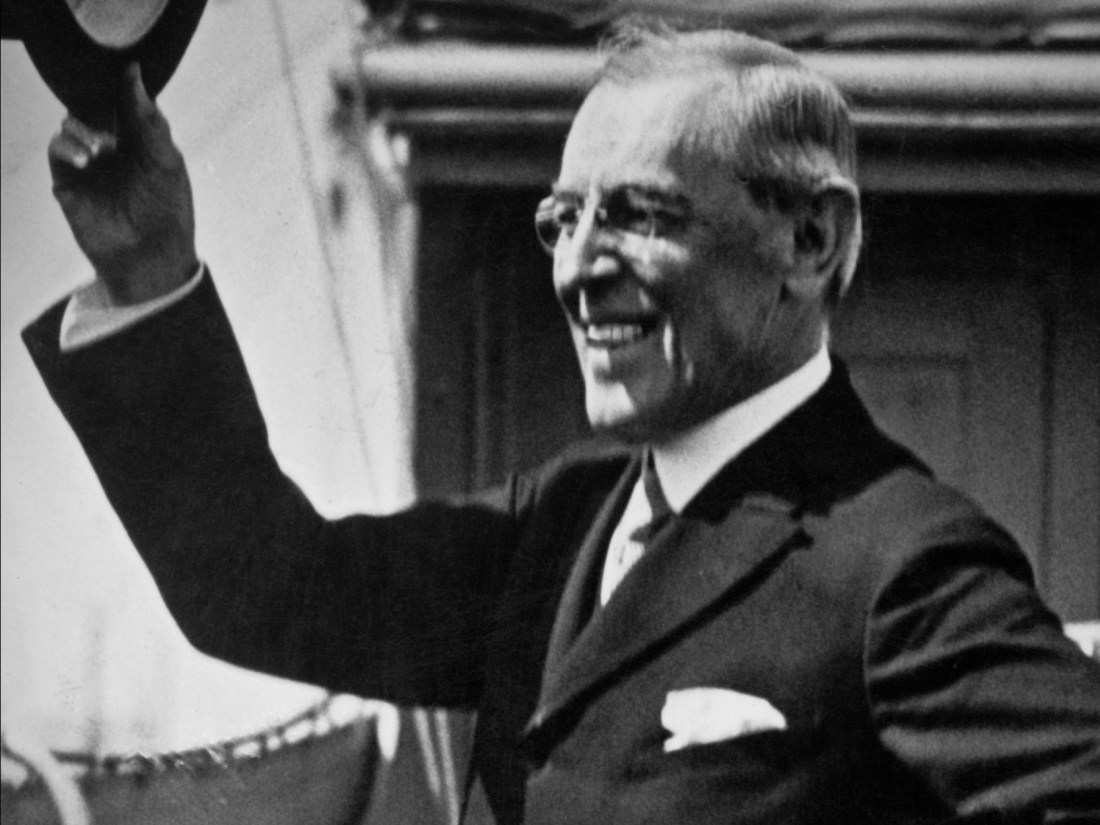
Wilson’s victory in 1912 had been something of a fluke. He was only the second Democrat elected since the Civil War (Grover Cleveland was the other), and it took the splitting of the Republican Party to make him president (Teddy Roosevelt ran against his former VP, William Howard Taft, as a third party candidate in 1912). So, it seemed a foregone conclusion that Wilson would probably lose to whomever the GOP candidate would be. And, so, realizing that the Republicans would probably win the election, Wilson hatched a plan that seems like something out of a movie rather than real life.

Now, I am not now nor have I ever been a Woodrow Wilson fan. He had a messiah complex as big as Texas, and he was an incurable racist. His stubbornness may have even led to the rise of Hitler 13 years after he left office and then, of course, World War 2. But in regards to the election of 1916, Wilson’s plan to make sure America and American interests would be safe in case of a Republican victory , Woodrow Wilson did an incredibly valiant and self-less thing: He planned to resign the presidency.

You see, at that time and until 1937, the incoming president wasn’t sworn in until the March following the election the previous November unlike today when the new president is sworn in only two months later. That original plan called for four months of lame duck-ness that, in times of great national crisis like the war in Europe or later, the Great Depression, can be an extremely long and costly time. So, here was Wilson’s plan. It was actually suggested to him by one of his close advisors. When Hughes won, Wilson would immediately ask for the resignation of both the vice-president and the Secretary of State. He would appoint Hughes to head the State Department, and then he himself would resign. Hughes would be then raised to the presidency as the next in line of succession immediately, thus bypassing the crucial four month waiting period.

But that didn’t have to happen. Wilson surged in the polls in the last few weeks of the campaign. Hughes, thinking that California was his for the taking, really didn’t campaign there much. But it was California that gave the extremely narrow victory to Wilson.

In fact, so confident was Hughes in his electoral victory that he went to bed on election night thinking that he was the next President of the United States. The next morning, when the phone rang in his house, one of his children answered. A reporter asked to speak to Hughes. The child is supposed to have said, “The president is sleeping.” The reporter’s reply was, “Well, wake him and tell him he lost.”

On the Butterfly Effect

I’ve been thinking about the Butterfly Effect lately–the idea that one small, seemingly insignificant event can trigger other things that lead to a major change in the world. As an amateur/armchair historian, playing the “what if?” game can be both fun and scary. What if Bobby Kennedy hadn’t been shot? No Nixon/Watergate then, no ending in Vietnam like we had it, possibly things like universal healthcare in the US, etc. And so forth.

Take the life of Gaetano Bresci, for instance. You’ve never heard of him, and neither had I, really, until I followed him down an internet rabbit hole search recently. Bresci was an Italian immigrant to the United States in the late 1800s. He settled in Hoboken and then Patterson, New Jersey, and took up with another immigrant, an Irish woman, with whom he had two children. Bresci worked as a silk maker in a mill there, and he became interested in making a better life for himself and his fellow workers. Thus, he began attending meetings of labor unions and workers’ organizations to see what could be done collectively to improve working conditions in the factories that dotted the New Jersey landscape.

But he quickly grew frustrated. The meetings were much talk and little action. “Much ado about nothing,” he remarked, and he began to think of ways that he could have an impact. You see, Bresci had a soft heart in one sense. He saw injustice in the way workers were treated by management–harsh conditions for little pay, no breaks during the day, huge profits for the factory owner on the backs of the workers, etc.–and knew that the system was inherently unfair. But what could he do to change it all? He was only one person, after all. You can understand his frustration.

Then, word came about an event back in his native Italy. It seems that some desperate factory and farm workers in Milan had rioted because they had no food. The Italian government stamped down, hard, on the rioters, and several dozen were killed and over 400 wounded when the military opened fire on their own citizens. This outraged Bresci. He purchased a pistol in New York, kissed his wife and children goodbye, and returned to Italy. He was going to act.

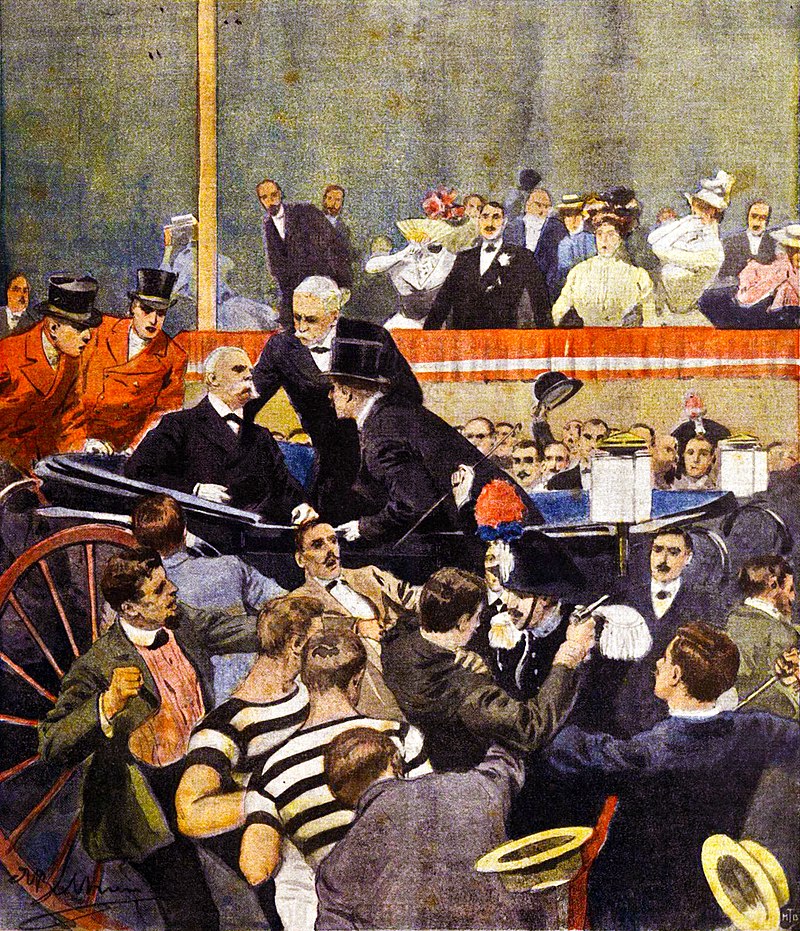
On July 29, 1900, Bresci stepped out of the crowd that surrounded King Umberto of Italy and shot him, dead. He then did not resist arrest, and he calmly stated that he had not killed a person but, rather, he had killed a principle. Well, of course, this “reason” for the assassination was seen as preposterous, and he was sentenced to life in prison. Shortly after being incarcerated, he was found dead in his cell–possibly killed by another, unknown assailant.

Back in the United States, the press hailed his death. Such should be the fate of anarchists and assassins, the newspapers said. But one young man, a Detroit-born fellow of Polish descent born Leon Czolgosz but who called himself Fred Nieman, saw Bresci as a hero. Here, he thought, was someone who was willing to do a wonderful thing to strike back at the people who held power and who exploited the little fellow, the nobodies of the world. Nieman, by the way, was the name chosen by Czolgosz because it means, literally, “nobody.”

So, inspired by the Italian assassin, Nieman took a pistol, wrapped it up in a bandage on his hand, went to the Buffalo World’s Fair in 1901, and shot and killed American President William McKinley. A nobody who killed a somebody.

But let’s Butterfly Effect this. Who became president upon McKinley’s death? Theodore Roosevelt. If McKinley had lived, then there might have been no Progressive Movement as we know it; no election of Taft in 1908; no splitting of the Republican vote in 1912 that led to the election of Woodrow Wilson. And if Wilson isn’t elected, then there’s no entry by the United States into World War I. And possibly no victory of the Allies in that war. And if Germany doesn’t lose, then no rise of Adolf Hitler in the early 1930s.

And no Hitler?

On a Funeral Procession

The assassination of John Kennedy, as traumatic and as paradigm shifting as it was, almost pales in comparison to the national outpouring of grief when Abraham Lincoln died at the hands of assassin John Wilkes Booth. Even in parts of the former Confederacy, true patriots knew that Lincoln was the best hope for not only national reunification but also for the rebuilding of southern society after such a devastating war.

When Lincoln died, it was decided that his body should go around the country by train, with stops in several important cities. The cities would then hold parades to allow as many people as possible to show tribute to the fallen leader. One of the largest parades took place in New York City.

Lincoln had not been always popular in New York. There were several draft riots during the war which caused tens of thousands of dollars worth of damage to the city. Being a democratic stronghold, many in the city viewed Lincoln as a tyrant. But, after his death, they also, mourned his passing because they knew he had steered the ship of state through rough waters into a safe harbor (to paraphrase the New York poet Walt Whitman).

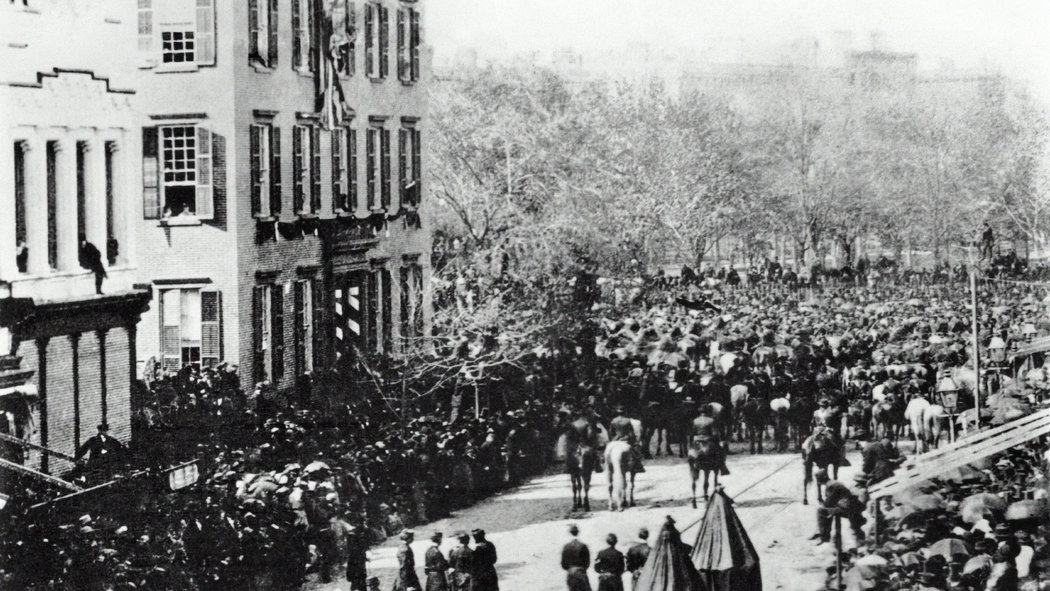
So the city turned out in large numbers to say goodbye to Abraham Lincoln. The funeral procession included huge rows of New York volunteer and draftee troops, freshly home from the Civil War. Family members and well wishers turned out to see them as well as mourners to see the extensive parade. Children who were old enough to witness the event and remember what they had seen spoke about the events of that late April day well into the 20th century.

Look at the photograph above. Years later, someone noticed that the house in the left center of the photograph belonged to one of New York’s wealthiest and most prominent families. They noticed two small figures in the second story window who were keenly watching the passing of the Presidential catafalque.

A relative of the family, in later years, said that she knew exactly who the two figures were. They were two young boys, cousins, in fact, of hers. One of them was named Elliot. This woman was certain of her identification because she ended up marrying the other one—the one whom she called Teedie.          

You know him as Teddy Roosevelt.