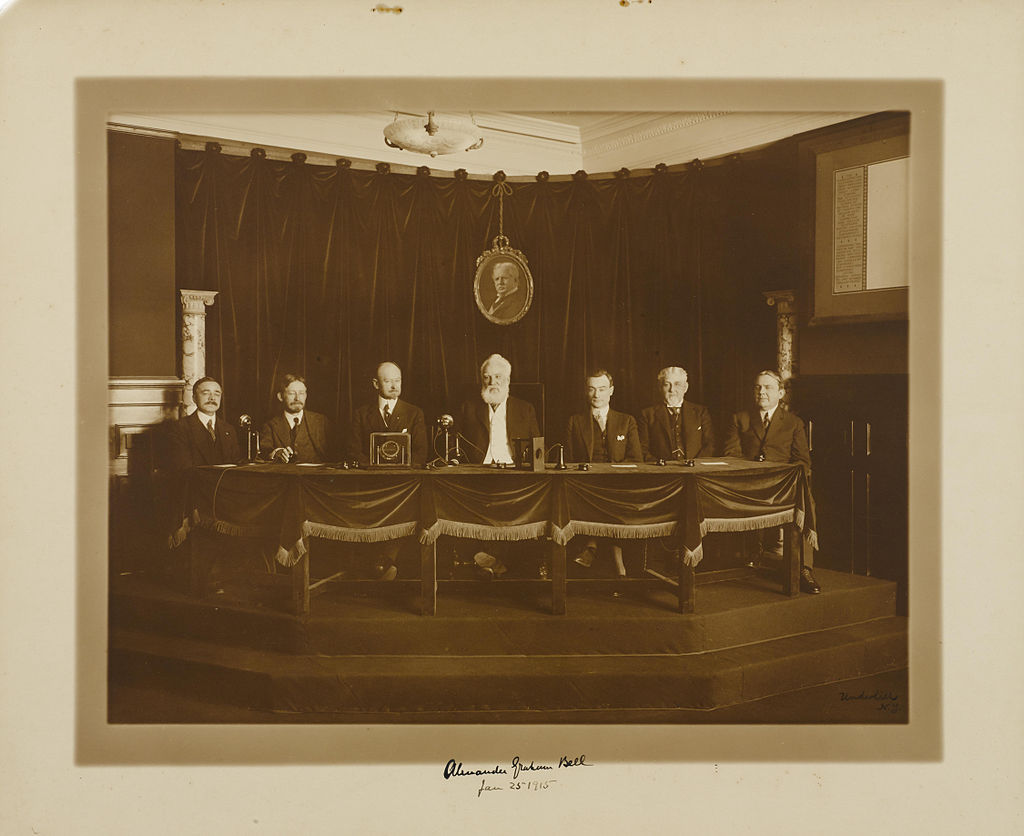
On a Phone Call

We’ve spoken before about how some historians argue that the modern world largely began in the period between 1820 and 1850. The use of steam engines to power factories, the creation of the railroad, and the invention of the telegraph occurred during those thirty years. It can be argued that almost all modern conveniences are merely modifications or improvements over these technologies. For example, the telephone is simply a better and more convenient telegraph, cars are trains for individuals that don’t run on tracks, and so on. Few inventions had an impact on society as the telephone, however.

We are all familiar with the story of how Scottish inventor, Alexander Graham Bell, and his assistant, Thomas Watson, were working on their telephone device one day when the first phone message was transmitted. The story goes that one day in 1875, Bell had spilled something toxic and needed Watson’s help, so he said something like, “Mr. Watson, come here–I need you,” and Watson heard the message through the machine as he was in the next room. Soon, the nation’s cities were crisscrossed with telephone wires tying people together instantly.

But there was no transcontinental phone system in place. The railroad had connected east to west in 1869. Paved highways from one ocean to the other were finished by 1913. It would be another two years later when phone wires were finally hung across the United States so that a phone call could be placed in New York and received in San Francisco. And to mark that historic milestone, a celebration and many commemorative events were planned. Now, phone lines had been connected from New York City to Chicago by 1892; that network had been expanded to Denver by 1911. And the final section across the Rocky Mountains to California was finished by late 1914. The president of American Telephone and Telegraph (AT&T) at the time, Theodore Vail, had tested the system that year, and it worked, but that first call was kept secret so that the event could be properly celebrated and marked. That’s why the first “official” call was scheduled for January of 1915.

Several dignitaries were to be involved in the call. Vail would be listening in from his winter home in Georgia. The mayors of both New York and San Francisco were also listening in on the line. And President Woodrow Wilson himself later spoke live from the White House to an audience assembled in San Francisco. In his remarks, Wilson noted that it boggled the imagination that a voice from thousands of miles away could be heard almost instantly by the people there. He mentioned the thousands of workers over the years since the invention of the device, the mostly anonymous men and women who manned the operator stations, erected the telephone poles, buried or strung the wires, and did the maintenance on the lines that made all of that possible. That part rubbed Vail the wrong way a little, because he wanted the celebration to recognize the power of AT&T and not the “little people” who were involved.

But the first call that day in January was placed from New York. Telephones had come a long way since Bell had first spoken to Watson 40 years earlier. To honor that event, the first official intercontinental telephone call repeated the words that Bell had said, too: “Mr. Watson, come here. I need you.” And, to make the call even more memorable, those words were spoken by the inventor himself, Alexander Graham Bell, on that January day in 1915.

And, on the other end of the line in San Francisco, when he clearly heard the same message that Bell had said to him 40 years earlier, Thomas Watson smiled.
On a History Theory

During a video work meeting recently, one of the moderators shared a video of a person using a pay phone. We were all struck with the fact that those things have pretty much gone from the landscape in much of the western world, an entire segment of the communication industry replaced by more modern methods of human interaction. Ask the harness makers from 120 years ago or the carriage companies from the same period about becoming obsolete. People are now being replaced in many areas of the manufacturing sector by robotics (and even in the logistics sector as well). Certainly, air travel, cell phones, and automated factories mark the modern world.

And that’s the way of the world, I suppose. Except maybe not. Let’s go backk (insert echo sound effect here in your head), backkk, bakkkk. We are really talking about innovations in three major areas of life throughout time: Communication, transportation, and manufacturing. It’s interesting to note that the ground-shaking changes in these three areas happened in an incredibly short time historically.

For most of recorded history, man traveled at the speed of, well, man. Ok, horses did speed up travel considerably (or camels or whatever beast a person rode in that culture). But, for the most part, people moved at the speed of people moving at speed. That means a person who walks at a normal pace could move about 3 miles per hour or 5 kilometers per hour. That was the pace of life. And, unlike what the western film genre tells you, horses couldn’t run for hours at a time. Most of the time, they walked not much faster than men did. Rivers were great ways to get around (and oceans, too), but when the current couldn’t pull a boat upstream, horses (or again whatever animal) did that work, too.

And people throughout history did indeed learn to communicate more rapidly than by foot. Birds where trained to carry messages. Signals (by fire or flag) also sped this up. But both were iffy and dependent on weather/visibility and limited to a small area compared to sending communications intercontinentally.

What about manufacturing. For much of history, mills that ground corn or even cut wood had to be built along rivers that powered the wheels that moved the machinery. True, some mills (think Holland and France, for example) were wind powered, but, again, humans were at the mercy of the breezes. So, if you needed consistent power, you’d have to have a water source.

So, what changed?

Well, according to historian Douglas T. Miller, the modern world wasn’t born anytime this century. Or the last one, either. No, Miller said that the modern world, especially modern America, was born in the relatively short window of 1820 to 1850. That seems crazy to have been so long ago (for us, 200 years), but that is incredibly recent in the long view of the history of mankind.

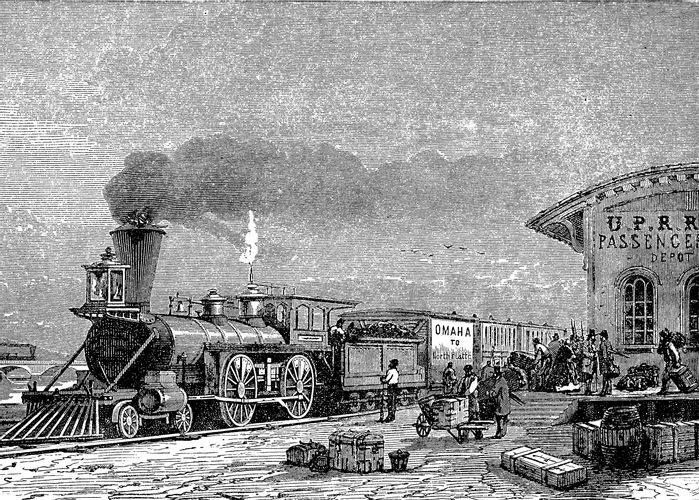
Miller argues that while steam engines had been used in factories and in manufacturing before 1820, it wasn’t until that year that the number steam powered plants equaled the number of water driven plants. By 1830, steam was well in the lead and never looked back. While water was still needed, factories didn’t need a constant supply of water running all the time and therefore they didn’t need to be along streams any more. 1826 saw the first practical use of steam applied to a train and the beginning of the wide use of steam powered boats on American waters. Suddenly, man, who, all of his existence, had been limited to travel at 3-5 miles per hour, now could go 40, 50, or more. That was mind-blowing to people at the time. And, it was 1844 that Samuel Morse sent the message, “What hath God wrought?” by telegraph, a message that was received miles away almost instantly.

And, what’s more, the airplane, the cell phone, and the automated factory are all extensions of those original creations and applications. In fact, Miller says that the revolution in those 30 years to society is greater than any modern revolution we’ve experienced.

That means a person who lived in those 30 years saw more fundamental change in transportation, communication, and manufacturing than any of us ever will.