On a Nervous Singer

The room began to fill with partygoers, and the sight of all those happy people coming into the union hall gave Ethel the shakes. “Why?” she said to herself; “why would I agree to sing at a New Year’s Eve party in front of total strangers?” The 18 year old girl retreated to a corner of the hall in an attempt to steel her nerves.

A young man with a pencil-thin mustache noticed her sitting in the corner, twisting her handbag in obvious distress. He approached her and asked, “What’s going on with you then?” Ethel looked up quickly. “Hmm?” she asked. He repeated his inquiry. “What’s going on?” Ethel glanced around the young man and pointed to the incoming crowd of revelers. “That. Them. Those people. That’s what’s going on. I agreed to sing tonight, but now, I’m not so sure.”

“Well, can you sing at all?” the young man asked. Ethel looked up at him a bit surprised. “Well, yes. A bit,” she said. “Then, what’s the trouble?” he wondered, and he pulled up a chair and sat next to Ethel.

She looked at him closely. He was somewhat handsome, she thought, with kind eyes behind his round eyeglasses, and he wore a nice smile. “I guess it’s nerves,” Ethel explained. “This’ll be the largest crowd I’ve ever performed for.

It was New Year’s Eve, 1935, and the Union Hall in New York City was buzzing with excitement. The Great Depression had put a damper on such celebrations in recent years, but the Roosevelt New Deal programs had begun to have a positive effect in some segments of American society by that point. The Union Hall was where what we today might refer to as socialists would meet to discuss how they could help affect even more change in the capitalist system. As they saw it, the moneyed interests represented the biggest culprit in the crushing of the American worker underfoot in recent years. The hall that night was filled with other, young and idealistic young people who put economic theory on the backburner for one moment and wanted simply to have a good time and welcome in what they hoped would be a better year to come for their cause.

And Ethel had agreed to sing. And now she was having second thoughts.

Well, the young man calmed her down. He politely excused himself and returned in moment with a drink that Ethel gladly accepted. She gulped it down, and he smiled at her. “Say, let’s go there (he pointed at this point to a nearby room), and you can sing to me to practice. It might also calm you down some.” Ethel smiled and agreed.

And it worked. Ethel sang that night, but she was singing to her new friend, the young man with the nice smile and the kind eyes and the round glasses and the dapper mustache. And he was waiting for her when she came off the stage to a nice round of applause.

“What’s your name?” he said over the clapping. “Ethel,” she answered, “Ethel Greenglass. And what’s yours?”

The man who would become her husband three years later, the man who would become the father of her two sons, and the man who would seal her fate, answered.

“Good to meet you. I’m Julius Rosenberg.”
On a Systematic Starvation

History since 1945 has winked at the fact that Joseph Stalin was responsible for more deaths in his own nation than any other dictator before or since. We have largely overlooked Stalin’s killings and mass incarcerations, the building of the gulags and the forced large-scale relocations, because Stalin was the ally of the United States during World War 2. The US has a difficult time (as many nations do) of admitting that we made a deal with a devil (Stalin) in order to defeat another devil (Hitler).

Holod means “hunger,” and “mor” means extermination. Thus, the word Holodmor comes to us from a period when Stalin purposely starved an entire area of the Soviet Union in order to replace an ethnic and cultural population there with Russians. This part of the USSR had been occupied by the same group of people for centuries. Like most of that part of the world, the system of land ownership and food production had followed a centuries-old system of large land owners and vassals or serfs who worked the land. While it was an inherently abusive system, it had managed to provide enough food for the people to have enough to eat for generations.

Stalin imposed a new system of land ownership where the land was collectivized and soviet supervisors replaced the land owners. The produce of the land, rather than going to the land owner and the peasants who worked the land, went instead to the state. It’s easy to see that this system would, obviously, cause hunger for people who had adequate but not an overabundance of food. The people of this fertile area of the USSR did not sit for this outrage. They rose against the machine, taking arms against Stalin and his soviet administrators.

As you can imagine, Stalin did not take kindly to any disagreement with his policies, much less one that involved an armed insurrection. He crushed the rebellion with the force of the soviet army. And then he got revenge. Apparently, one rule of the dictator game is that you want to make sure not one tries to do something like that again by making an object lesson out of the people you’re punishing. Part of Stalin’s anger also seems to have been that this particular region of the USSR had fought against the soviet revolution and with the Czar’s army (the so-called White Army against the soviet Red Army) a few years before. Stalin’s memory was long, and he never forgot what he considered to be disloyalty from this region. He would make them pay.

To punish the people there, Stalin ordered that the state-controlled food distribution system purposely stop sending food to this area. Further, he closed the borders, effectively insuring that the people there could not leave the area to search for food in other regions. The final blow came in the winter of 1932-1933. Stalin sent the soviet secret police door-to-door in cities and villages to confiscate what food had been stored or hoarded there. He even mandated that pets be taken in case the starving people turned to eating their cats and dogs. It’s not difficult to see what the results of these policies would be.

Holodomor.

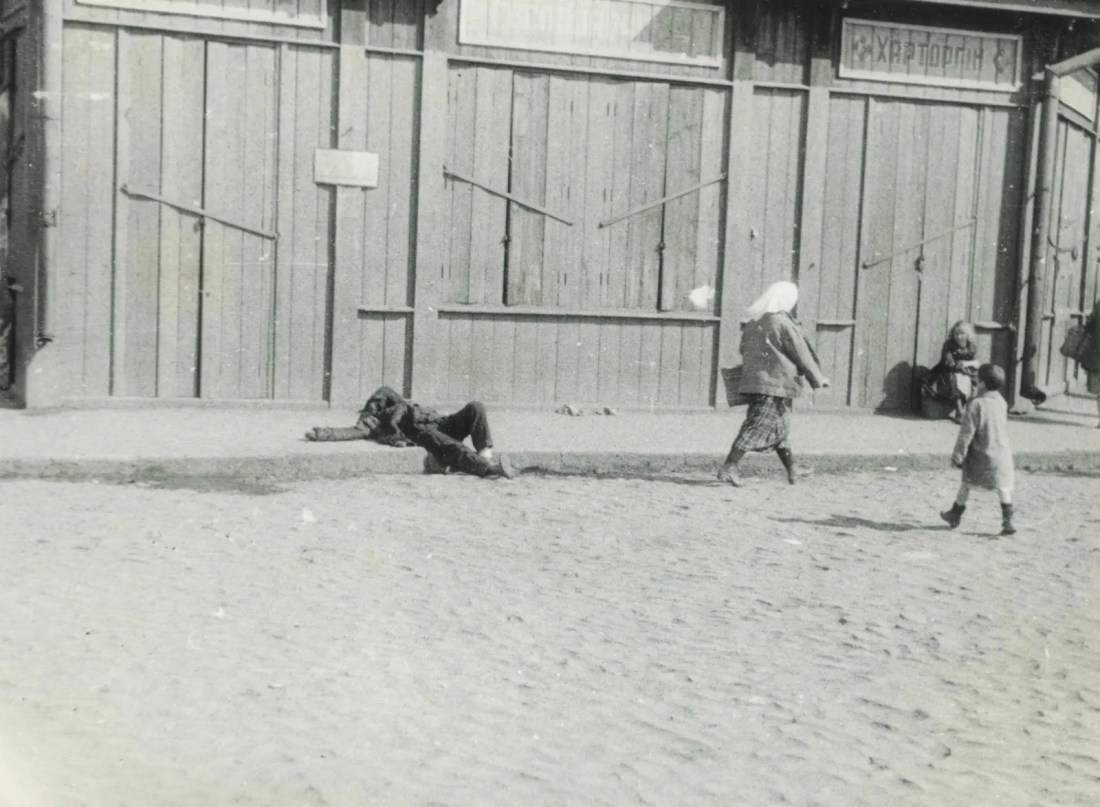
Almost 4 million people in this area died from starvation within a couple of years. It became usual to find bodies in the streets of the cities. Mass graves became commonplace. Meanwhile, Stalin began quietly removing the ethnic and cultural leaders of the people and sending them to gulags in the far east. He replaced all government administrators with Russians. Finally, he ordered all government records that might have recorded the Holodomor, such as census records that would show the mass deaths, to be suppressed or changed. In other words, he erased all physical evidence of the horror these people endured.

Except Stalin could not erase the memory of the Holodomor in the minds of the people. The people–they never forgot. And they still do not forget what the Russians did to them. It motivates them to this day, in fact.

You know them as the brave people of Ukraine.