On a Perfectionist

One of the best bosses I have had across my various jobs was a woman named Kay Tyler. She taught me two valuable lessons. One was to thing things through. What will happen each step of process? What effect will those things have on all involved and on the pursuit of the goal? The other lesson was to have not only a Plan B but also at least have an idea of Plans C-F or so. Those lessons have stayed with me and helped me be a better administrator and even a better person. Ms. Kay was a perfectionist, and she was one of those who backed up what she taught with a lifestyle to match. Another such perfectionist who is about the same age as Kay Tyler is a programmer and code writer named Margaret Hamilton.

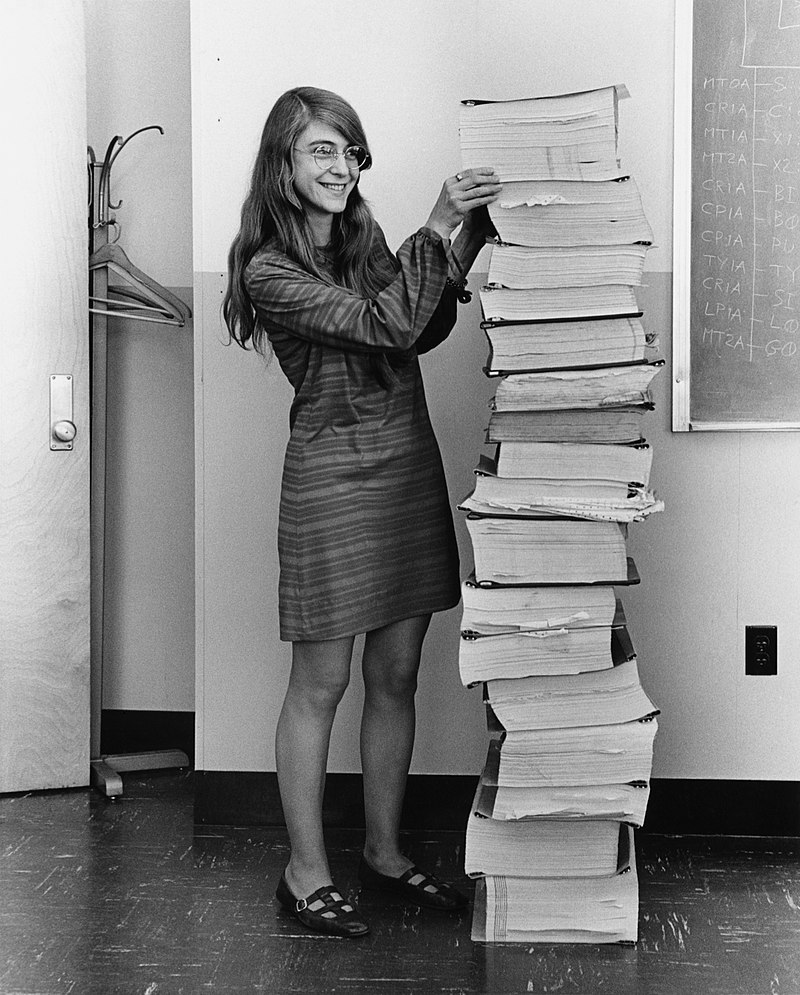
Margaret wrote computer code for M.I.T. back in the days when writing code was literal writing–by hand–each line of code on paper. Those codes told the computer what function to do next in a process. Like Kay Tyler’s advice, Margaret also had to think things through, and she definitely had multiple back up plans just in case. People would ask her, “In case of what?” Margaret would smile and answer, “Exactly!” In her capacity as a code writer, people’s lives were on the line; the decisions her code made could make the difference between life and death for some. There’s a story that, one night during a work party, it struck Margaret that one line of her code was incorrect. With her apologies, she rushed out of the soiree and returned to her office. Sure enough, one small part of a line of code was in error. Margaret realized that even something so small could make a world of difference in the right situation. So, Margaret became a perfectionist out of a sense of responsibility and ownership of her work–concepts that are becoming more and more foreign to some in the workplace today.

And remember that, during the 1950s and ’60s, it was rare for women to be in the workplace compared with today. And Margaret was also a mother. People at the time would ask her nosy questions like, “How can you work and have a child?” and “Don’t you love your family?” Yes, those were the types of things people thought about working mothers 60 years ago (not that some don’t still feel that way). Yet, despite knowing that her work was important, Margaret still felt some societal pressure to conform to the middle-class expectations of a woman being a wife and mother first.

So, often, Margaret would bring her daughter to work at M.I.T. with her. And that seemingly little thing led to something amazing. One night, while her daughter was with her in the office, Margaret allowed the child to play with one of the machines she had written the code for. The child, in her innocence, tasked the machine to perform a function for which Margaret had not written code. That piqued Margaret’s attention. What would happen, she wondered, thinking things through, what would happen if someone using her code would accidently make the same input that he daughter had done? Would that cause a catastrophic failure of the system? Should she write code that would keep the machine from even performing that operation at all, even it would be accidental? Better safe than sorry, she reasoned. So, Margaret wrote the code.

Turns out that when the code was finally used in the real world, someone indeed accidently made the same input that Margaret’s daughter had done. However, because of her sense of perfectionism, Margaret was ready for it. And, in the final analysis, it was that mentality that perhaps saved lives.

What you don’t know, most likely, is that Margaret Hamilton wrote code that produced the modern coding systems we use today. In the same way that the invention of the telegraph led to modern cell phones, Margaret’s code is the grandparent of the code used on the device you’re using to read this blog right now. At the time, of course, Margaret’s code was groundbreaking and revolutionary. And, it’s true, her code saved people’s lives.

You see, Margaret wrote all the code for NASA that sent humans to the moon.

On a Solo Trip

Valentina was 26 years old when the Soviet Union chose her to take a trip alone for the first time. The girl was known in her town for her confidence and her perseverance. Born in Russia in 1936, she lost her father in the first year of World War 2 and was raised by her mother along with two sisters.

The hardship that family of women faced is difficult for us to imagine today. We think today of having a wide range of opportunities and choices, but those multiple options weren’t readily available to Valentina. No, the young girl determined that she would have to work to make any opportunities in life.

And so she did. Without telling anyone, the teen took classes, training, and even got a job her mother didn’t even know about. At her regular school, Valentina excelled at almost every subject. She finished her primary and secondary education in only 7 years. Besides, working, schooling, and training, Valentina enrolled in correspondence courses in a technical school and received a diploma there as well.

But Valentina had other secrets as well. The biggest one was that she learned to skydive. Her love of that sport led her to enter skydiving competitions in the area around their town. And she was good at it. Her sense of competition and her drive to excel attracted the notice of the local communist party leadership. Like most of the young people in her area, Valentina joined the communist party, signing up in 1962. The local party big-wigs sent messages to Moscow about the determined, smart, and competitive Valentina, the hard-working girl who secretly learned to parachute, and they recommended her for higher things in the party.

That led Valentina to be sent on the trip alone at age 26 for the first time. The trip involved a parachute jump, and that’s why the party chose her. Another girl was also chosen to go, but it was decided at the last that only Valentina should travel and make the jump. So, on the morning of June 16, 1963, Valentina said goodbye to her friends and family and left on her trip.

She was gone for three days by herself.

When she came home, she told people that the journey had made her a little sick and that the jump was one of the most difficult she’d ever experienced. She’d felt nauseated and had to fight a strong wind on the descent. But everyone said she’d done so well despite the conditions. Her training and her determination saw her through.

Yes, as Valentina Tereshkova parachuted out of the Vostok space capsule four miles above the earth’s surface, she returned home a hero as having been the first woman in space.

On a Test Animal

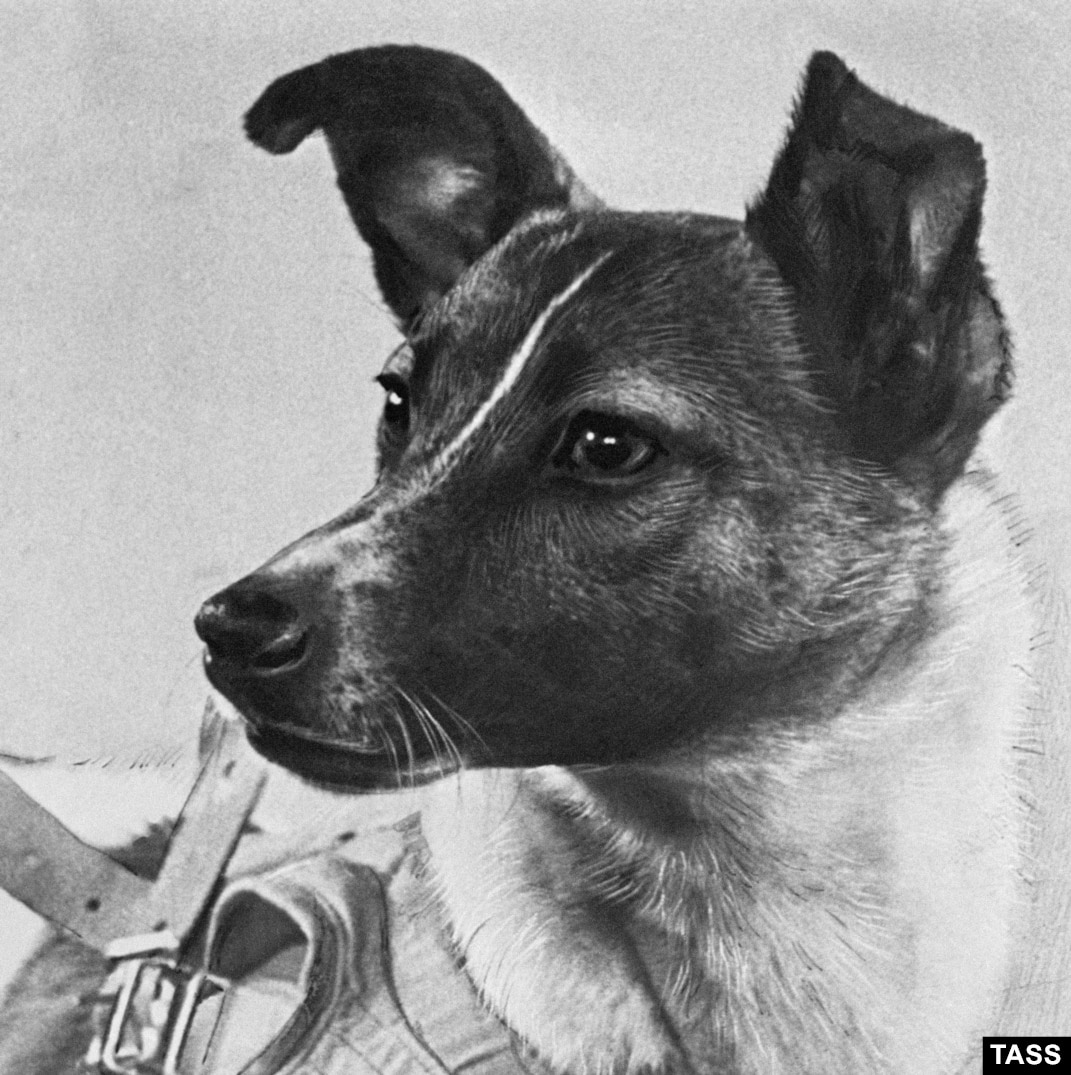
The scientists named her Barker.

She was found wandering the streets of the city and was quite obviously a stray. She was also quite obviously a mutt. Oh, she had some physical characteristics of a Samoyed, and some of a Husky, and there was definitely a bit of Terrier in there as well. Ah, but she was a tiny thing. She weighed only about 12 pounds.

And that’s why it was somewhat comical that such loud barking yelps came from a girl this small. Of course, they had to name her Barker. The best that the scientists could determine, Barker was about three years old. Her ears stood straight up, except at the top tips which folded down. Ah, she was a real cutie.

The scientists liked using stray dogs from the city streets because they felt that those dogs had been conditioned to extremes of temperature and of hunger. Their experiments needed dogs that could withstand both. Now, as an animal lover, I will go on record as being against the use of animals in scientific experiments on principle. However, this was the mid-1950s, and the use of animals in scientific experimentation was commonplace. Sadly, the experiments that were being performed on the street dogs would end up killing them.

One of the scientists who was conducting the experiments developed a soft spot for Barker. He would scratch her ears and whisper to her so that the other scientists could not hear his sweet nothings. He would put his head on hers and quietly say that, in another life, he would love to have her at his house to play with his children, and to watch her grow up with them. In fact, on the evening before the experiment that would lead to her death, he did, indeed, take Barker home. She and the kids had a wonderful time, running and playing throughout the house. Of course, the kids were giggling, and Barker was, well, barking. “She was so charming,“ he would say later. Knowing her fate, the scientist wanted to do something nice for her.

I wish this story had a happier ending. It is true that all stories involving dogs end sadly. When you bring a puppy into your life, the result is going to be heartache because nothing is forever.

The next day, Barker began the experiment that would take her life. And because of that experiment, she would go down in history. Or, in this case, perhaps, up.

You see, Barker is what her name is in English.

You know her better by her Russian name, Laika, and as the first animal from earth to go into space.