
The development of language in history is a large area of academic study. These scholars examine not only how languages come into existence but also why and how. Linguists ask what is it in humans that causes them to seek to communicate with language? Which choices are made in a society when it determines things like grammar and syntax, noun declensions and tenses, alphabets and even types and manner of writing? Since languages have been around for so long, it’s sometimes difficult for language researchers to answer these questions because sources detailing the answers to these types of developmental questions are almost completely non-existent. That’s why what happened in Nicaragua in the 1980s excited language scholars like nothing else in the history of the field: A new language was born, and they got to watch it develop.
Now, to be fair, there are some examples in history of small groups of people, usually family members or often sets of twins, developing a simple “private” language between themselves. The development of these, known academically as cryptophasia or “twin talk,” isn’t usually widely known and is rarely documented, and of course these private languages aren’t shared by a wider audience. However, the language that sprang up in Nicaragua was and is widely used in that country. We should also mention that the creation of languages such as Esperanto, a language created in the late 1800s as an attempt at an international tongue, didn’t occur spontaneously or organically. Esperanto was the brainchild of one man, an ophthalmologist named Zamenhoff, who made up all the rules for the language himself (Esperanto has an estimated 100,000 speakers today). So, the development of that language didn’t happen “in the wild,” so to speak. But the one in Nicaragua did.
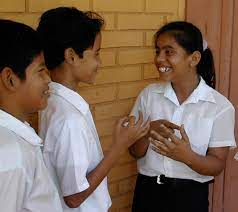
This language sprang up among some children in the Central American nation. As you are probably aware, Nicaragua speaks Spanish as a nation since the area was colonized by Spain and settlers from Spain moved there beginning in the 1500s. But there was a sizeable segment of the nation’s children who could not speak Spanish. And it was among these kids that the new language sprouted and grew. And it happened when the children were first brought together to a special school precisely because they couldn’t speak Spanish. The school, founded in 1977, was the first of its kind in the country. These children, who at first numbered about 100 and had no grasp of Spanish, were so thrilled to find other kids who didn’t speak the national tongue. And they began, completely on their own, to create a language through which they could communicate with each other.
Within five years, the number of kids who attended the school had grown to over 400, and the newcomers were quickly absorbed into and immersed in the new language. Up until that time, many of the children were assumed to have mental disabilities because of their lack of understanding of Spanish. But they rather quickly picked up the new idiom that the other children had created, thus showing that their lack of Spanish understanding had nothing to do with mental ability.
What was interesting was the these kids had been brought to the school specifically to learn Spanish, but they all resisted their instruction. Their teachers and staff began noticing that they were communicating with each other with a language that was completely new and unknown to the teachers. The children were having rapid, animated conversations using their own methods of communicating. The teachers were fascinated. By 1986, the school contacted a leading language scholar from the Massachusetts Institute of Technology (MIT), Dr. Judy Kegl, to come to Nicaragua and study this new language. Dr. Kegl felt as if she had found buried treasure. Here was the perfect laboratory to watch the creation of a language. It would be like an astronomer or astrophysicist witnessing the birth of a new star in real time or a biologist being present at the creation of an entirely new species. Kegl found that the kids had made the choices about the syntax, the declensions, the tenses, and the grammar all on their own. They had established the “rules” for the language organically. They had invented a language.
Thus, the children of this school had created what is today known as Idioma de Señas de Nicaragua or ISN. It is used today by thousands of people like them in the nation who don’t speak Spanish or any native tongue. And you might be wondering what all these people in Nicaragua, all these who now use this new language, ISN, have in common.
It’s that they are all deaf.
 The Rest of the Story