On an International Criminal

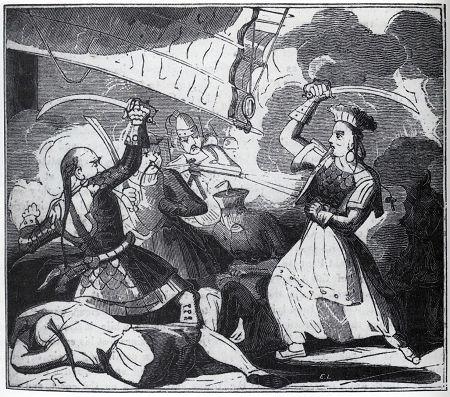
Action films often depict criminal masterminds who control vast armies of minions who carry out their dastardly deeds before succumbing to the pursuit and prosecution of heroes or the police. Believe it or not, that type of thing has historically been more common than you might realize. One such international criminal was known as Zheng Yi Sao, and this criminal operated in the early 1800s in the seas off the coast of China. Yes, Zheng was a pirate but not just any pirate. Zheng was in charge of the largest fleet of pirate ships and a pirate army that totaled over 50,000 men at its most powerful.

Zheng acquired a small group of ships through marriage. From that start, the pirate parlayed the fleet into what it became–the scourge of the China seas. Sailing as far south as the coast of Vietnam and as far north as Korea, no ship or port was safe from the power and prowess of Zheng the pirate. When finding a rival pirate ship or fleet, Zheng would give the pirates the choice of death or joining the growing number of the pirate navy and army. Well, you can imagine that almost all of those other pirates made the decision to join rather than die. So, through cunning and bravery, Zheng spend years pillaging and stealing great amounts of wealth from any ship or city that got in the way.

The pirate conglomerate became known as the Red Flag Fleet because that’s the color of the banner they sailed under. Zheng also created a Pirate Code, a set of laws that the members of the fleet had to abide by. These rules called for specific conduct in war and peace, and the code was closely followed by all who sailed under the fleet’s red banner. One interesting rule was that no women would be purposely harmed by anyone in the fleet. Harming a woman was punishable by death.

The Chinese government sent an armada to stop Zheng and the Red Flag Fleet, but, easily outsmarting the Chinese admiral in charge of the government’s navy, Zheng lured the government ships into a trap and destroyed them. Then, to confuse the government officials, Zheng split the fleet into three parts. Each part was sent on pirate raids in different directions, with Zheng taking direct command of one of the three prongs. The government was overwhelmed. They didn’t know which of the three groups was actually Zheng, and they were tricked into doing nothing. Was this another trick? Which prong–if any–was the one led by Zheng? The government was helpless. And, at this point, they asked for help from the international community.

Portugal, by this time in history, controlled the Chinese port of Macao. And China, desperate to stop Zheng’s piracy, asked Portugal’s fleet for help. A combined Sino-Portuguese fleet managed to trap several of Zheng’s ships in a harbor for a time, but the pirates managed to fight their way out. The Portuguese were impressed by the pirates’ bravery and ability. And they felt challenged by the pirates’ victory over their ships. So, they, in turn, asked the British Navy for help in corralling the Red Flag Fleet. Britain was delighted to help, and that proved to be the beginning of the end of Zheng’s power. You see, the British had the best-equipped ships in the world at that time. The powerful but small Carronade, a Scottish cannon, was the standard armament on the British ships, and it could wreak havoc on the thinly wooden-clad Chinese ships. Zheng knew that the gig was up.

Using an envoy, Zheng sent a message to the Chinese government. The pirate fleet would be disbanded, all ships and crews would be put under the command of the authorities if–if–Zheng could keep all the pirate loot gained up to that point and would be given a complete amnesty. And that’s basically what happened. The Red Flag Fleet, largely undefeated in battle, was disbanded with a simple agreement. Zheng took the money from the years of piracy and moved to Guangdong, China. There, the former pirate made even more money running a large gambling house and brothel. Zheng died wealthy and happy at the age of 69.

And, in the years before that death, people from all over the world would come to Zheng’s casino and whore house for a chance to meet the world’s most famous female criminal mastermind.
On a Translator

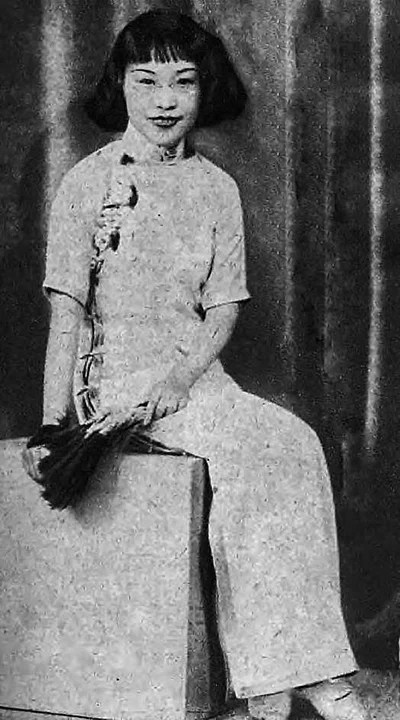
Chen Xiaocui (A reminder to the readers in the west that Chen is the family name) was a Chinese woman who worked as a translator and made a great reputation in China and around the world as a poet. She lived from 1902 to 1967, a period that saw great upheaval in not only Chinese society but also in the world. Born in a rural area to what would now be considered a somewhat middle class family of literary people, Xiaocui and her family moved to Shanghai when she was quite young. Her father, an author in his own right, opened a publishing company there in the days before the Second World War.

Xiaocui had a penchant for language from an early age. Her mother was responsible for much of her schooling, but the poetry, the poetry was a gift. Her literary father steered her into studying the classical Chinese poets and also introduced her to the poets that were famous from around the world. Her early published poems helped support her family in the years before her marriage in 1927 to a son of a high-ranking administrator in the Republic of China government. The marriage produced a daughter, and then the couple separated. It seems that Xiaocui was more dedicated to her work than to the relationship, and that makes sense given her innate talent in language and poetry. She took up painting as well, using the traditional Chinese methods to produce lovely works that were highly praised.

Throughout her life, Xiaocui also helped her father’s publishing business. She became his chief translator in the business. The firm’s name was Sanren Gongsi, translated as Three People because the firm really was her father, her older brother, and herself. Within a few years, Xiaocui managed to produce translations for over 70 novels of famous western authors into Chinese. The most famous of these translations and the ones that produced the most income for Three People were the ones that made up the entire canon of Sir Arthur Conan Doyle’s Sherlock Holmes stories. They became bestsellers in China because of her translation, and that helped the firm become somewhat successful.

In the years before the war, she spearheaded efforts to promote the writing of poetry and the painting of works both in classical Chinese styles within the Chinese school system. It was her belief that if children could be shown poetry at a young age, as she had been done, that it would nourish their imaginations and intellectual growth. She also worked with women’s artists and writers groups in the 1930s to promote more of the visual and literary arts among Chinese women. She taught in universities, urging her young women students to work on crafting their voices in art and literature. After the war ended and the Communists took over in China, Xiaocui had a chance to leave the country for Taiwan, but she chose to remain. He daughter managed to get out of China in the 1950s and make it to France where she, too, became a painter of some renown.

As you might imagine, someone working to create intellectual curiosity through artistic expression in Communist China would invariably run afoul of the authorities, and that’s exactly what happened to Xiaocui. She was removed from her teaching posts and lost her house. Realizing that her situation was growing dangerous, she tried to escape the country, but she was caught and tortured by the state police. Allowed to go free temporarily, she decided that it was better to take her own life rather than allow the communists to take it from her. Her poetry is only now being appreciated more and more in the west, almost sixty years after her death. What we forget about Chen Xiaocui is that she was such a prodigy. Her ability at such a young age can be seen not only in her early poems and paintings but also in those translations she did.

Remember those over fifty Sherlock Holmes stories she translated so well from English into Chinese?

You see, she translated them before she was 15.

On a Trade Good

Of the thousands of lost and forgotten wars over the centuries of humankind, only a few of them have had an impact on the modern world as much as he one that took place between Britain and China in the 1840s. While we don’t think about China as being a powerful nation until the past 70 years or so, the fact is that the Chinese Empire was a powerful regional presence in Asia. Then, economic and social upheaval caused the country to become weak at the beginning of the 20th century. Also, in part, the spread of European colonialism carved up the nation’s sphere of influence.

European trade money had flowed into China for centuries, giving that government the ability to raise large armies, navies, and control a large area of land in Asia. Japan was really their only rival, and that was mostly later in the 19th century. But back to the war I mentioned at the start. In exchange for the Europeans’ silver, China sent tea, porcelain, silk, and other desirable trade goods to Britain. But the largest British import from China became the subject of an export ban by the Chinese government.

This trade ban outraged Britain so. The anger against China banning this particular product became so great that voices in Britain’s Parliament and across the country called for a declaration of war to force China to once again sell them the trade good. For China’s part, they felt the product was detrimental to their society. They begged Britain to reconsider. China had even sent a letter to the newly-enthroned Queen Victoria, asking her to please allow them to no longer sell this trade good. Young Victoria didn’t even bother to read the letter.

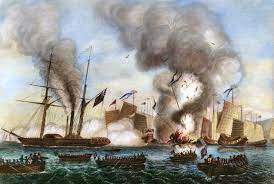
British desire for the product was so great that British sailors began violent confrontations with Chinese merchants in Chinese ports when they realized that the item was no longer for sale. And, so, Britain decided to go to war to force another country to sell them a product that the producing country did not wish to sell. And, of course, despite the money that China had, the technological advantages of the British Carronades (short-nosed naval guns) on their war ships made short work of the Chinese fleet.

China was forced to sign a treaty in 1842 conceding that they would once again allow Britain to purchase the trade good. In addition, Britain was granted control over five harbors on the Chinese coast, including Shanghai. The jewel of the treaty that ended the war was, of course, Hong Kong. Britain was granted absolute control over the city. For China to relinquish sovereignty over their own port cities–that’s how overwhelming the British victory was and how strong Britain’s desire for this trade good was..

And so, Britain followed the Golden Rule: They who have the gold make the rules. The British corollary of that is they who rule the waves, wave the rules. And Britain did both. Of course, you know what the product was, the trade good that Britain was so desperate to get their hands on that they were willing to go to war over it, the product that allowed them to control important coastal cities in China up until the past few years, right?

Opium.

On an Import to China

We hear talk often of the trade deficit with Asian markets as cheaply made products from that continent, specifically from the nation of China, crowd out the more expensively produced western goods in stores on this side of the globe. Western products get re-imagined and re-engineered over there because, in part, of cheaper labor, and then consumers in the west choose the cheaper product. And who can blame them? But here’s a story about an import to China that won’t and can’t be undercut and sold back to the west.

It involves a Canadian man named J. Howard Crocker. Let’s call him Howard. He worked in the early 1900s for an international organization that assigned him to the (at that time British-held) Chinese city of Shanghai. The organization shipped him off to China in 1911 with a farewell banquet and its best wishes for success in his new venture. So, even though he knew little about China and had worries that he would fit in over there, Howard agreed to go.

When he arrived, Howard found the organization’s organization in shambles. Offices in several Chinese cities didn’t coordinate with each other. There was overlapping territory, lack of coverage in other places where should be some, and almost zero cooperation or even communication going on between the offices. So, after being given the go-ahead from the home office, Howard set about re-organizing things. His efforts paid off pretty quickly. Within a short time, things in the China branch were humming along. Howard managed to bring people together. He borrowed a phrase from a fellow Canadian and touted the slogan, “The Joy of Effort” to represent doing your best in a job and enjoying the results.

But then, in 1912, China experienced a revolution. The emperor (and the power behind him) was toppled and replaced with a president. Rather than meeting opposition from the new regime, Howard found that China’s new leaders welcomed his group and promoted it. That led Howard to begin a wide ranging campaign of building offices and facilities throughout China in an effort to spread the goals of his organization. And rather than meeting opposition to what he was doing, the Chinese people embraced it eagerly.

By 1915, Howard realized that ultimate success in China depended not on bringing Canadian or other foreigners to China but rather to train native Chinese people to work for his group. The locals in turn would train other locals, and so on and so on. Soon, this thing was found in every city and hamlet in the nation, and it is still there today. In fact, China excels at it.

Now, this was fairly radical for Howard’s time, given that the western mentality of colonialism remained strong in most western mindsets. But Howard found success in training locals to take over the jobs that had been held by westerners. Now, to be fair, Howard was sort of forced into this because World War I took many of his western workers away from China, but the result was that the local people his group trained spread what he and his group had brought with them throughout the country much better than Howard ever thought his group could.

Eventually, because the Canadian war effort needed his organizational skills, Howard was recalled to Canada, but what he and his organization left behind in China is now today one of that nation’s greatest sources of pride. When J. Howard Crocker died in 1959, he had no idea that the thing he had introduced into China would make it one of the world’s leaders in that area.

What was it that Howard brought to China and in which it is now one of the world leaders in? Well, the organization Howard worked for was the International Organization of the YMCA, and the thing he gave to China, the thing that they’re one of the world’s best in is volleyball.