On a New American

Some of us are born to citizenship, while others of us choose the nation we come to call home. My grandfather (my father’s father) came to the United States as a teenager in 1907 from Greece. His eventual wife’s family left Denmark only a few years before that to move to New York City. My own son also chose America over a quarter of a century ago to make America his home as well. We are a nation of immigrants. I’m still gobsmacked that people can do that even though my family is rife with immigrants. Imagine emigrating in the late 1800s or early 1900s from Europe to the US, coming to a new place where you know almost no one, didn’t speak the language, and had no job or place to live; how does one do that? The fear of the unknown–as scary as that can be–has to be less than the fear of what one is leaving behind. Yet, that’s what over 12 million people did, first entering the United States through the immigration processing center known as Ellis Island in New York harbor.

One such family was the Beilins. They came from what is now the Siberian steppes of Czarist Russia in 1893. Moses, the dad, an itinerant cantor, and Lena, his wife, and the mother of eight children, came to the US like many other Jewish families did because their lives had simply become untenable in their native land. Isn’t that why many people emigrate? They were processed at Ellis Island, the children put in a pen, separated from their parents, until it could be determined that they had no infectious diseases and were deemed fit to enter. Moses managed to find a couple of rooms in a dank, moldy basement in New York for the family to live in. While Lena worked to make the dark, musty place a home, Moses found basic, honest work in a kosher butcher shop. The children were expected to contribute to the household income, even some of those who were under the age of ten. For example, young Israel, when he reached the age of 8, began selling newspapers to earn a few pennies that would buy food for the family. His sisters wrapped cigars in a factory. One of the brothers made shirts. Every evening, the family would come home deposit their meager earnings into the lap of Lena’s apron as she sat at the small kitchen table.

But in those days before antibiotics, illnesses we can fight off fairly easily today could devastate a family. When Israel (the family called him Izzy) was 13, Moses died. By that time, Izzy had decided that he wanted to be a singer. He had inherited his deceased father’s musical ear, and he managed to get a job as a singing waiter. From that humble start, he began to work with musicians to write songs that other waiters would sing as they served. In an effort to both continue to support the family and take away his mouth to feed, Izzy moved to a boarding room, a “flop house” shared with several other young, immigrant youths. He would later describe the living conditions as something out of a Dickens novel. Izzy also made some coins being an early 20th Century version of a street busker, singing to passersby for a few pennies when he wasn’t at this regular job. And, at other times, Izzy taught himself to play piano after the restaurant and bar he worked at had closed. He never took a lesson, but he learned how to put together a song that people liked. Simple songs, he would say, songs that people could relate to.

And you know those songs well. In fact, Izzy’s songbook makes up much of the modern American canon of national melodies. Songs like Alexander’s Ragtime Band (his first hit), White Christmas, Puttin’ on the Ritz, Cheek to Cheek, Easter Parade, Blue Skies, There’s No Business Like Show Business, God Bless America, and dozens more made him a household name.

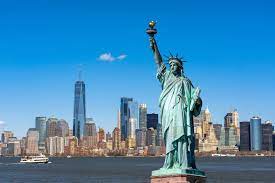
Like my grandfather, grandmother, and son, Izzy changed his name when he came to America. It’s a place for a fresh start, a new beginning, and the chance that, if you work hard, you can be anything you want to be. That has been America’s genius from the beginning, to a large extent. It’s not that the Statue of Liberty, which immigrants to Ellis Island would pass as they entered New York Harbor, represents freedom–even though it does.

No, to immigrants like my grandparents, my son, and songwriter Irving “Izzy” Berlin, Lady Liberty represented something more: Opportunity.

On Some Cordial Telegrams

Historians are lucky to have access to letters and telegrams that were sent between people on both sides of the conflict we know as World War I. This year marks the 115th anniversary of the end of that horrendous conflict. Let’s look at some of the language used by two men who exchanged telegrams at the start of the war, one on the Russian side and one on the German side. Please know as you read these messages that the men are first cousins, and they know each other well and remember the other one with great affection. Also, know that the telegrams were sent in English because their family had its origins in the United Kingdom.

Austria-Hungary had declared war on Serbia on July 28, 1914, and the world stood by and watched as the great powers like England, France, German, and Russia decided whether or not to join the conflict and to honor treaties made with the involved parties. The decades leading up to the war had seen these countries (and others) become involved in massive arms production. War seemed inevitable. And that’s the context of these affectionate messages between the cousins.

The first telegram, sent by the German cousin on July 29th, pointed out that they, the two of them, had no quarrel between them. He spoke of “the hearty and tender friendship which binds us both from long ago with firm ties.” To these cousins, it seems, the idea of war appeared remote and almost unthinkable. There had been family gatherings over the years where the entire group had come together in happier times such as weddings, and sadder occasions like funerals–the typical times when families celebrate the future and remember the past. So, the pair of correspondents had a long past together despite living in different countries. They even bore a familial resemblance to the other.

The Russian cousin replied and expressed his “thanks for your telegram conciliatory and friendly.” The telegram exchange continued, the cousins in the rival nations almost incredulous that the war machines of each country would contemplate war against the other. The German’s next message included a reference to one of their common ancestors: “My friendship for you, transmitted to me by my grandfather on his deathbed, has always been sacred to me.”

Yet, as we know, the machines of war marched towards what would become an absolute slaughter. Both Germany and Russia would see major revolutions result from the war, with the removal of both the Kaiser in Germany and the Czar in Russia. And the cousins seemed to sense that any impending war would bring about such disasters upon their respective nations. The Russian said, “It may all end peacefully,” but he expressed doubts at the same time, saying while “peace [is] dear to our hearts…mobilization (of Russia’s vast army) seems inevitable.” The German expressed the same sentiments. He stated that only “immediate and clear and unmistakable” actions from both governments were needed, but he expressed doubts that those actions would be forthcoming.

And the cousins were right. Germany declared war on Russia on August 1, 1914. The resulting war cost over 20,000,000 lives lost and about the same number wounded. The Austrian, German, Russian, and Ottoman empires were broken up. And today, we remember those who fought in this Great War on all sides, a war that, as the cousins expressed, didn’t need to happen if only the leaders of both sides had been better at talking to one another. If only they had the feelings of love and affection that these two cousins felt.

The problem was, these telegrams between the cousins–Kaiser Wilhelm of Germany and Czar Nicholas II of Russia–still didn’t prevent war from happening.

On a Hot Dog Stand

Would you believe me if I told you that, during the Cold War, the Soviet Union had nuclear weapons targeting a simple hotdog stand? Apparently, that’s true. Now, the location of the stand is key, here, as you can imagine. It was sited in a courtyard, as you probably suspect, a courtyard located in the heart of the United States government near Washington DC. Now, to be sure, it was a rather large hotdog stand, but a hotdog stand nonetheless.

But the Soviets were convinced that the hotdog stand was either a cover for a much more important building beneath it, sort of a bunker or some kind of operations center, or it was a top-secret planning headquarters for the US military. Some Russian analysts believed that the structure was at the heart of the US military establishment. As a result, Russia spent, millions of rubles and countless man hours trying to get close enough to this hotdog stand so they could figure out what was going on inside the small building, possibly underneath it. They never succeeded in finding out the truth.

So, just to be sure, that’s why they had not one, but two of the nuclear warheads targeting this  Hot dog sand. Now, what the Soviets didn’t know and couldn’t confirm was that this particular hotdog stand was well, really only a hotdog stand. It wasn’t masquerading as something else. It wasn’t a front for anything. And you might be wondering why the Soviets would target this particular and seemingly innocent hotdog stand , instead of one of the countless other hotdog stands in the US. And the reason is because of the clientele.

You see, the Soviets were able to easily ascertain that most of the people who went to get hotdogs there were people associated with the upper echelon of the US military. That was curious to the Russians. It’s not that the Soviets were paranoid, although they were. Of course, perhaps these military members were simply stopping there to get a hotdog because it was lunch time, and they were hungry. But the Soviets didn’t see it that way. It’s just that if, in the spy game, you see behavior being repeated, that indicates a trend or a “tell”, and a trend can be a tip off for something deeper, something that requires more analysis. And the stakes of the Cold War were simply too high for the Soviets to ignore this trend.

Interestingly, this hotdog stand outlived the Soviet Union. It was torn down in 2006, and a new structure was put in its place. I wish this story had a surprise ending for you. But it really doesn’t. The Soviets were wrong. It was, ultimately, simply a hotdog stand.

Of course, the courtyard in which the hotdog stand stood was located in the exact center of the Pentagon.

On a Business Deal

During the Cold War, one of the not-so-secret secrets was that, despite embargoes on many goods in the Soviet Union, western companies tried desperately to enter the Soviet market. And western consumer goods were in high demand despite the communist rhetoric about the evils of capitalism. One American corporation that desperately desired to enter the Russian market was PepsiCo, the food and soft drink conglomerate.

Long the number two cola company behind Coca-Cola, Pepsi knew that if they could somehow leverage an entre into the USSR, the fiscal reward would be substantial. Besides, there would be the tremendous free publicity that such a news event would generate for the company as the first and only American company in the communist country. Pepsi, after tense and lengthy negotiations, finally was able to enter the USSR market in 1972. Within a very short period, the company was making upwards of half a billion dollars a year in Russia; the drink was incredibly popular (and had the cache of being a “forbidden” decadent western company) with no rival, giving Pepsi a monopoly in the market.

But there was a major catch. Rubles, the Russian currency, was not tradable or usable in the US or most western banks, especially in the amounts Pepsi was making them in Russia. Besides, the country didn’t allow their currency to leave the USSR in such large amounts. So, another round of fierce negotiations followed, and a comprise of sorts was reached. Where there’s money to be made, it is interesting how creative solutions can be found. And that’s what happened here. The leadership of the USSR offered to pay Pepsi not in rubles but, rather in trade goods. Pepsi could then take the trade goods, sell them in the west, and take the profits. While the extra step was not ideal, the amount of money the company was making (and would continue to make as the monopoly) proved to be more important than having to basically become a middle man for Russian trade goods.

The first round of Russian goods to be swapped for Pepsi products was, you guessed it, vodka. And that worked for a while; Pepsi simply opened a liquor branch of the company and sold the vodka in the US and other western nations. This worked for a while, but then the United States and its allies began a boycott of all Soviet goods because of the Russian continued invasion and occupation of Afghanistan in the 1980s. Pepsi then had no way of turning their soda profits into raw cash anymore. The company then approached the Soviet hierarchy and asked if they had any other products that they could trade that Pepsi could then turn and sell to recoup their money.

And, of course, the Soviets did. And they traded these products throughout the 1980s and early ’90s, and Pepsi managed to turn the trade goods into cash…eventually. By the way, Russia is still PepsiCo’s second largest market after the United States. Of course, today, with the collapse of the Soviet Union and the communist system, Pepsi is paid in cash. But, for a time, because of the unusual circumstances, the company received metal that they, in turn, sold as scrap. And that metal was in the form of old Soviet warships and submarines.

As a result, for a time in the early 1990s, PepsiCo had the 6th largest navy in the world.

On a Real Estate Deal

Bill’s neighbor had dangled the deal several years before. The property offered wasn’t quite next door to where Bill lived, but it was close. The land, from what Bill could tell, offered great views and had some ocean views. But Bill had other business that kept him from pursing the offer for some years. Finally, the other business settled, Bill turned again to the neighbor to see if the offer still stood.

Sure enough, the representative for the seller, one Mr. Stoeckl, said that, yes, the offer still stood. In fact, the price had come down because the neighbor was eager to sell. The neighbor was cash-strapped due to some other issues, and needed to get rid of the property as soon as possible. Bill, smelling a deal, moved to purchase the land.

Bill reached an agreement with Stoeckl, and the real estate deal was approved in April. By late May, the funds were made available and the paperwork was signed. Although the actual deed wasn’t returned until October, Bill was extremely happy with the purchase. But that’s when other people started to ridicule the purchase that Bill had worked.

People who heard about the real estate deal Bill had made began by saying that the land was actually unusable, even if it were pretty. They asked Bill if he had done his due diligence before the deal was struck. He had to answer that, no, he made the sale sight unseen. That made Bill’s enemies–and many of his friends–roll their eyes. Why would he buy land that had no value and that he had never laid eyes on? What would the land be used for, they asked. Bill answered with the answer most people have when buying land: They ain’t making any more of it. Still, he was laughed at and belittled for striking this real estate deal.

You might be wondering why Bill’s acquaintances would have any business minding his business. Why would they care? Well, you see, Bill actually used their money to make the buy. And when you spend over $7,000,000 of other people’s money on land that seemed to have no value, then, yeah; people would naturally be upset. It’s why they ridiculed Bill’s deal as “Seward’s Folly.” You see, William Seward, the United States Secretary of State, thought that buying the land from Russia in 1867 was actually a wise investment.

You know the land as Alaska.

On the End of an Empire

Empires come and go. They have done so since the beginning of history. It is the way of the world, isn’t it? The mighty Assyrian, Egyptian, Babylonian, Persian, Greek, Roman, Mongol, Turk, Spanish, French, and English empires all saw the sun set on them. Those who feel that this fate could not possibly happen to their empire are in for a rude historical awakening.

Such a fate befell the empire of the Soviet Union, the world’s largest at the time. As I write this, we have passed the 30 year anniversary of the dissolution of that empire. The story began in August of 1991…well, it actually began much earlier when Mikhail Gorbachev came into power in the USSR and introduced openness and restructuring to Soviet society. The communist party structure that held power was shaken to its core as Gorby’s reforms began to rumble through the 16 republics that made up the empire. The leader wanted to bring true democracy (or, at least, a semblance of it) to the people and those lands. Opposing the communist bureaucratic power structure were grass-roots calls for reform and a desire on the part of many of the republics (specifically the Baltic states of Estonia, Latvia, and Lithuania) for independence from the Soviet state.

In August, 1991, as most Europeans did, Gorbachev went on vacation. That’s when the coup plotters decided to act. The problem was that both sides seemed to choose that moment when the leader was out of town to make their moves. The hard-core communists sought to overthrow Gorbachev and roll back his progressive agenda. The change agents and anti-Soviet groups also decided that it was the perfect time to declare their independence from the USSR. A third party, Moscow Mayor Boris Yeltsin, also stepped in when both of these opposite parties struck.

Meanwhile, Vassily* continued his job at the Kremlin, the Soviet government building complex, because no one told him not to do so. Every day, he made sure that the task he was assigned was carried out. His salary was still paid, so, he really didn’t care what the government was. He had one job, he took it seriously, and he did it well, day in and day out. Oh, when he arrived home during that hot, tumultuous August, he watched the official government news channel as everyone did, but, again, none of that affected his job. Common people like Vassily and his family are often only pawns in the rises and falls of empires, and this case was no exception.

And no one told him to stop what he was doing. Throughout that autumn, when the republics began to leave the Soviet Union, no one advised Vassily to not come to work or to change his job in any way. No one seemed to know what to tell him to do differently. When Yeltsin climbed on the tanks and spoke to the people of Moscow, he kept on with his work. Day in, day out. When Gorbachev returned to the capital and to a crumbling empire, Vassily still did his job.

Finally, in December, 1991, Gorbachev realized that he was the leader of an empire that no longer existed, and he resigned as the last leader of the once-mighty Soviet Union–a gesture that seemed completely empty in one sense. That is when Vassily’s job changed in one major aspect.

That night, December 25, 1991, as the Moscow church bells tolled the end of the Soviet Union, Vassily Pavlichenko climbed the stairs, as he did every day, to the rooftop of the Kremlin, and, for the last time, he lowered the red flag of the Soviet Union that had flown there since 1917.

In its place, he raised the white, blue, and red flag of the nation of Russia.

*Not his real name

On an Influential Minister

Greg took his role seriously. His country’s power brokers listened to him, hung on his every word, made major decisions based on his wise advice and sage counsel. Greg’s time in the halls of power saw his nation suffer the agony of political, economic, and even military upheaval. So, his inputs and opinions about the major issues of the day were invaluable to those who ruled his land.

Today, Americans do not think it odd that religious leaders such as Greg would be considered as an important advisor to those who hold political power. We are used to such things as a National Day of Prayer and presidents speaking before religious groups. Often, minsters, rabbis, and pastors are called to the Oval Office to discuss the issues of the day and how morality applies to them.

That’s the type of role Greg filled for his nation. The major difference was that Greg’s voice became the only one the leaders listened to. His influence was seen in some circles of government as being too large, his power over the decisions of government too great. Yet, Greg continued to have the ear of those who held the reins of power.

Those who knew Greg marveled at his rise to such a position. Born to a poor farming family in a rural part of the country, his mother had seven other children, but only Greg lived to adulthood. His youth was misspent and saw him get in trouble with the local constabulary for such misdemeanors as petty thefts and drunkenness. His schooling was spotty at best. He finally settled down somewhat and married a farmer’s daughter and began a family, taking on the farmer life for himself.

Stories about his entry into the ministry vary. For whatever reason, he decided to become a pastor. After some training in a seminary, Greg returned from his training a changed man. He had sworn off alcohol, became strict in a vegetarian diet, and began preaching a message of personal responsibility and strict abstinence from all worldly passions. The message resonated in part because of Greg’s personality.

Those who heard him speak became taken with his passion, his drive. It was said that Greg could cast a spell over his church audience. His local congregation of followers grew and grew. He began to be someone people (and many rich people) came to for advice and counsel. And Greg’s sessions proved to be fruitful to those who came to him. It was only a matter of time before those holding  political power sought him out for not only his advice but also for the reputation he had garnered in his growing ministerial work.

One day, the leader of the government asked Greg for a favor. Would the minister please pray for his youngest child, his son, who had a congenital disease? Absolutely, Greg said. The prayer seemed to provide the young man some relief. The family, especially the young man’s mother, ever so grateful, brought Greg into their inner circle as a healer, a holy person, and someone in whom the powerful family placed their entire—and, it turns out, misplaced—trust.  

You know how this story ends. That powerful family—the family of Russian Czar Nicholas II—relied on the peasant preacher Gregori Rasputin more than any other advisor. And they did so as their empire and eventually their own lives crumbled around them.