
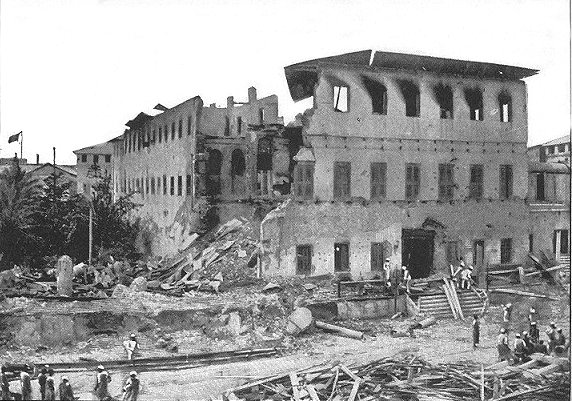
Zanzibar. You have no idea where it is, right? Would you believe me if I said it was in northeast Asia, off the coast of Korea? See? You don’t even know if that’s true. The truth is that Zanzibar is off the coast of southeast Africa, just off shore from Tanzania, and it is a semi-autonomous province of that nation. For real. The purpose of this little joke is that Zanzibar isn’t on anyone’s radar, so why would Britain go to war with Zanzibar in 1896? Well, it seems that wars during the Victorian Era was what Britain did. To be somewhat fair, the archipelago was on one of Britain’s shipping lanes from Suez down the east coast of Africa to Britain’s colonies in the southern part of the continent.
While Britain didn’t officially colonize or take over Zanzibar, it did determine who ruled the small nation. And, when the hand-picked ruler of Zanzibar died in 1896, a ruler emerged in the country that wasn’t as friendly to British interests as the one they themselves had chosen. According to a deal of “protection” between Zanzibar and Britain, any potential Sultan of Zanzibar was required to receive British approval. The new Sultan, the nephew of the previous ruler, didn’t do that. And, so, the British representative in Zanzibar issued an ultimatum: Relinquish power or the British would force him out. Well, the new Sultan called Britain’s bluff. He sent a message saying, in effect, you guys wouldn’t dare remove me.
Apparently, this man hadn’t learned the rule that he who rules the waves waves the rules. And, in the late 1890s, Britain’s navy was the world’s most powerful. It was British policy that their navy would be the size of the next two navies in the world combined in an effort to protect Britain’s vast empire and insure the flow of trade goods to and from Britain. And, when the new Sultan of Zanzibar rebuffed Britain’s demands to step down from power, the Royal Navy sent ships to deal with the situation. Britain, the world’s largest empire at the time, declared war on tiny Zanzibar.
The war started with the naval vessels bombarding the Sultan’s palace. Several members of the Sultan’s household were killed, and the mostly wooden structure caught fire. The fire spread quickly, and the palace was largely destroyed. The fire reached a cache of cannonballs and gunpowder, and the ammo dump exploded, thereby almost completely eliminating the Zanzibarian supply of ordinance. Meanwhile, the only ship in Zanzibar’s navy, a retired British ship gifted to the previous Sultan, tried to fire on the British ships, but it was quickly sunk by a British salvo in the shallow harbor, its top masts still sticking out of the water for several months afterward. The incredibly accurate and experienced British ships used their naval superiority to quickly disable the stationary guns Zanzibar had aimed at the harbor where the British ships lay.
Needless to say, the British won what is now called the Anglo-Zanzibar War. The Sultan was whisked away from the scene by the German consulate to the coast of what was then the German colony of Tanzania. Britain quickly installed a Sultan that they approved and one who would continue the mutually beneficial relationship (well, more beneficial to Britain, but still). The British rebuilt the royal residence into a better and more stable building. Order was restored.
And the Anglo-Zanzibar War, lasting all of 38 minutes, is known as the shortest war in history.

 The Rest of the Story