On a Bus Rider

You know this story.

A young Black woman in Montgomery, Alabama, in 1955, refused to give up her seat on a public bus and was arrested for her refusal. But there’s much more to her story than you may realize.

You see, we sometimes forget that the United States was a racially segregated nation within living memory. I have a memory from when I was about 4 years old of going into the “wrong” restroom at a bus station–I went into the “colored” restroom and was gently escorted out and shown the “mens” room by a nice person inside. Black Americans simply did not enjoy the same rights as White Americans. One significant but overlooked area in which this was true was in where Blacks were allowed to sit on public transportation. The laws in Montgomery, a city only about 4 hours south of where I grew up, said that Black riders could sit anywhere they wished–until the front seats were needed by White citizens. That was the law and it was enforced. So, if the bus were starting to get full, and a White person boarded, Black citizens had to get out of their seats and move to the back of the bus so the White person could sit.

And that’s what this young Black woman was fighting against when she took a stand in March of 1955 and decided she wasn’t going to move, that she had the same right to the seat as any other citizen of Alabama and the United States. The police were called, and she was arrested for violating the law. Well, the truth of the matter is that is what happened, and it’s also not what happened.

You see, the decision to test the law was made by the National Association for the Advancement of Colored People (NAACP). In order for the unjust law to be challenged, there had to be a court case. And, the way you achieved standing (the right to have a case tried) was to have a reason for being in court in the first place–the issue has to affect that person. And the way a person can show that the law had a negative impact on them was to be arrested and have the case heard. And that’s what happened.

Except this story ends differently that you might think. You see, the young woman who got arrested in March of 1955 for not relinquishing her seat to a White person was not quite what the NAACP was looking for in a sympathetic defendant in court and in the court of public opinion. The attorneys for the group felt strongly that she was wrong for the test case on several counts. First of all, she was single and pregnant at a time when that situation still caused a negative reaction by the public at large. Secondly, she had extremely dark skin, and that was off-putting to many White people. Finally, she was only 15. So, despite the injustice she suffered, Claudette Colvin’s case wasn’t taken up by the NAACP.

It would be 9 months later before a more suitable candidate for the lawsuit, Rosa Parks, would be arrested for the same thing.
On a Nice Woman

Louise was nice. Everyone said so. In 1957, facing increasing difficulty finding work in Alabama, Louise accepted an invitation from her brother’s family to move to Detroit, Michigan, and find work there. Jobs were plentiful, her brother said, and someone of her disposition and abilities (she had decent schooling) would have no trouble finding work. So, that’s what Louise did.

Now, you should know that Louise was African-American. Detroit, she thought, would also offer a less divided, less segregated society than the Alabama of the 1950s was. Sadly, Louise found out that Detroit was almost equally as racist and segregated as Alabama had been. For example, Louise experienced discrimination when it came to searching for adequate housing in metropolitan Detroit. On the other hand, her brother had been correct; Louise found work as a secretary and receptionist in the Detroit office of United States Congressman John Conyers, one of the first black officeholders from Michigan. It would be a position Louise held until she retired in 1988.

Even during her initial interaction with her boss, Conyers noticed one thing right off the bat about Louise, and it’s something we have already pointed out. She was simply so nice. “You treated her with respect,” the congressman said once, “because she was so calm, so serene, so special.” Louise was often the first point of contact for people reaching out to their congressional delegate, and she took every issue, every question, every appeal personally and seriously. You know that if Louise had her attention on your issue, that she would see to it that it would reach a conclusion that satisfied you.

It was her quiet way, her nicety, that made people open up to her and, well, want to help her any way they could. You knew your issue would be resolved when you brought it to Louise. In her role as Conyers’s spokesperson in the community, Louise visited schools, hospitals, nursing homes, low-income housing communities, jails, and churches, working in her own quiet way to affect change in the way people in that congressional district (and beyond) were treated.

All the while she worked long hours on other people’s behalf, Louise managed to nurse a husband with cancer and a mother with cancer and dementia until both passed away. She herself suffered health issues that she kept quiet and private, working through pain because, as she insisted, people were counting on her voice in carrying issues and situations before Congressman Conyers. She was also attacked by a robber in her own home in retirement, but in court she advocated for leniency for the robber. Who does that?

Someone who was nice.

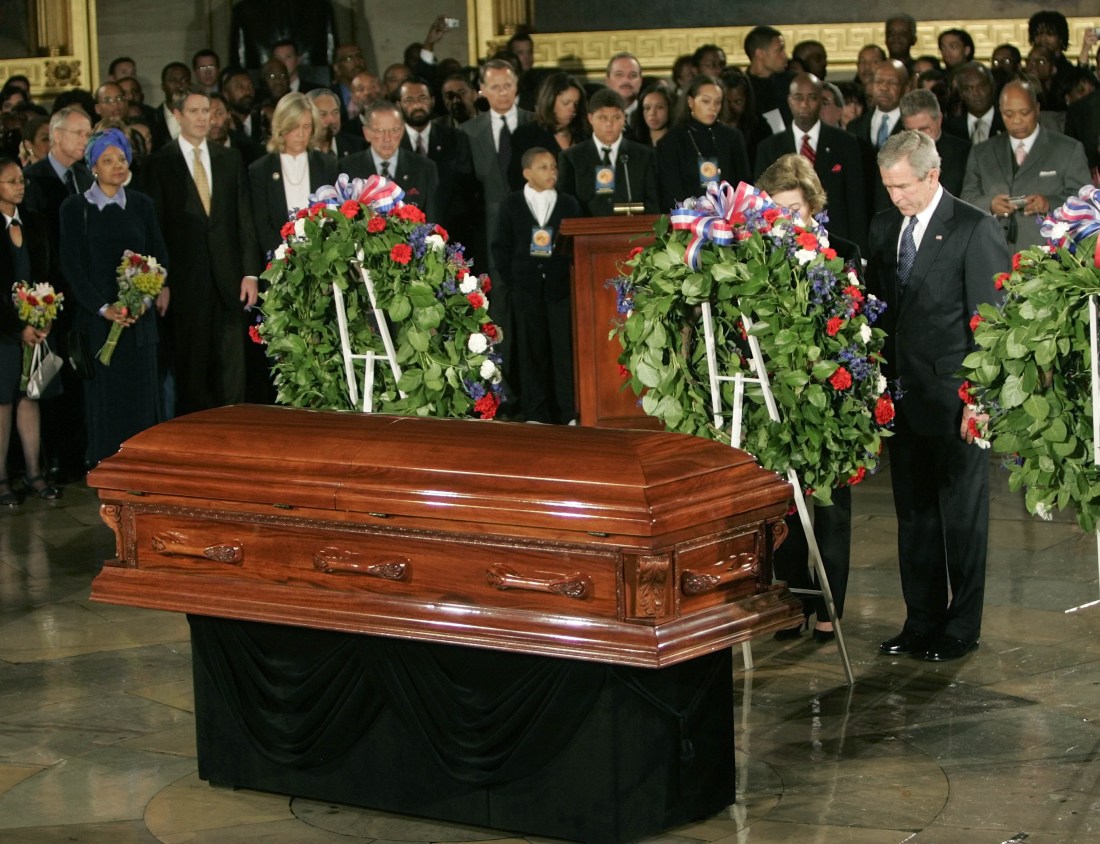
When Louise passed away in 2005, her funeral was well attended despite the fact that it wasn’t held in Detroit nor even in her old home of Alabama. Louise’s funeral was held in Washington, D.C., and she remains only non-officeholder to have her body lie in state in the United States Capitol Rotunda. But this unique honor wasn’t because Louise was nice.

It’s because you know her better by her first name, Rosa.

Rosa Parks.