On An American

This blog has written several stories about the American Civil War, and several of those stories have pertained to the surrender of the Confederate Army of Northern Virginia to the Union’s Army of the Potomac in April of 1865. General Lee meet General Grant in the parlor of Elmer McLean’s house at the crossroads of Appomattox in Virginia, and the two men signed the papers that effectively ended that bloody conflict.

Here is another story about that momentous event.

While we’ve talked some about the two commanders in the room that day, we haven’t really looked at the others who were there in Elmer McLean’s parlor early that afternoon in April. Colonel Charles Marshall, a relative of both the former Supreme Court Chief Justice John Marshall and of General George Marshall of World War 2 fame, accompanied Lee as his military secretary and aide de camp. The only other person from the Confederate side to join Lee and Marshall that day was a private, one Joshua O. Johns, who stayed outside and held the reins of Lee’s and Marshall’s horses while the two officers conducted the end of the war inside the house. While Marshall goes on to be one of the founders of the “Lost Cause” narrative of the southern rebellion against the United States, history seems to have lost what happend to that third member of the Confederate Army at Appomattox that day.

It is when you attempt to detail who accompanied Grant to the surrender meeting that things get a little tricky. You see, accounts vary as to the exact number of Union officers who were in McLean’s parlor that afternoon. Most of Grant’s staff were there–Grant showed up late, characteristically, by the way–and were eager to see this historic event. Paintings made of the event much, much later, depict as many as 12 members of Grant’s staff and other officers present (including Robert Lincoln, the President’s son, who was on Grant’s staff). As some of those present recalled the scene in later years, their stories changed, as eyewitness accounts often do, and they sometimes added or subtracted a person here and there as they told their stories.

We know for sure that Grant’s aide, Colonel (breveted Brigadier General) Ely S. Parker was there, because it was Parker who wrote out the terms of the surrender for Grant and Lee to sign. Parker had been with Grant through much of the war; the two men were friends before it, and it was Grant who had taken Parker on as an engineer on his staff in 1863 during the Vicksburg campaign, giving Parker the rank of Captain.

Interestingly, Parker had tried to volunteer for the war, but he was refused to join because, ironically, he was not officially a citizen of the United States despite having been born in New York State. That didn’t matter to Grant, who recognized the talent the 35 year old man had, and, besides, Grant’s army was in desperate need of good engineers. Parker eventually made his way onto Grant’s personal staff, becoming the General’s adjutant and military secretary, the same role that Marshall performed for Lee. In fact, almost all correspondence from Grant during the Civil War from 1863 onward came from Parker’s pen.

Colonel Parker wrote out the terms in his clear hand, presented the copies to both men, and the two leaders signed them. The entire interaction between the two generals took less than 45 minutes. Lee recognized who and what Colonel Parker was, and, before he left McLean’s room, he stretched out his ungloved hand to the man.

“I’m glad to see one real American here,” Lee said to Parker.

Parker took the famous man’s hand and shook it. Realizing that the war was now over, Colonel Ely S. Parker, eyewitness to one of the most important events in Amerian History, and born with the name Hasanoanda on the Seneca Native American reservation and therefore not an official citizen of the United States at the time despite having fought for that country for the past few years, gave General Robert E. Lee the perfect reply.

“We are all Americans now, General.”
On a Meeting in Wartime

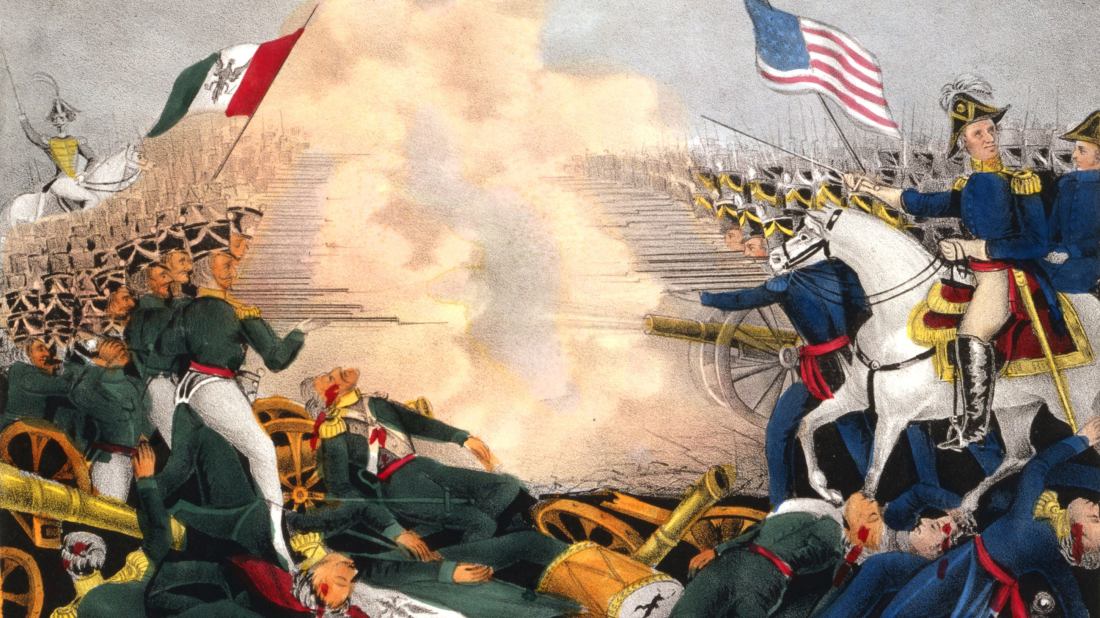
The United States has fought in several wars over the nation’s 250 year history. The war that probably gets the least amount of print in history texts or even mentions in the public mind is the Mexican War, which was fought from 1846-1848, not quite two full years. The war was a resounding victory for the still-fledging United States, with the US Army easily conquering the entire country and entering Mexico City as conquerors. About 18,000 American military personnel were either killed, wounded, or missing from the fight, while Mexico’s military casualties were about twice that. At the war’s end, the United States kept everything from Texas to the Pacific and gave the rest back to a more amenable Mexican government.

For the next decade, men like the heroes General Zachary Taylor (who was later elected president) and General Winfield Scott (and others) dominated not only the American military but also much of American politics. Another of the main results of the war was that it provided what would become most of the officer class on both sides of the American Civil War which began a short 12 years later. Some historians have called that war “the training ground” for the experience it provided the soldiers who would lead both sides in the next war. Men who were junior officers in Mexico would become colonels and generals when the Southern States would rebel beginning in 1860. That meant that men who fought together to a victory over Mexico would fight against each other when the Confederacy took up arms against the United States.

A chance interaction between two officers during the Mexican War bears repeating. The story is told that a young American lieutenant named Sam, his regiment’s quartermaster officer, had been out foraging on horseback in the Mexican countryside for food and supplies. He was returning one hot afternoon to the army’s encampment not too far outside Mexico City as the American were preparing to take the city in the next several weeks. Sam was tired, sweaty, and dirty. His uniform front was unbuttoned because of the heat. Now, Sam was a good horseman, but keeping his uniform in regular “army condition” was never a priority for him despite the fact that he had graduated from West Point a few years before. At any rate, here he came, riding back into camp looking like a tramp in an army tunic.

As Sam was dismounting, a colonel came up to him quickly. Sam noticed that the man had a bushy mustache, an immaculate uniform, and spoke to him with a distinct southern accent. The colonel upbraided Sam for his slovenly appearance. Sam was somewhat taken aback, but he knew better than to dispute with the older and higher-ranked officer. Sam buttoned his tunic, wiped the grime from his cheeks, and saluted the colonel. The officer returned Sam’s salute, turned, and walked away.

Now, such a short encounter would probably not be remembered by most men, but Sam kept the meeting in his mind. In 1865, as the Civil War was ending, Sam ran across that very same colonel as the Southern troops were surrendering. The two men met once again in the front room of a house on one of the battlefields. In an effort to be jovial to the defeated rebel, Sam reminded him that they had met years earlier in the Mexican War. Sam recounted that first meeting, but the former colonel looked puzzled. The man who had been the colonel back then told Sam that, yes, he vaguely remembered the incident but that he didn’t exactly remember that it had been Sam whom he had reprimanded that day. The two men, veterans of two wars–one in which they had been comrades and one in which they had been enemies–reminisced about better days for a moment. But the moment of reflection passed.

It was then that General Robert E. Lee of the Confederate Army reminded the commander of the Union troops, Ulysses S. Grant, known as Sam to his friends, that they had better get on with the surrender of Lee’s troops and end the Civil War.

On the Capture of a Radical

John Brown led a small insurrection against the United States in 1859 in what is now West Virginia. Brown’s intent was to raid a federal gun depository–the armory at Harper’s Ferry, in what was then Virginia–and arm slaves with guns so that they revolt against their masters. He and his fellow ultra-radical abolitionists thought that the slave population would rise to answer their call of armed insurrection against the evil of what many Americans referred to as The Peculiar Institution. Abolitionists like Brown felt that they were the hands and feet of God’s freedom and were put on earth to end slavery.

So, with a small “army” of about two dozen men, both black and white, Brown truly believed that he and his men would soon be joined by hundreds of armed newly-freed slaves. These slaves would then turn their guns on their masters, punishing the slaveowners for what Brown felt was a terrible sin in the eyes of God. But, after he and his men took the armory, he realize that he had no way to let the enslaved people know about his plan without raising an alarm that would bring state and federal militias against him and his cohorts. So, to make sure the outside world wouldn’t hear of the capture of the armory, Brown ordered the telegraph lines to be cut.

But he forgot about the train. Some of his men shot at a train that pulled through Harper’s Ferry, and the train managed to make its way down the tracks to a station that had a working telegraph. The train crew sent out word about the situation in Harper’s Ferry, and, soon, a detachment of marines were dispatched to recapture the armory and arrest the insurrectionists. Within seven hours, Brown and his men found themselves surrounded by the marines and other various militia groups who had come on their own accord.

The colonel in charge of the marines sent a message under a flag of truce into the armory, telling Brown and his fellow rebels that they would be protected if they surrendered and gave up all their arms. Brown refused the terms. That led the colonel to order a full assault on the armory. Inside the building, a short but bloody skirmish took place that saw the marines quickly regain control. Afterward, Brown lay seriously injured by a saber blow and several of his men, a few marines, and some civilians Brown had taken hostage were either hurt or killed.

Brown’s actions were first seen as being terrible and radical, especially in the south. Pro-slavery proponents pointed out that his actions were the natural result of uninhibited and dangerous abolitionist rhetoric. After the initial shock of the violence, people in the north began to speak of Brown in glowing terms, began to see him as a shining example of liberty and freedom as defined in the American founding documents. Many today see Brown’s attempted rebellion as the first shots of the American Civil War.

After Brown was finally executed by hanging for his insurrection, people began eulogizing him in literature and song. John Brown’s Body became a refrain sung by Union troops as the Civil War began two years later. In part, it said, “John Brown’s body lies a-moldering in the grave, but his truth is marching on.” Julia Ward Howe changed those words to what we now know as the Battle Hymn of the Republic–leaving out references to Brown but keeping the ideas of the ware being a blow for freedom against slavery.

Oh, and remember that colonel who led the marines in the recapture of the armory at Harper’s Ferry? The one who penned the surrender terms to Brown?

He was offered the command of the Union Army by President Lincoln as the Civil War began.

But, as we know, Robert E. Lee turned down that offer.