On a Vital Modification

The year 1941 was one of those years in history that could easily be called a “make-or-break” year. Germany had swept across the European continent since World War 2 had been declared in September 1939, taking almost every nation in its path. Hitler and his armies were attacking Russia in the east, while only England stood between the Nazis and complete control over the continent in the west. The United States had yet to enter the war, and it seemed like only a matter of time until the Germans would launch an invasion of the British Isles and end the war on that front.

All that seemed to stand in Hitler’s way was the British Royal Air Force. Hitler preferred to bomb the British into submission, as he knew that an invasion of Britain would be costly in Reichsmarks and in lives lost. And as the German Air Force, the Luftwaffe, was pounding Britain with bombs day after day, the only British response was the work of the RAF. Thus, the Battle of Britain was also the battle for Britain. Those British planes would engage and harass the Luftwaffe bombers and fighters in daily dogfights, and the British public came to realize how important those planes were to keeping the invaders from their shores. For every fighter or bomber shot down by the British, that meant a slightly better chance the Germans could not invade. Later, Prime Minister Winston Churchill would say that never in history had so many owned so much to so few; he was speaking of the brave pilots, mechanics, and crews of the RAF.

The best fighter plane the British had was the Spitfire. While the Hurricane aircraft were more numerous, the Spitfire was faster (upwards of 400mph/600kph), better built, and much more maneuverable than the Hurricane. The British plan was to destroy the German fighters that accompanied the larger bombers. If left undefended by fighters, the bombers would be much easier to pick off and shoot down. But the Germans had the Messerschmitt B-109, a worthy adversary to the Spitfire. Both machines had 12 cylinder engines, with the Spitfire’s power being supplied by the Rolls-Royce company.

And there was a major problem with the Spitfire. When the German fighters were being pursued by a Spitfire, all the German had to do was to execute a roll–a simple spin of the aircraft–and peel off from its flight path. Spitfire pilots were chagrined to find that, when the Spitfire tried the same maneuver, the plane’s engine would stall because the carburetor would flood the engine with fuel. That meant the German pilot–flying his Messerschmitt with fuel injection–could easily escape a pursuing Spitfire.

To fix this problem, the British turned to the most unlikely of sources: An engineer who had experience working on motorcycles with the improbable name of B.T. Shilling. Shilling also didn’t look the part of a war hero. Bespeckled, frumpy, and slightly pudgy, Shilling was nonetheless the foremost expert in the UK on handling problems with carburetors. Despite having a long background as a grease monkey, working on racing bikes and cars, Shilling had a masters degree in mechanical engineering. Recognizing the talent they had at their disposal in Shilling, the RAF had given the engineer the position of chief technical officer over carburetors when the war began. And now, with the Spitfire’s engine flooding problem, they turned the situation over to Shilling.

Sure enough, within a few weeks, Shilling had an answer, and it was deceptively simple. The solution was to restrict the flow of fuel to the Spitfire’s engine during the rolls and dives. That would keep the fuel from flowing into the engine too rapidly and killing it. The restrictor that Shilling designed ended up being a small, nut washer size disc with a hole in it that would be added to the fuel line in all the Spitfires. After testing the device, it was soon evident that Shilling had resolved the issue. Soon, after fitting the restrictor into the Spitfires, the German fighters couldn’t escape the power and speed of the British planes–nor could they escape the bravery of the British pilots. For the work that perhaps saved their nation, Shilling was awarded the Order of the British Empire (O.B.E.) after the war.

And the grateful mechanics and pilots, who realized how important that little device was, named the life-saving (and probably also war-saving) restrictor after its inventor.

Miss Shilling’s Orifice, they lovingly called it, after its inventor, Beatrice “Tilly” Shilling.
On an Airplane Jump

Nicholas Alkemade was a British man who fought in World War 2. His job during the war was not an enviable one–he was the tail gunner in a British bomber. That position was one that had a short life-span. Many of the men who were tail gunners never lived to tell the tales of what they experienced as the bombers flew miles above Germany during the war. You see, the tail gunner had a great responsibility. The German attack planes that were sent up to stop the bombers would usually attack the Allied bombers from below and from behind. Men like Nicholas had the difficult task of trying to fend off the attackers so that the bombers could carry out their tasks. But that also meant that they and their small, cramped nest at the rear of the plane were incredibly vulnerable. They were the first ones to see and sometimes even feel the bullets the Nazi airplanes spewed into the bombers. And, too often, the bombers retuned to England after the bombing raids with no tail gunner at all.

On March 24, 1944, Nicholas, who was 21 years old, and his bomber group were tasked with making a raid on Berlin, the German capital city. And the attack was scheduled, as many were, at night, when it would be more difficult for the enemy to see the bombers. Three hundred planes were sent on the mission. Now, once the bombers crossed the English Channel, they were over enemy territory and thus susceptible to anti-aircraft fire as well as the harassing German fighters, fighters that were much faster than the lumbering big bomber.

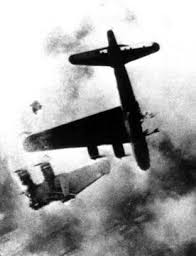
Nicholas’s plane, a British Lancaster bomber, had a crew of 7 men. They had dropped their bombs, and they turned for home. That’s when a small squadron of German Stukas, a heavily armed fighter/bomber, attacked. Nicholas and the other gunners tried to fend off the Stukas, but their plane was shot up badly. It caught fire. It began to spiral down towards the earth. There was nothing Nicholas could do but abandon the burning plane.

When he landed, Nicholas was quickly captured. He’d sprained his leg when he landed, so he had to be assisted by the German soldiers who captured him. The Lancaster had crashed nearby, and four of his fellow crewmates never made it out of the burning plane. Nicholas was taken to the local Gestapo (the Nazi secret police) headquarters for interrogation. That part was routine; the Nazis wanted to know the location of Nicholas’s airbase, what the number of planes were in his squadron, and other such information that might help them in the war. Of course, Nicholas didn’t reveal anything other than his name, rank, and serial number. Oh, and he told them about jumping out of the burning plane, of course.

And that’s when the Nazis began to doubt Nicholas’s story. How did he manage to jump out and survive when four of his fellow crewmembers didn’t, the Nazis wanted to know. His tale seemed too incredible to believe. The plane was at 18,000 feet (5,500 meters) above the German nation when Nicholas bailed out. Something didn’t add up about his story, the Nazis said. Yet, Nicholas insisted that his version of what happened was the truth.

The Nazis called him a liar. They made the injured man return with them to the crashed Lancaster. They forced him to show them where he was when he jumped. And then he pointed to his parachute. That’s when the Nazis shook their head in disbelief, but they had to admit that Nicholas was telling them the truth. You see, the charred parachute that Nicholas pointed to, the one that he was to use in case of the bomber being shot down, was still in the plane, still lying in the burned out wreckage of his tail gunner’s position.

And Nicholas Alkemade had somehow survived when he jumped 18,000 feet to earth without it.

On an Air Force Enlistee

In August, 1922, Mr. John H. Ross went to London and applied to become an enlistee in the British Royal Air Force. That was an odd time to join the military in one sense. The Great War (World War 1) had been over for 4 years. Most military services were cutting back both in terms of costs and personnel. Since the war ended, most world governments believed that another such conflict was not only unlikely but also could not be conceived of. You see, neither Hitler nor Mussolini had quite made their way into the international consciousness, and, besides, the League of Nations would stop any such conflict, surely.

Yet, here was this somewhat middle-aged gentleman approaching the RAF and offering his services. He had papers proving who he was, and the recruiting officer looked over them carefully. He knew that several pilots from the war had returned home after the war, grew bored, and had been itching to return to service. Sometimes these men would use false identities to re-enlist, pretending to be completely new recruits. The officer was named W.E. Johns, and he later became a fairly famous author of crime novels. At this time, however, his job was to ferret out who was a legitimate recruit and who wasn’t. In this case, the man insisted he had no flying experience whatsoever. He admitted to having served in the war, but he said his job was as a lower-level supply staff person.

Officer Johns got the feeling from this John Ross that here was a man who, while sincere, was hiding something. Maybe it was the fact that Johns had experience in knowing the little “tells” recruits had when they lied about their past. Maybe it was something in the way this man carried himself, his presence, that made Johns feel that all wasn’t on the up-and-up. Johns thanked the man for his willingness to be a part of the service, but he told Ross that he believed his paperwork was fake and declined to take him into the service that day. “Ross isn’t your real name, is it?” Johns asked. Ross shook his head “no” and thanked the officer. As he left, Johns figured that was the last he would see of the man.

Surprisingly, a little while later, Mr. John Ross reappeared, this time with an RAF messenger in tow. Ross said nothing, but the messenger handed Officer Johns a written note. It was from his superior officer. The note ordered Officer Johns to admit John H. Ross into the Royal Air Force based on the documents provided. Johns couldn’t understand it. His superiors had never overruled his decisions regarding recruits. What made this man–a man who admitted to using a fake name and fake documents–so special that he had to be allowed to join the RAF?

Johns followed the order and processed the enlistee’s paperwork. He informed Ross that he was now admitted to the air service. Ross smiled and thanked Officer Johns. As Ross turned to go, John’s curiosity got the best of him. “Who the hell are you, really?” he asked.

The man turned back towards Johns’ desk. “I’m nobody. Just want to serve my country,” he answered with a smile.

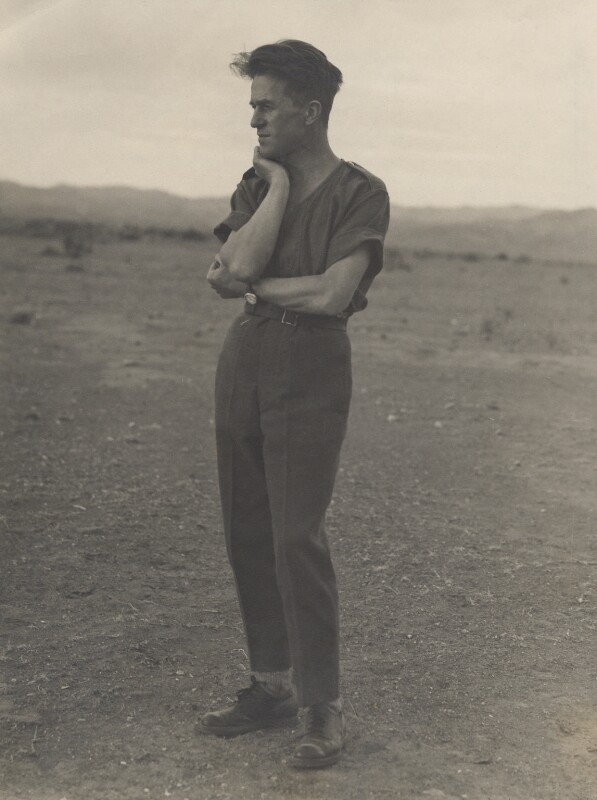
It wasn’t until February of the next year that Officer Johns realized that he had processed the enlistment of T.E. Lawrence, known to the world as Lawrence of Arabia.