
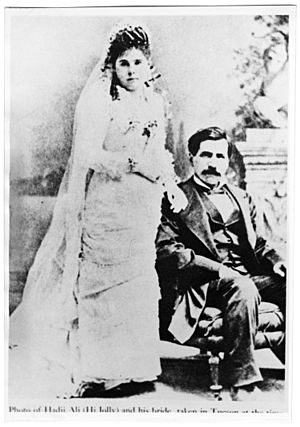
The small Arizona town of Quartzsite is home to a remarkable grave. The stone says the body buried beneath it is someone called “Hi Jolly,” but that’s a remnant of the racist nature of the United States 150+ years ago. We’ll look at his name in a moment, but how this man came to live and eventually die in the American Southwest is as odd as it is interesting.
The man’s name was actually Hadji Ali, but it’s easy to see that someone in the United States back in the mid-1800s might hear that name as “Hi Jolly.” So, to make his life somewhat easier, he want by the name that the locals in Arizona called him. From what we can glean he was born in what is now Turkey to Greek Orthodox shepherd parents in the 1820s. His Greek name was Philip Tedro. But, at an early age, Ali converted to Islam and changed his name. Because he had made a pilgrimage to Mecca early in this religious journey, he chose the name Hadji. He also served in the French Army as a young man, fighting part of the French colonial wars in Algeria. His background with animals saw him assigned to care for the pack animals used in by the French in their supply lines.
It was in this capacity that Ali was hired by, of all outfits, the United States military. How that happened has to be explained. You see, in the presidential administration of Franklin Pierce, the Secretary of War (what the Secretary of Defense was known as at that time) was none other than Mississippi’s own Jefferson Davis. This is the same Davis would would go on to become the President of the Confederate States of America during the American Civil War. Since there were no real foreign threats to the US during this time, the major focus of American defense policy was the pacification (meaning removal and/or eradication) of the native residents of the vast stretches of the western US. Davis looked for ways of creating better supply chains for the string of forts the army had set up to protect Americans from what they felt were native threats to settlement. That’s why Davis sent American agents to the Middle East to find and hire the best animal wranglers and handlers money could buy–people who had experience in handling animals in harsh, desert conditions. Ali was one of several hires made by Davis’s agents, and he came to the US in 1856 and arrived in Texas before making their way to the Southwest.
Ali was appointed to be the leader of these animal handlers. Everyone who worked with him commented on his professionalism and experience. As a vital member of the army’s quartermaster corps, he began enacting the plan Davis created to supply the forts and, at first, all seemed well. But 1857 saw the start of a different presidential administration and a new Secretary of War who didn’t have the priorities that Davis did. Besides, the tensions surrounding the beginnings of the American Civil War began to divert government funds from the western theater to the creation of warehouses and armories back east that began stocking supplies and weaponry. Soon, Ali found himself out of a job and unable to return to his native lands.
So, he decided to stay. He married a Greek girl in Arizona and did more supply work for the army in the wars against native groups in the late 1800s. He did some prospecting as well. He and his wife raised two children. Finally, he died in 1902, having never returned home. In fact, Ali became an American citizen and came to love the beauty and freedom of the deserts of Arizona.
You might be wondering why Jefferson Davis would have to send away to the middle east to find people to manage pack animals in the American Southwest. Well, that was needed because no one in the United States had any experience working with the specific pack animal Davis was using in the deserts in an interesting although failed experiment.
Ali, you see, had a good deal of experience working with camels.
 The Rest of the Story