
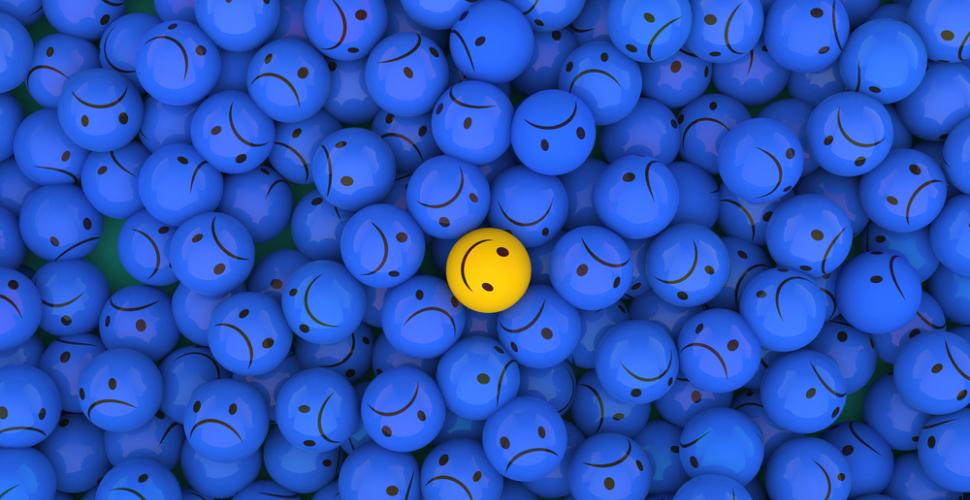
Seasonal Affective Disorder is one of those afflictions that sounds made up to explain how many people feel these days. And it is one of those things somewhat, but it also describes a real situation for many people during the winter in the Northern Hemisphere. When the daylight grows shorter and the clouds roll in, when people have to stay inside more often due to the foul weather, our negative moods increase. We add on holiday weight and enjoy a festive time of year, we share time with friends and family until January comes around and then…nothing. The parties are gone. The gifts we rejoiced over a few days earlier lie around the place, unused. We become depressed. It can be a serious, chronic condition and can be debilitating for some. All of that is true for many people. Seasonal Affective Disorder (SAD) is merely giving a title to those feelings of depression that affect many this time of year.
Psychologists have been trying for years to put together some sort of list of symptoms and causes for SAD, but it’s been difficult. How long does it last? How is it first manifested? Does it affect single people differently than people in relationships? And so forth. SAD has been a slippery thing to define and explain scientifically. And that’s where Dr. Cliff Arnall came in. He managed to put a formula together that supposedly explains it all, and, even, he can pinpoint the exact day every year when SAD reaches its peak in the northern hemisphere. Now, that sounds like problem solved in a neat and scientifically packaged explanation. Oh, if it were only so simple!
Dr. Arnall is purported to be a psychology lecturer at Cardiff University in Wales. Turns out that he only lectured there in some evening classes for the extension program. Arnall’s formula to explain SAD was:

Later, Dr. Arnall changed the formula to:

Now, I know that you thought there would be no math. I’m math-averse, myself. But all those letters and thingies stand for such data as time, debt, days since Christmas, motivation, weather, failure to meet/hold/keep New Year resolutions, and so forth.
And it’s complete hokum.
You see, Dr. Arnall made the formula in conjunction with Sky Travel, a large travel agent company in the UK. The idea was that the company could “validate” their potential clients’ desires to book a summer holiday in January. The cure, they said, pointing to Arnall’s “scientifically proven” formula, was that what they were feeling was legitimate and that they needed to “cure” their Seasonal Affective Disorder by planning the ultimate vacation, thus giving them something to look forward to.
Well, newspapers pounced on the story (and Arnall), rightly calling out the pseudo-scientific theory and formulas. The papers pointed out that what the company was doing was diminishing the real effects of SAD and minimizing how truly devastating the disorder was to many people. But the the travel company didn’t care; the newspaper stories gave them the exact publicity they craved for their products. And, every year about this time, papers (and bloggers, too, apparently) write about Arnall and the formulas. One year, the travel company sent Arnall to the Canary Islands to “prove” that a vacation could help relieve the symptoms of SAD. Of course, the press covered the doctor’s trip, again giving his wacky theory more press. To prove that this man is a craven showman and hack, he later accepted money from an ice cream company to say that the opposite of SAD existed–the happiest day of the year, which he “proved” was near mid-summer’s day. Of course, you should celebrate it, he said, with ice cream.
What gets lost in all of this is that a specific day has now been set aside, due to Arnall’s theory, that is recognized as the peak of Seasonal Affective Disorder. It now has been declared that the third Monday of January each year is the peak of the SAD season. In a case of a fake something being close enough to reality to seem real, the public has latched onto the idea that one day is the pinnacle of a disorder.
The press has labeled that day Blue Monday.

 The Rest of the Story