On a Pin-Up Girl

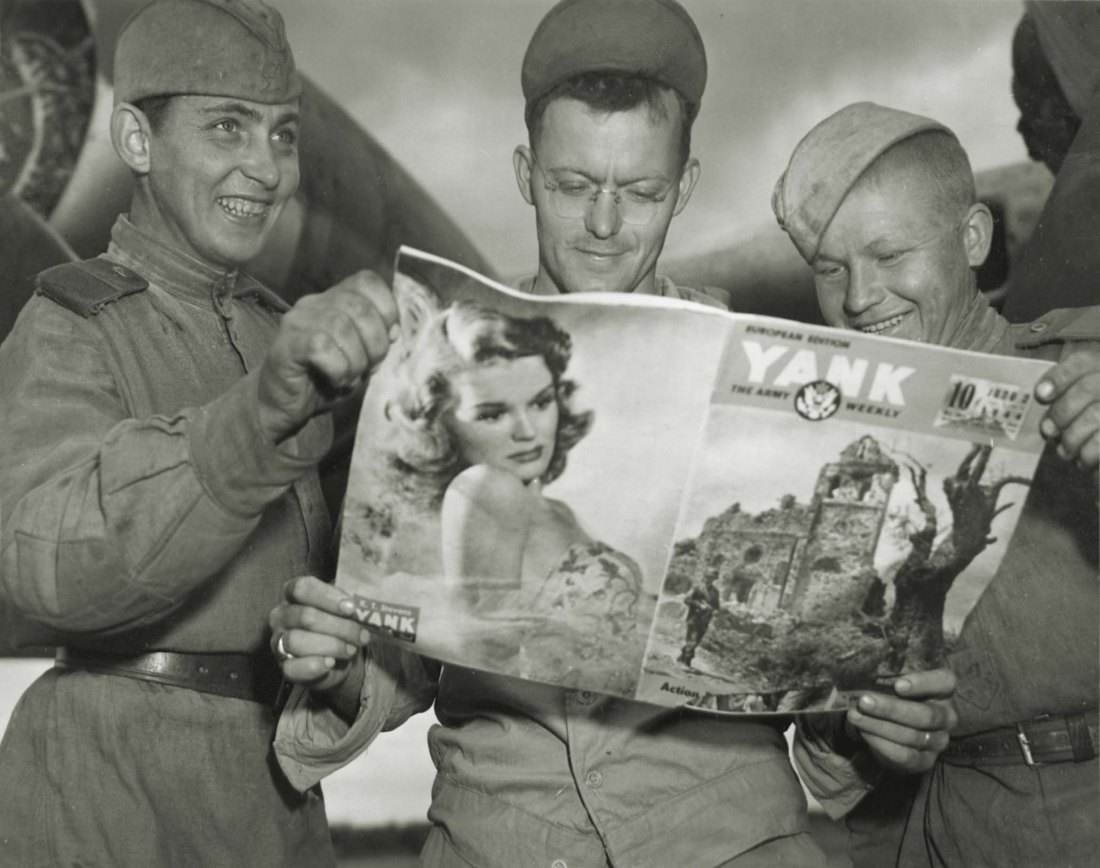
This tale might be distasteful to some, and I’ll confess that the subject matter is disquieting. The fact remains that, during World War 2, in an effort to boost morale among the American male servicemen, the military magazine YankThe Army Weekly (short for Yankee, the name by which most GIs were known overseas) always included a poster that featured a female in tight clothes. Known as a Pin-Up Girl, these women’s depiction was meant for the men to take out of the magazine and put up (or pin up) on the walls of their barracks, rooms, or even offices. The magazine, with a circulation in the millions, was sent weekly during the war years to every theater of war, from North Africa to Southeast Asia, Alaska to England.

Please realize that Yank never published pictures/pin-ups of women like magazines such as Playboy would later in the Vietnam War. But, while the women in Yank were clothed, they were posed in what was, for that time, suggestive postures. Bare legs featured prominently. Sometimes, the woman would be portrayed in a swimsuit or lying on a sofa or bed. Often, film or music stars were the photograph in the magazine; Ingrid Bergman, Lauren Bacall, Maureen O’Hara, and Donna Reed were some of the more famous ones. Jane Russell and Betty Grable were favorites of the servicemen. As a tongue in cheek issue in 1943, Yank featured a man (a sergeant named Charles Gardocki, shirtless and dressed in loincloth) as the pin-up, the editors saying that they did it for the women in uniform.

The magazine also contained news about life after the war such as opportunities for work and education, interviews with celebrities, and included the famous cartoon character, Sad Sack, a typically downtrodden army private. Some issues had short stories by famous authors in the 24 page magazine. One issue carried a letter from a Black soldier who wrote that German POWs were treated with more respect in the US Army than were Black men. That letter caused some controversy because of the number of letters received from servicemen who actually supported the assertion. But the pin-ups were what most men were eager to see in Yank.

And the magazine was incredibly popular with the troops. Copies of it carried great value as something that represented home and country to the fighting men. Once, supposedly, thousands of pin-ups were dropped over a Japanese-held island with the message, in Japanese, “This is what’s waiting for us at home; this is what we’re fighting for,” as a way of hurting Japanese morale. Of course, the Americans weren’t the only ones who liked the pin-ups. Enemy soldiers were sometimes captured with pin-ups found in their pockets or in their belongings, having gotten the magazine somehow during the ebb and flow of battle.

Now, we should mention that the objectification of anyone like the photos in Yank is wrong, obviously. But, for its time, Yank‘s pin-ups had a positive effect on the troops. And, as the war drew to a close, the editors had to decide what girl would have the honor of being the last pin-up girl in the magazine’s last edition. For weeks leading up to the last edition in late 1945, the magazine teased its readers with the secret identity of the girl. She had to be the best, the greatest girl that the boys on the front had ever seen. She had to epitomize the United States and all that it stood for. She had to be the ultimate pin-up.

And that’s why, in the last published edition of Yank, the pin-up girl was the one that every American, no matter who, loved the most.

The Statue of Liberty.

On a Perfect Person

“Nobody’s perfect” isn’t simply a saying; it’s a fact. If you are a human, you have flaws. Try telling a believer in Jesus, for example, that the savior had bodily functions and got tired and hungry and frustrated and sneezed on people and got in trouble with his parents. Then stand back and watch them argue that he was “perfect.” Remind them that to deny the humanity of Jesus flies in the fact of what the Bible says about him, and that’s the point. Perfect people don’t exist.

Except in one case, apparently. The person I’m referring to apparently isn’t quite human, apparently. For example, it is said that he has never had a poo or wee in his life. He is said to be “too perfect” for such mundane things as passing food and liquid waste through his body. Or take the story about him climbing a high, treacherous, snowy mountain in a business suit and dress shoes with no effort and with no blemish to either suit or shoes.

He is said to have automatically driven a car at the ripe old age of three years. With zero lessons in his life, he is also recognized as the greatest artist his nation has ever produced. At the age of 9, he challenged a professional yachtsman to a race and handily beat him–all without ever stepping foot on a boat before then. And, did I mention that his musical compositions top the pop charts in his country even if he never received any musical instructions, either? To top it off, this man has been voted the most desirable man on earth for multiple years running.

To be fair, this prodigy seems to have gotten his perfection from his dad. The dad, after all, wrote 40 books a week during his time as a student, bowled perfect/300 games every time he took to the lanes, and shot several holes in one the first time he played golf. Not bad, not bad. So, at least he got his perfection honestly, right?

And it helps that his home country has been labeled the Happiest Country in the World several years running. It helps that the people there have the best government ever created on the planet. It helps that the nation enjoys 100% unanimity in support of that government.

And this perfect person? Why, it’s the exalted leader of North Korea, Kim Jong Un, of course.

On a Familiar Face

The late 1800s and early 1900s were the heyday of the popular magazine. Collier’s, Leslie’s, and the Saturday Evening Post were some of the more circulated magazines that featured popular opinion and news articles of the day. And, since putting photographs in print was still a novelty, the magazines hired graphic artists who generated images that captured the public’s attention (and dollar). In many cases, the artists became somewhat public celebrities themselves, earning good money and large followings. For example, Norman Rockwell and Charles Dana Gibson became rather well known for their art and artistic voices.

One of the most famous artists of the period was one James Montgomery Flagg. You know him best most likely as the man who created the famous “I Want You!” poster featuring the character Uncle Sam. We all know that character and how he is dressed in patriotic colors and a top hat, a thin man with a goatee and a grim face, a bony, almost accusatory finger pointing at the person looking at the poster.

Flagg created the character to accompany a story in one of the magazines about American preparedness (or lack thereof) during World War I. You see, the US didn’t take part in the first three years of that war; we didn’t join the fight on the side of the Allied Powers until the spring of 1917. When we did decide to enter the war, a rapid mobilization of personnel and materiel needed to be accomplished. Flagg’s commission for the magazine was to create an image that would speak to the nation’s need for everyone’s help in “making the world safe for democracy,” as President Woodrow Wilson put it.

So, Flagg wanted to embody the nation with the Uncle Sam image. The problem was–whom could he use as a model? He asked one of his elderly neighbors, a broad-shouldered gentleman with a long, bony finger, to act as the body’s model. That part was fine for Flagg. But the man’s face was all, well, wrong for the art. Flagg tried to show the man what he wanted, but it was no use. The man’s face was too round and not, well, righteously angry enough for the drawing Flagg had in mind.

Then he had a brainstorm.

And the resulting artwork became one of the most iconic posters in American History. The US Government War Department procured the rights to the picture to reproduce it as propaganda, to use it to do things like sell war bonds at home and encourage people to join the armed forces. There was something about that bony finger pointing at the viewer that demanded action, but it was the face, the grim determination that most Americans felt in joining the fight that really made Flagg’s poster speak to Americans then and now.

Because of the success of his artwork, Flagg was, for a time, the highest paid illustrator in the United States.

And whom did Flagg find to be the model for the determined Uncle Sam, the one that our enemies didn’t want to mess with?

Why, the model he chose was himself.