
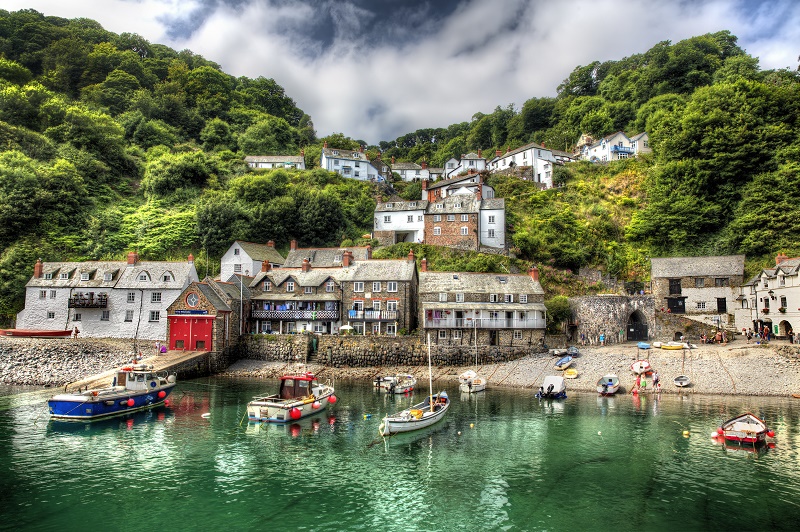
Clovelly. The name of this English village itself contains the word “lovely,” and that’s a perfect description for this quaint fishing settlement on the north coast of the lower left (west) leg of England, almost directly north of Plymouth. If you’ve ever seen a puzzle box that features those brightly painted small fishing boats resting in a quiet little harbor with neatly kept character English houses lining the seafront behind them, well, then, you’ve probably seen Clovelly. There are several interesting things about the village that makes it unique in England and, in many ways, the world.
Take, for instance, that the village is built on a steep hill that ends at the waterfront. The streets of the town are still made of cobblestones–many of them the original ones. Slightly fewer than 500 souls live in the village’s 80 houses today. The population of Clovelly love the village. Most say they wouldn’t live anywhere else even if given the chance. Not that everything is easy in the village, because it’s not. For example, to take, well, anything up or down the hill, the villager can’t rely on cars because cars aren’t allowed in Clovelly. No, to take groceries, mail, supplies, or even a refrigerator up the hill from the harbor, the village has relied on sledges–almost every house has at least one–and these sledges are often pulled by donkeys. Now, this isn’t a description of life a few hundred years ago, but it is the reality of life for the Clovellites today. So, no cars are allowed. And, by the way, visitors to the village must pay the equivalent of $10 to enter. You’d think that would keep tourists away, but you’d be wrong. Clovelly is one of the most popular villages to visit in England, and it’s been labelled the prettiest village in Devon. Social media type have even given Clovelly the title of England’s Most Instagrammable Village.
Shortly after taking England in 1066, William the Conqueror “relieved” the Saxon lord who owned the village of his title, and William gave the village to his wife as a gift. Since then, only three families have owned the land that William originally took. That was in the day when the local lord owned all the land and only allowed the workers or peasants to live and work on it. Today, the most recent family (for the past few hundred years) who have lived in the lord’s house have been the Hamlyn Family. But it was the Cary Family who, in the 1600s, spent considerable money at that time to create a breakwater just off the coast to make a harbor. And harbor protected and sustained a fishing fleet that the village has maintained and used consistently make its livelihood from the sea. While fishing is still a mainstay of the population in Clovelly, now, of course, the main trade is tourism.
And then, there’s the houses and shops of the village itself. The Hamlyns will gladly pay for the residents to repair their habitations, but there’s a catch to the family footing the repair bill. The house must be kept to original specifications and, if possible, as close to the original materials as possible. That means the only exterior materials must be either stone (the newer dwellings) or cob (the older houses). Obviously, modern conveniences are in Clovelly, but people can’t make radical changes to the buildings. That’s because, in part, that the entire village is listed as a historic site. The result is that the whole place, according to one source, is like stepping into a time machine. You can walk down (or up) the main street and easily imagine you’re back in the 1700s rather than the 2000s.
And the Hamlyns prefer it that way. In fact, they insist. You see, the reason the Hamlyns insist on paying for repairs to the houses in the village is because they own the village. And the houses. And the surrounding land. All of it. Every inch. Clovelly is, today, the most picturesque of the last dozen privately owned villages in England.
And the happy people of Clovelly are fine with that.
 The Rest of the Story