On a Pin-Up Girl

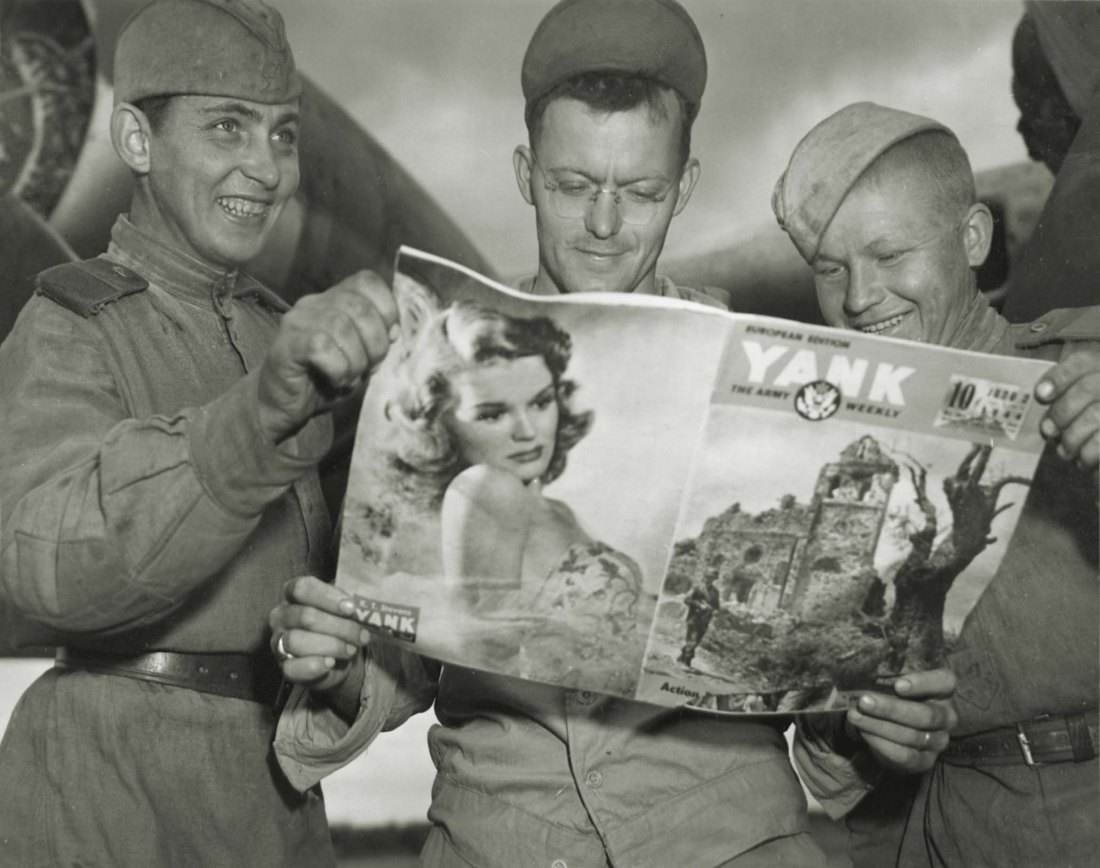
This tale might be distasteful to some, and I’ll confess that the subject matter is disquieting. The fact remains that, during World War 2, in an effort to boost morale among the American male servicemen, the military magazine YankThe Army Weekly (short for Yankee, the name by which most GIs were known overseas) always included a poster that featured a female in tight clothes. Known as a Pin-Up Girl, these women’s depiction was meant for the men to take out of the magazine and put up (or pin up) on the walls of their barracks, rooms, or even offices. The magazine, with a circulation in the millions, was sent weekly during the war years to every theater of war, from North Africa to Southeast Asia, Alaska to England.

Please realize that Yank never published pictures/pin-ups of women like magazines such as Playboy would later in the Vietnam War. But, while the women in Yank were clothed, they were posed in what was, for that time, suggestive postures. Bare legs featured prominently. Sometimes, the woman would be portrayed in a swimsuit or lying on a sofa or bed. Often, film or music stars were the photograph in the magazine; Ingrid Bergman, Lauren Bacall, Maureen O’Hara, and Donna Reed were some of the more famous ones. Jane Russell and Betty Grable were favorites of the servicemen. As a tongue in cheek issue in 1943, Yank featured a man (a sergeant named Charles Gardocki, shirtless and dressed in loincloth) as the pin-up, the editors saying that they did it for the women in uniform.

The magazine also contained news about life after the war such as opportunities for work and education, interviews with celebrities, and included the famous cartoon character, Sad Sack, a typically downtrodden army private. Some issues had short stories by famous authors in the 24 page magazine. One issue carried a letter from a Black soldier who wrote that German POWs were treated with more respect in the US Army than were Black men. That letter caused some controversy because of the number of letters received from servicemen who actually supported the assertion. But the pin-ups were what most men were eager to see in Yank.

And the magazine was incredibly popular with the troops. Copies of it carried great value as something that represented home and country to the fighting men. Once, supposedly, thousands of pin-ups were dropped over a Japanese-held island with the message, in Japanese, “This is what’s waiting for us at home; this is what we’re fighting for,” as a way of hurting Japanese morale. Of course, the Americans weren’t the only ones who liked the pin-ups. Enemy soldiers were sometimes captured with pin-ups found in their pockets or in their belongings, having gotten the magazine somehow during the ebb and flow of battle.

Now, we should mention that the objectification of anyone like the photos in Yank is wrong, obviously. But, for its time, Yank‘s pin-ups had a positive effect on the troops. And, as the war drew to a close, the editors had to decide what girl would have the honor of being the last pin-up girl in the magazine’s last edition. For weeks leading up to the last edition in late 1945, the magazine teased its readers with the secret identity of the girl. She had to be the best, the greatest girl that the boys on the front had ever seen. She had to epitomize the United States and all that it stood for. She had to be the ultimate pin-up.

And that’s why, in the last published edition of Yank, the pin-up girl was the one that every American, no matter who, loved the most.

The Statue of Liberty.

On a Simpleton

Doug Hegdahl was a sailor aboard the USS Canberra off the coast of Vietnam in 1967 when the concussion from the ships large guns knocked the young sailor overboard. His fellow sailors didn’t notice that the 22 year old was missing until later. Meanwhile, Hegdahl managed to swim and float for a bit until some Vietnamese fishermen picked him up out of the sea.

Unfortunately for him, these fishermen were not sympathetic to the South Vietnamese, and they turned him over to some North Vietnamese soldiers. Thus, the sailor from a small town in South Dakota found himself in the notorious Hanoi Hilton, the POW camp. At his initial interrogation, his captors soon found that the young man, who looked much younger than he was, came across as something of a simpleton. He had a blank stare about him, and he was always humming a simple tune under his breath. Even when the North Vietnamese soldiers beat him up, he didn’t change his look or habits. Finally, they simply left the simpleton alone, figuring that he was useless to them for information or as a propaganda tool. Apparently, he couldn’t even read or write. They called him “The Incredibly Stupid One.”

As a result, and, rather unusually, Seaman Doug Hegdahl became somewhat of the camp “mascot” for both the captors and the fellow prisoners alike. For the Vietnamese, he was a cypher. For the other American prisoners, he was like a little brother they wanted to both protect and care for. One prison guard asked another American was the tune was that Hegdahl was that he was always humming. “Oh, that?” the POW answered, “it’s a children’s song called ‘Old MacDonald.'” He was seen as such a simpleton, such an idiot by the guards that he was allowed to wander the compound freely. They knew he wouldn’t try to escape or do anything, and, besides, he wasn’t hurting anybody. He would visit everyone around the camp and make everyone laugh, Americans and Vietnamese alike.

Now, during the war, the US and the communists often traded prisoners. Usually for the US, they wanted the officers to be swapped for North Vietnamese captives. After Hegdahl had been held for two years, he and two American officers were exchanged for prisoners held by the US. It was decided that such an innocent, such a simpleton, should not have to stay in the POW camp. It was even commented on that it was a surprise that someone so simple would have been accepted by the US Navy in the first place.

When he finally reached the US after his release, Doug Hegdahl promptly reported to his superiors. And, after they had debriefed him, he was reassigned. They immediately fly him to Europe to become one of the US representatives at the Paris Peace Talks so that he could talk to the negotiators there and confront the North Vietnamese delegation. You see, this sailor, all the time he was humming the tune to Old MacDonald, he was using the song as a way of memorizing names, places, and information. He walked out of the Hanoi Hilton having an encyclopedic recall of every one of the almost 300 US POWs who were in that facility–names, condition, messages to loved ones, etc.–and details of how each prisoner was treated.

No, Doug Hegdahl was no simpleton–far from it.

Instead, he was the consummate actor.

On a War Prisoner

My feeble mind isn’t expansive enough to feel the impact of the Holocaust. That 6,000,000 people at least died in the various camps operated by the Nazi Party during the Hitler Regime is beyond me. The addendum to this unspeakable tragedy is that hundreds of thousands of German POWs from several nations also died in camps from disease, malnutrition, abuse, and outright murder.

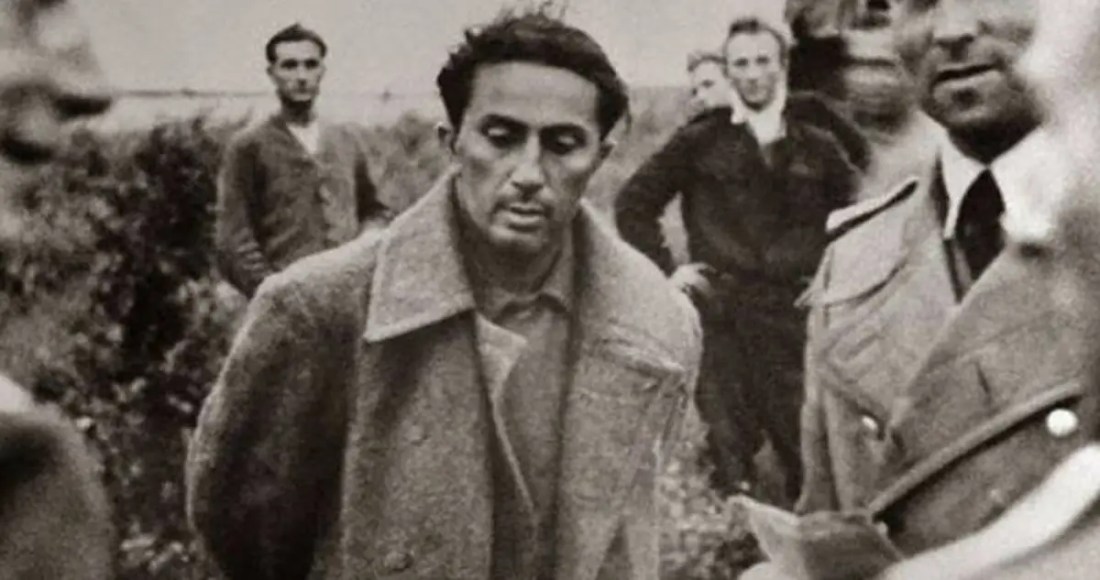
Take Yakov Dzhugashvili for example. He was one of the countless Soviet war prisoners taken by the German Army as they invaded the Soviet Union in June 1941. Yakov had been a bright but shy, sensitive boy with some mental health issues; he attempted suicide several times before reaching adulthood, and his overbearing father tried to direct the young man’s life. While Yakov wished to pursue a career in engineering, the father forced him into the military, making him attend artillery officers school. He graduated as a Lieutenant only weeks before the Nazi invasion of his country.

Sent immediately to the front lines, Yakov fought in the Battle of Smolensk. He was captured by the Germans in mid-July after refusing an order to retreat; he ordered his battery to keep firing long after the other units left in an attempt to cover his comrades’ retreat. Sadly, rumors reached his family that he had surrendered freely and as a coward to the Nazis rather than the heroic circumstances that would later be revealed by his fellow soldiers and captives.

Yakov was sent to Sachsenhausen POW Camp, which is a misnomer because it was one of the notorious concentration camps. As one of the earliest officers captured during the invasion of Russia, the Nazis wished to use Yakov as a propaganda tool and possibly force him to make Russian-language radio broadcasts to his fellow soldiers on the front lines. That never materialized, but Yakov probably wouldn’t’ve cooperated in the first place.

The young man’s old depression returned shortly after he was interned in Sachsenhausen. There were reports of self-harm. He would often engage in sometimes violent and almost always non-sensical arguments with fellow prisoners and sometimes even with himself out loud as he walked around the camp grounds. Finally, in early 1943, Yakov died by seemingly purposefully running into the electrified fencing at the camp and then being shot by the guards for attempting to escape.

The Soviet leader, Stalin, once said that one death is a tragedy while a million deaths is only a statistic. Yakov was an example of both of those, being a tragedy and a statistic. In fact, over 3,000,00 Soviet soldiers died in German custody. Stalin also noted that many sons of Russia died in the Great Patriotic War. Yakov was also one of those. And Stalin would know.

You see, Yakov was the son of Stalin himself.