On a Returning War Prisoner

Andras Toma had been a 20 year old Hungarian soldier when he was captured by the Soviets near the end of World War 2 in 1945. Toma was taken to a POW camp near what is now St Petersburg, Russia. The German soldiers and their allies, including captured Hungarians, often had to trek across hundreds of miles of countryside by foot when the war ended and they were released from custody in order to return to their homelands. I have some friends in Western Germany, near Cologne, who had their ancestor show up unannounced at the front door of the family homestead in 1947, fully two years after the war ended. They thought he was dead. That wasn’t an unusual event. Toma, too, had to stay some years in Soviet custody before his release, and his family had long since though him deceased in the war.

But Toma had survived. After the POW camp, an illness saw the young Hungarian transferred to another facility, a Soviet hospital, still deeper in the Russian interior. He languished there for several months, and then he was transferred to yet another facility, and that’s when he lost track of time. He didn’t realize how long it had been since he was put in the facilities. Back home, since he didn’t return after the war, his family had him declared dead. Again, this wasn’t unusual for families whose sons, husbands, brothers and other relatives didn’t come back.

Meanwhile, Toma was having trouble communicating with the doctors and the staff of the medical facility. Hungarian is a rich language, but it’s also one of the most difficult languages to learn. Besides, it’s not spoken much outside of Hungary. And Toma knew no Russian. So, when the doctors made their rounds and the nurses brought him his food and checked on him, there was almost no interaction between Toma and them. Apparently, he had no conversations with them at all while he was there.

Then, a doctor in the hospital who was from Czechoslovakia noticed the man. the doctor soon realized that, because of his name, Toma was most likely Hungarian. The man, curious as to what seemed to be a patient with no obvious or visible issue by that time, arranged for a records check on the Toma, and the entire story came to light. It seems that, for some unknown reason, Toma had ultimately been placed in a Soviet mental institution. His inability to speak Russian (and the Russians’ lack of Hungarian language skills) had allowed him to stay in the mental facility for an inordinate amount of time both unchallenged and unchecked.

And that’s how Andras Toma finally made it home to his family in Hungary after the war. He was given a hero’s welcome, and he was awarded back pay for all his time in the service, even though the war had ended some time earlier. The joyful reunion between Toma and his family occurred on August 11, 2000.

Because he didn’t speak Russian, Toma had been a POW for over 55 years.
On a Simpleton

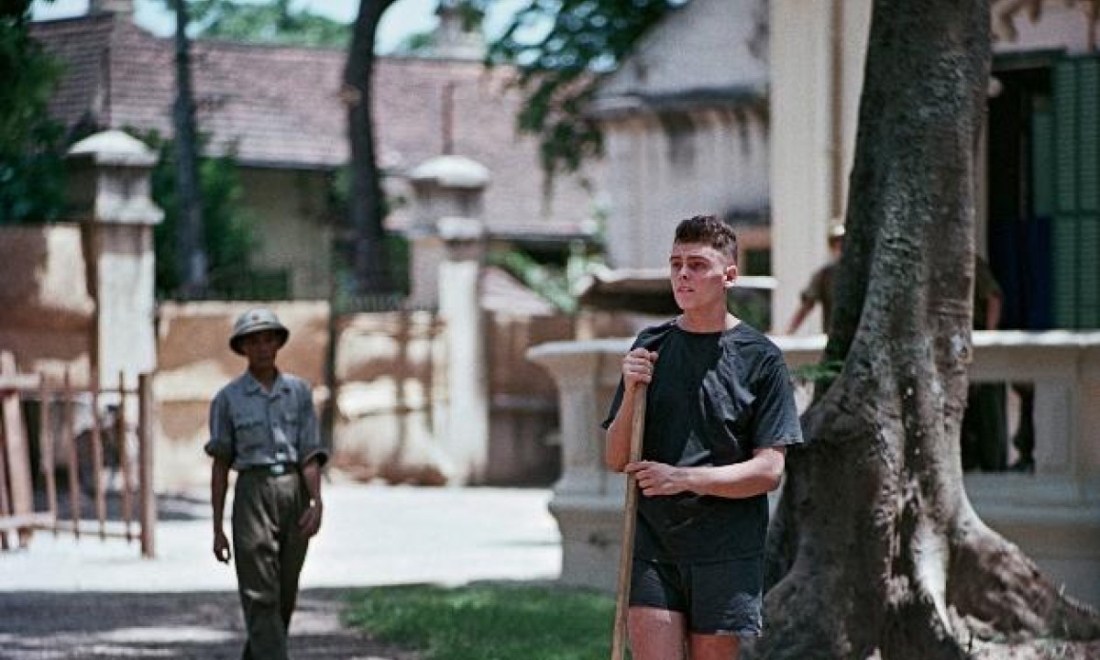
Doug Hegdahl was a sailor aboard the USS Canberra off the coast of Vietnam in 1967 when the concussion from the ships large guns knocked the young sailor overboard. His fellow sailors didn’t notice that the 22 year old was missing until later. Meanwhile, Hegdahl managed to swim and float for a bit until some Vietnamese fishermen picked him up out of the sea.

Unfortunately for him, these fishermen were not sympathetic to the South Vietnamese, and they turned him over to some North Vietnamese soldiers. Thus, the sailor from a small town in South Dakota found himself in the notorious Hanoi Hilton, the POW camp. At his initial interrogation, his captors soon found that the young man, who looked much younger than he was, came across as something of a simpleton. He had a blank stare about him, and he was always humming a simple tune under his breath. Even when the North Vietnamese soldiers beat him up, he didn’t change his look or habits. Finally, they simply left the simpleton alone, figuring that he was useless to them for information or as a propaganda tool. Apparently, he couldn’t even read or write. They called him “The Incredibly Stupid One.”

As a result, and, rather unusually, Seaman Doug Hegdahl became somewhat of the camp “mascot” for both the captors and the fellow prisoners alike. For the Vietnamese, he was a cypher. For the other American prisoners, he was like a little brother they wanted to both protect and care for. One prison guard asked another American was the tune was that Hegdahl was that he was always humming. “Oh, that?” the POW answered, “it’s a children’s song called ‘Old MacDonald.'” He was seen as such a simpleton, such an idiot by the guards that he was allowed to wander the compound freely. They knew he wouldn’t try to escape or do anything, and, besides, he wasn’t hurting anybody. He would visit everyone around the camp and make everyone laugh, Americans and Vietnamese alike.

Now, during the war, the US and the communists often traded prisoners. Usually for the US, they wanted the officers to be swapped for North Vietnamese captives. After Hegdahl had been held for two years, he and two American officers were exchanged for prisoners held by the US. It was decided that such an innocent, such a simpleton, should not have to stay in the POW camp. It was even commented on that it was a surprise that someone so simple would have been accepted by the US Navy in the first place.

When he finally reached the US after his release, Doug Hegdahl promptly reported to his superiors. And, after they had debriefed him, he was reassigned. They immediately fly him to Europe to become one of the US representatives at the Paris Peace Talks so that he could talk to the negotiators there and confront the North Vietnamese delegation. You see, this sailor, all the time he was humming the tune to Old MacDonald, he was using the song as a way of memorizing names, places, and information. He walked out of the Hanoi Hilton having an encyclopedic recall of every one of the almost 300 US POWs who were in that facility–names, condition, messages to loved ones, etc.–and details of how each prisoner was treated.

No, Doug Hegdahl was no simpleton–far from it.

Instead, he was the consummate actor.

On a War Hero

We throw around the word “hero” fairly casually these days (I did exactly that in yesterday’s post, in fact). Colonel Jim Thompson absolutely deserves the word “hero” as a descriptor. Colonel Jim died 21 years ago after dedicating his life to the service of his nation in the United States Army.

Born in New Jersey in the 1930s, Jim was too young for World War II but wanted to be in the army. When Jim was finally old enough, he joined up in the 1950s; he went to Officer Candidate School and found that he loved the military. He decided that the Green Berets would be the unit for him. After a stint as an Green Beret instructor, Jim also did a tour of duty in South Korea.

As the US involvement in the Vietnam conflict began to expand in the mid-1960s, Jim was one of the first officers to go over to southeast Asia. The Americans needed the expertise of Green Berets like him, so Jim was assigned a 6-month tour of duty in that theater. However, Jim ended up being in Vietnam a total of almost nine years. Yes, you read that correctly. Jim was in theater almost nine years.

Later, in interviews, Jim related that he really hadn’t heard of Vietnam before his tour began. Yet, his time there became the defining experience of his life. During his 9 years, Jim suffered wounds to his face, he broke his back in a plane crash, and he was burned at least once. Also, during his time abroad, much changed in the US military and in the nation as a whole. The United States that Jim left in 1964 was not the same place he returned to in 1973.

Because of his meritorious service during the conflict, Jim was awarded a slew of medals. Among these citations were the Bronze Star, the Silver Star, the Legion of Merit, and the Distinguished Service Medal. When he finally returned home from duty, Jim also received his promotions to Lt. Colonel and then full “bird” Colonel because of his time in Vietnam.

But being in-country for almost a decade had taken its toll on Jim. Like so many other men of his generation (and most generations that go through war), Jim could not make the transition back to life outside of wartime. He suffered from what we now know was Post-Traumatic Stress Disorder. He began having terrible night terrors. He drank heavily. His personal relationships suffered. He became more and more detached from family and friends.

The price Jim paid to serve his nation was a high one.

You will often hear veterans and other say, “All gave some, and some gave all” referring to those soldiers who lost their lives in the war as well as those who suffered from it one way or another. Well, in many ways, Jim was as much a casualty of the Vietnam War as a person who died there.

I’d like to say everything turned out ok with Jim, but that simply isn’t true. A stroke left him paralyzed on one side in his later years and forced his retirement from the military. He died alone in his home in Florida at the age of 69.

What you don’t know about Jim’s time in Vietnam is that the 6-month deployment that turned into 9 years wasn’t Jim’s choice. In fact, it was absolute hell for him.

That’s because for those 9 years he was in Vietnam, Jim Thompson was one of the longest-serving Prisoners of War that the United States has ever had.