On a Beautiful Village

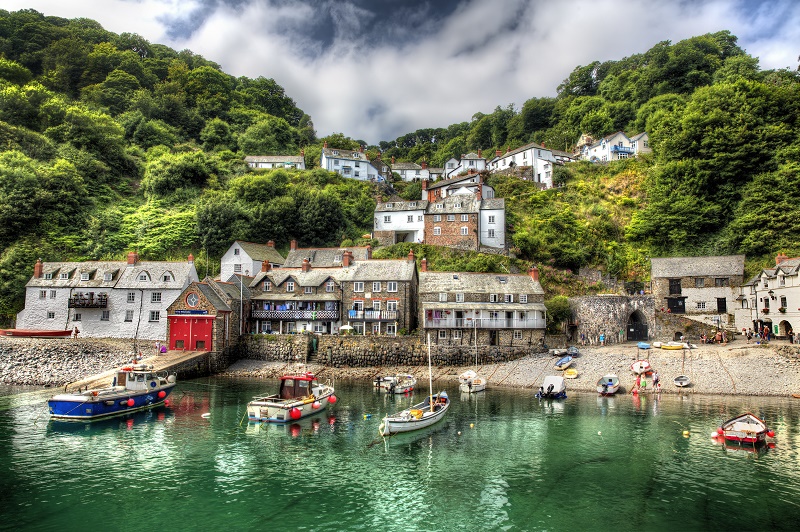
Clovelly. The name of this English village itself contains the word “lovely,” and that’s a perfect description for this quaint fishing settlement on the north coast of the lower left (west) leg of England, almost directly north of Plymouth. If you’ve ever seen a puzzle box that features those brightly painted small fishing boats resting in a quiet little harbor with neatly kept character English houses lining the seafront behind them, well, then, you’ve probably seen Clovelly. There are several interesting things about the village that makes it unique in England and, in many ways, the world.

Take, for instance, that the village is built on a steep hill that ends at the waterfront. The streets of the town are still made of cobblestones–many of them the original ones. Slightly fewer than 500 souls live in the village’s 80 houses today. The population of Clovelly love the village. Most say they wouldn’t live anywhere else even if given the chance. Not that everything is easy in the village, because it’s not. For example, to take, well, anything up or down the hill, the villager can’t rely on cars because cars aren’t allowed in Clovelly. No, to take groceries, mail, supplies, or even a refrigerator up the hill from the harbor, the village has relied on sledges–almost every house has at least one–and these sledges are often pulled by donkeys. Now, this isn’t a description of life a few hundred years ago, but it is the reality of life for the Clovellites today. So, no cars are allowed. And, by the way, visitors to the village must pay the equivalent of $10 to enter. You’d think that would keep tourists away, but you’d be wrong. Clovelly is one of the most popular villages to visit in England, and it’s been labelled the prettiest village in Devon. Social media type have even given Clovelly the title of England’s Most Instagrammable Village.

Shortly after taking England in 1066, William the Conqueror “relieved” the Saxon lord who owned the village of his title, and William gave the village to his wife as a gift. Since then, only three families have owned the land that William originally took. That was in the day when the local lord owned all the land and only allowed the workers or peasants to live and work on it. Today, the most recent family (for the past few hundred years) who have lived in the lord’s house have been the Hamlyn Family. But it was the Cary Family who, in the 1600s, spent considerable money at that time to create a breakwater just off the coast to make a harbor. And harbor protected and sustained a fishing fleet that the village has maintained and used consistently make its livelihood from the sea. While fishing is still a mainstay of the population in Clovelly, now, of course, the main trade is tourism.

And then, there’s the houses and shops of the village itself. The Hamlyns will gladly pay for the residents to repair their habitations, but there’s a catch to the family footing the repair bill. The house must be kept to original specifications and, if possible, as close to the original materials as possible. That means the only exterior materials must be either stone (the newer dwellings) or cob (the older houses). Obviously, modern conveniences are in Clovelly, but people can’t make radical changes to the buildings. That’s because, in part, that the entire village is listed as a historic site. The result is that the whole place, according to one source, is like stepping into a time machine. You can walk down (or up) the main street and easily imagine you’re back in the 1700s rather than the 2000s.

And the Hamlyns prefer it that way. In fact, they insist. You see, the reason the Hamlyns insist on paying for repairs to the houses in the village is because they own the village. And the houses. And the surrounding land. All of it. Every inch. Clovelly is, today, the most picturesque of the last dozen privately owned villages in England.

And the happy people of Clovelly are fine with that.
On an Immigrant Group

Moving to another nation can one of the most traumatic events in life even if one is leaving a bad situation and seeking a better life. A group of religious dissidents made the choice to leave their families and the way of life they knew and seek another place. These people, who had been persecuted for their beliefs in their home country, came to Holland to seek the freedom to live and work and worship the way their consciences dictated. In their home country, they had been marginalized and their livelihoods had been taken away, and they were so grateful for the opportunity to start life over again in Holland.

The small group settled in Leiden, near the university, and many of them quickly found work in the textile industry of that city. Others took up the trades and jobs they had previously had in their home country. The university made a strong effort to incorporate the new immigrants into the community; they offered free classes and training, they gave the group a place to meet to hold their religious services, and they provided language training as well to help the newcomers better fit into Dutch society.

For roughly a decade, the group flourished. But, then, they began to worry about the influence the open Dutch society was starting to have on their families. Their kids were growing up not knowing their native language. They were adopting Dutch mentalities and attitudes towards, well, everything, including inclusivity–the very inclusivity that had welcomed the immigrants in the first place. So, because of their own prejudices and intransigence, the religious refugees decided to move again as difficult as the move would be on their families and the group as a whole.

The United States would do well to emulate the Dutch with regards to how we treat those seeking the freedom to live the way they wish to live, whether they are from the US or immigrants seeking a better life. As we look at those things we are thankful for, we might do well to re-examine the basic freedoms of mankind upon which the nation was founded–the freedoms of life, liberty, and to pursue those things that make one happy.

Oh, that religious group? They looked for a place where they could raise their families free of any so-called negative influences, to create a society of their own choosing without any real oversight or control. And a place where their kids wouldn’t grow up wearing wooden shoes.

They chose Massachusetts.

You know them as the Pilgrims.

Happy Thanksgiving.

On a Member of the Staff

We forget that, once upon a time, going trans-Atlantic meant going by boat. Even when air travel began on an intercontinental scale, ship lines crisscrossed the ocean between Europe and the Americas as an alternate form of getting from there to there—or vice versa. Today, other than cargo shipping, about the only way to cross the Atlantic is on a repositioning cruise by one of the Carnival-Norwegian-Princess type cruise lines.

Here’s a story about an Atlantic crossing back in the day when going by ship was the norm. In those days, the journey was about the destination and not the vacation trip we think of today. The staff onboard this particular ship consisted of not only the crew operating the vessel but also wait staff and servants for those who paid for the voyage.

One such servant was a young Englishman named William Trevore. In the grand tradition of that ocean-going nation, William, like other young men of his generation, had experience on other ships, but his time on the sea as part of the service crew had been limited to European waters. This was his first trans-Atlantic crossing. He had been hired on one ship first and then transferred to a new ship owned by the same company for the trip across the ocean. William made his goodbyes to his family and spoke about how much he looked forward to working for the passengers onboard.

According to those upon whom he waited, William performed his duties at sea with great enthusiasm. The company who hired him, the ship’s owners, were pleased with his work and attitude. He often entertained the passengers with tall tales of life at sea, of his numerous voyages in European trips over the years, and of distant, mystical islands that he hinted he had visited years before.

But in the mid-Atlantic, the sea grew rough. The waves were such that passengers were confined to their cramped rooms to keep the storms from potentially washing them over deck. “The voyage was difficult even for seasoned sailors, much more for those who had never been on a ship before,” one commentator noted.

Through it all, William continued to be his usually cheerful self and performed his duties as if nothing were amiss. Even as many of the passengers on which he waited grew seasick, William continued to try to make them smile. Most of those onboard were unused to life at sea, and the heaving and tossing was simply too much. Soon, the smell of the vomit permeated all areas in the passenger spaces. Through it all, William simply smiled and cleaned and served.

Such was William’s commitment to ensuring the passengers were clean and as supplied as they could be under such dire circumstances that his work drew praise in the ship’s log—an unusual thing for a lowly crew member of the wait staff on a trans-Atlantic voyage.

William’s contract with the company was only for one year, and, when his time was up, he eventually went back to England. He rose through the ranks of the English commercial fleet and eventually captained a ship of his own on which he made several trips back and forth from Europe to America.

Yet, for all his later experience on the seas, William Trevore forever spoke with greatest pride about his two month’s work aboard the Mayflower.