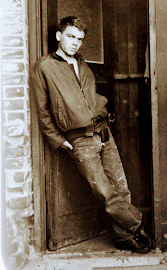
On a Missing Son

In New York City in 1968, two boys entered an abandoned tenement building and proceeded to explore it. While looking in the various rooms of the building, they stumbled upon a recently deceased body. It really freaked them out. They ran out of the building and found a policeman who was walking his beat nearby.

The dead man looked young-ish, and his body was surrounded by beer cans and religious pamphlets. The identification on him told the authorities that his name was Robert Driscoll, and the coroner decreed that he’d died from hardening of the arteries–a condition that was a side-effect of extensive heroin use. He was 31 years old, but his life of drug use and abuse of his body told a different story. Robert had lived a hard life. Not having a fixed address, the city of New York buried him in their pauper’s field, in a mass grave.

After a few weeks, of course, his parents, having no word from him, set about finding what had happened to their son. They first tried all the friends they knew he had been around, but those friends knew very little about Robert’s activities in recent weeks. It seems that he had disappeared. The parents began to worry. In their desperation, they reached out to a former employer of Robert’s, a company that had been run by a wealthy man who had some connections and could get things found out. Robert’s parents made the phone call, and the employer promised they would do what they could to find out what had happened to Robert.

Now, if you’d’ve asked Robert, he would have told you that his profession was as an artist. In fact, Robert had been a part of the artist colony associated with Andy Warhol, and his chosen medium was the collage. Robert had a good eye, and his collages were intriguing and showed promise. But the allure of heroin and other drugs pushed him to his early death.

Anyway, his former employer set about trying to locate Robert and maybe let his concerned parents know what had happened to their son. Soon, Robert’s former employer, a wealthy, connected company, had an answer. They made the phone call and informed the parents that, sadly, Robert had died from hardening of the arteries as a side-effect of his drug use and that his body was irrecoverably buried in a common grave in New York. The family erected a memorial in a cemetery in California, where they lived, to commemorate the death of their beloved, talented son, who had succumbed to the lure of drug addiction. And they thanked the former employer for their efforts in giving them closure over the death of their son. At least they knew that he was at peace at last.

But, you see, it could be argued that it was that former employer, the famous and influential man, who pushed Robert into his drug abuse. It was while he was employed by the wealthy man that Robert had been fired without any explanation. One day, he was a respected and valued member of the company and the next he was let go without a reason being given by his employer. In fact, Robert had attempted to contact the man at the time, but the head of the company refused to meet with him.

Robert Driscoll is better known as Bobby. He’d won an Academy Award in 1950 for his work as an actor, in fact. You know him and have seen him. He starred in Treasure Island, Song of the South, and provided both the image and voice of Peter Pan in that film of that name.

And the employer who’d fired him without any explanation, the man who had owned the company to which the family turned when they wanted to find their missing son?

Walt Disney.

On A Royalty Payment

J.M. Barrie is fondly remembered as the creator of one of the most loved children’s fictional characters: Peter Pan. Born in the year that the American Civil War began, during the Victorian Era in Britain, Barrie lived to see the rise of Hitler and Mussolini and the spread of things like radio and automobiles. He first published Peter Pan in 1904 as a play and soon had it made into the book that generations since have known and loved.

And such a popular story meant that the author, too, was popular. Until his death in the late 1930s, J.M. Barrie was asked by people of all backgrounds to meet their children, to tell them stories, and to entertain youngsters with his tales of children who never grew up. He was constantly receiving invitations to children’s birthday parties and other events such as tea parties and holiday gatherings, where it was expected that he would read from one of his stories or otherwise provide entertainment for the young folks gathered for the occasion. Three year old Margo and her big sister were two of the children that Barrie got to meet over the years.

These girls were the children of some wealthy people who had imposed upon Barrie to make an appearance at Margo’s birthday party. In fact, the old man was escorted to the table where he found himself being seated next to the guest of honor herself. And, as he always did, Barrie quickly established a rapport with the young children. They knew who he was, but it was his quirky and funny manner that drew then to him. They liked that he didn’t talk down to them as so many adults did, but, rather, he engaged them as equals, asking questions of them and appreciating their answers.

Barrie noticed that, despite the obvious wealth of Margo’s parents, the presents that lay before the birthday girl seemed like they had come from a typical department store such as Woolworth’s. He pointed to one of them and said to Margo, “Are those presents yours?” The precocious three year old eyed the old man and replied, “Well,” the child said thoughtfully, “let’s say that they are yours and mine.” Barrie was thrilled. Later on during the party, when some other adult asked Margo about her interactions with the old man. Barrie was again enthralled when he heard the child’s response.

“He is my greatest friend, and I am his greatest friend.”

Barrie practically ran home and wrote about his interaction with this charming and well-spoken child, a young girl whose poise and vocabulary were far beyond her three years. He later added these interactions to another of his plays almost verbatim. And, being a gentleman, Barrie also contacted a barrister. He asked the man to create a contract that credited young Margo with the lines that Barrie used in the play. He insisted that his young muse receive proper compensation for the inspiration she provided to him.

Barrie then had another reason to visit the family and young Margo and her older (and much quieter) sister. He presented the legal document that asked permission for Barrie to use the lines to Margo and her parents, and they though at first that he was having a laugh. Barrie persisted; he was completely serious. To prove it, the author produced a dark canvas bag that held 170 gold pennies as payment for him to have used her words.

We have the contract, still today, and it contains three signatures. One is, of course, that of J.M. Barrie. The other two are the mother, a woman named Mary, and then there was that of Margo, but she signed the document using her formal name and not the name that her family called her:

Princess Margaret, the younger sister of the quiet one–the quiet one who would go on to be Queen Elizabeth II.