On a Heroine

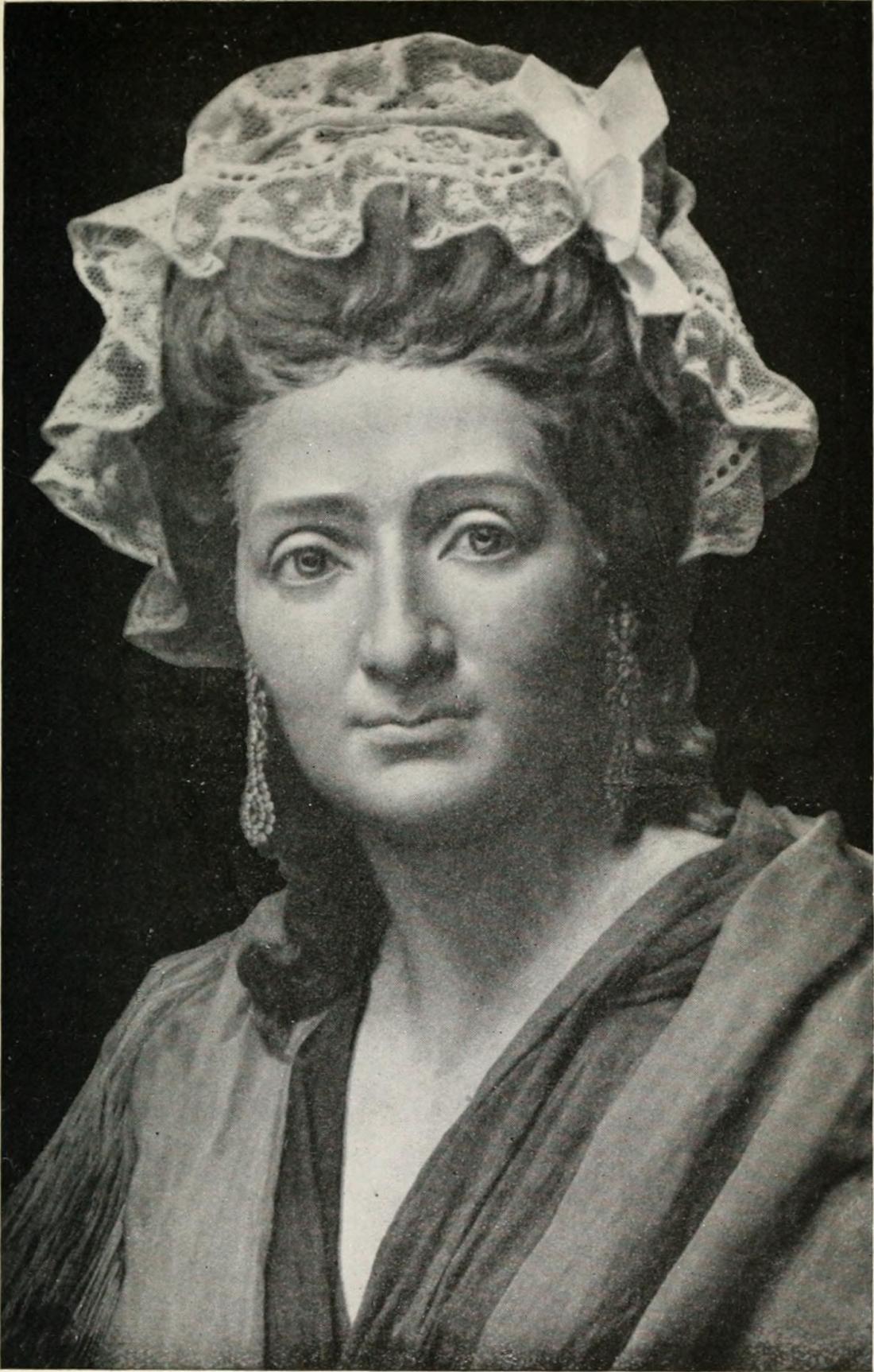
Louise Julien died at a much-too-early 38 years old of tuberculosis on the British island of Jersey. She went there in 1853 for her health after leaving France by way of Belgium, but by the time she reached Jersey, the illness was too far gone in her weakened body. Louise had been born in Paris, the illegitimate child of a seamstress and a minor Portuguese nobleman. Louise came into the world at a time of great upheaval in the history of France. Napoleon had only recently been removed and exiled, his attempts at European domination finally thwarted. France had to get used to a new government, and the changes brought about by the French Revolution and Bonaparte’s reign were still being processed by the culture and society.

From a young age, Louise was different than other girls. Strong-willed and almost foolishly brave, she eventually married a tailor but chose to go by the last name Julien rather than her husband’s name. She made money singing in workingmen’s clubs, becoming rather popular in those circles. And that experience helped her develop a sense that workers were, by and large, still at a disadvantage in French society despite the changes the revolution had brought. In addition, she made a reputation as a poet.

In 1848, France experienced another revolution, as workers rose up and demanded more rights and accommodation in the public weal. It began in Paris, and Louise was at the forefront of the movement. The Second French Republic was proclaimed as a result, and some major changes were made in society. But then, Napoleon III, the nephew of the former emperor, staged a coup and declared himself the new French Emperor. Again, Louise took to the streets in protest, urging her comrades to march against the illegal takeover by public demonstrations. The will of the people must be heard, Louise said, and the only way those in power would hear the people’s voice would be through mass demonstrations. In a skirmish with government troops, Louise was injured and then arrested by the new government for being a dangerous revolutionary. It was in prison that she contracted the tuberculosis that eventually took her life on Jersey.

At her funeral in Jersey, the famous author, Victor Hugo, and the poet of the Second Revolution, Joseph Déjacque, gave eulogies over her coffin. Hugo’s speech in particular was so moving that Parisian newspapers reprinted it, and the story of Louise’s heroic efforts on behalf of the revolution and French workers was retold for generations afterward. But that’s not why most people remember her today.

No, we remember her for Hugo’s memorialization of her, at least indirectly. You see, when it came time some years later for Victor Hugo to put pen to paper and write the great novel of the French Revolution of 1848, he used Louise as the inspiration for one of literature’s most enduring characters. He was looking for a character who, like Louise Julien, lifted herself from humble beginnings and attempted to make her world a better place. Thus, you know Louise Julien best as the character Cosette, the girl adopted by Jean Valjean, in Hugo’s landmark story, Les Misérables.

On a Smuggler

Ludwika (Louise) Jędrzejewicz was a most unlikely smuggler.

The daughter of a proper Polish family, Ludwika was born in 1808 in Warsaw. Her father was a Frenchman who had emigrated to Russian-controlled Poland some years earlier as a businessman and tutor in French. She and her siblings grew up being multi-lingual, and Ludwika had a relatively privileged upbringing compared to most young girls her age. Czarist Russia had control over Poland at that time, and the Polish people desperately wanted independence from their Russian overlords. At the same time, Russia worked hard to keep efforts at Polish independence and patriotic expressions among the Polish people to a minimum.

Ludwika became a musician and composer, something that was unusual for a woman in that time and place. Her music was unique and well-received; the Poles pointed to it as an example of the quality of Polish culture and creativity. She and one of her siblings, a sister, wrote anonymous pro-Polish propaganda against the Russians, too. She supported organizations that advocated Polish nationalism. In 1832, Ludwika married a lawyer, a man named Józef Jędrzejewicz. Even though the marriage produced a child, it was an unhappy pairing.

Then, in the summer of 1849, Ludwika received a letter from her younger brother, Frederic. He had moved to France to work on his own music career, and he was in poor health. He asked if his older sis could come help him, nurse him back to heath, and, maybe, help him return to Poland and the family. Ludwika agreed, much to her husband’s chagrin. Józef accused her of putting her birth family before her own child and marriage, but she ignored his complaints and went to Frederic. She nursed her brother and cared for him as best as she could, but the man had tuberculosis. He had always been thin and frail, and his body was not able to fight off the illness. He died that autumn in Paris, his loyal and loving sister at his side. However, before he died, Frederic asked his sister for a favor. He wanted her to smuggle something into Poland for him. “Take it to the church,” he said to her in one of his last sentences before his death. “Promise me,” he said. Through her tears, his devoted sister promised. Frederic was buried in Paris, and Ludwika began making her plans to return home to Poland.

By this time, Józef had left her, fed up with her loyalty to her brother. So, with literally nowhere else to go, she decided to return home to her mother’s house near Warsaw. But she still wanted to honor the departed Frederic’s wish to return “home” the item he made her promise to give to the church. And to do so, Ludwika had to smuggle the item past not only the Russian border and customs authorities, but she also had to smuggle it past the guards at the Austro-Hungarian border as well. So, she did what any decent, self-respecting woman would do. She hid the item under her dress. Surely, no customs official would search a lady’s person, even someone as rude as a Russian border guard.

And she was proved right. Her voluminous skirts proved a perfect hideout for smuggling the item back into Poland. After sitting on her mother’s fireplace mantel for a time, Frederic’s item was given to the Warsaw’s Holy Cross Church. Ludwika would mirror her brother and die young from a disease in 1855. But she felt that she had shown honor to Frederic by keeping her promise. The item she gave to the church in Warsaw is still there today, and it occupies a prominent place in the building, where it has been a national treasure ever since. It has survived revolutions, two world wars, and several occupations. And it stands as a monument not only to Frederic and his sister, but it also represents the patriotic spirit of the Polish nation. You see, Ludwika’s maiden name was Chopin. Her brother, Frederic Chopin is today one of history’s greatest composers and a Polish national hero.

And the item he had his sister smuggle into Poland, the item that is the pride of the Holy Cross Church is Frederic Chopin’s heart.

On a Tourney Win

Margaret Abbott was an American amateur golfer at a time when “ladies” didn’t really play competitive sports. She was born in 1878 in India where her parents had moved because her father had business there. Her mother was equally accomplished, becoming a newspaper reporter and literary editor for many newspapers in the United States. And Margaret herself lived a privileged, full, and varied life before dying in the 1950s. She studied in the United States and abroad, but it was while her family lived in Chicago that Margaret first began to take golf seriously.

And she was naturally athletic. A couple of local amateur golfers (true gentlemen of the time refrained from being crass professionals, don’t you know) from the club where her parents were members took Margaret under their wings and taught her all they knew about the game. Under their tutelage, Margaret’s golf game rapidly advanced far beyond others her gender and years. She won several tournaments in and around Chicago and beyond and developed a reputation for being a fierce competitor.

Then, in 1899, Margaret and her mother traveled (by themselves! Amazing!) to Paris for the pair of them to study art. Margaret’s mother also used the time to pen a travel book for American women who had the same desire, entitled A Woman’s Paris: A Handbook for Everyday Living in the French Capital. The two women had a wonderful time, enjoying all that the fin de siècle era Parisian culture had to offer.

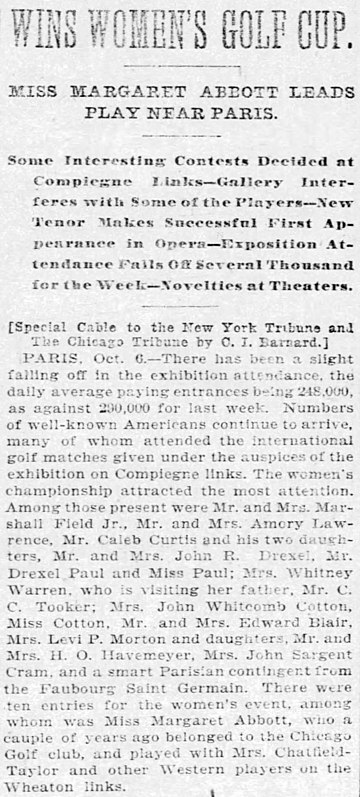
It was while the pair were in France in the summer of 1900 that they noticed a newspaper article stating that, in association with all that was going on in Paris that year, a golf tournament was open for any and all entrants. And there was indeed a great number of events happening in Paris that summer. The Paris World Fair was held that year. The French capital city hosted the second incarnation of the modern Olympics that summer as well. The city was filled with tourists from across the globe. And then here was this golf tournament. Now, Margaret’s mother was no slouch at golf, either, and the mother-daughter team decided to enter the tournament.

And Margaret won. By two strokes. And Margaret’s mother finished the tournament a respectable seventh. And, for her win, Margaret was awarded a beautiful porcelain bowl that had gilded embellishments around it. The story of this American girl winning the Paris golf tournament made the US papers, but the story was quickly forgotten.

Margaret got married eventually upon her return to the United States. She raised a family. She played some golf, but an old knee injury made her give up the sport. Almost thirty years after her death, her son, Philip, received a phone call from a professor at the University of Florida, a woman named Dr. Paula Welch. Dr. Welch asked Philip about his mother, about her life and then about what she told him of the tournament she won in Paris three-quarters of a century earlier.

Philip was surprised. His mother really hadn’t spoken much about it, he said sheepishly. I mean, he said, it was only another tournament, and she competed in many during that time. According to Philip, Dr. Welch was silent on the other end of the phone line for a moment. In fact, he wasn’t sure if the professor were still there. Finally, Dr. Welch spoke, and what she said stunned Margaret’s son.

“You mean your mother didn’t tell you that she was the first American woman to have won a gold medal in the Olympics?” she asked.

On a Model Maker

Marie Grosholtz. was born in Strasbourg France during the Seven Years War. Her father, Joseph, died in the war two months before Marie’s birth. She and her widowed mother, also named Marie, moved to Switzerland, to the city of Bern, where the mother found work as the housekeeper of a surgeon.

This surgeon became the most influential person in the young Marie’s life. His name was Dr. Curtius. Marie became like a surrogate niece to the doctor, and she returned his love. Curtius took the young girl into his surgery and taught her anatomy. Here, from the time she could clamber on to a stool to reach the counter, Marie learned the skills that would make her life’s work.

The doctor used models to teach anatomy to students, and he found that the young girl had a natural feel for the creation of those models. Using pliable materials, Maria sculpted body parts that Dr. Curtius would then teach from. She saw the models she did not as work but rather as play, as time she could spend learning more from her beloved and adopted uncle. The pair became inseparable, and, by the time she was in her teens, Marie’s models were far superior to those off the good doctor.

In between the years of the Seven Years War and the beginning of the French Revolution, Curtius and Marie and her mother moved moved to Paris. There, the doctor set up his practice, but he started a sideline business—he began exhibiting the models that Marie had so lovingly and skilfully crafted. People were fascinated by the fact that she was so young, yes, but also that she was so talented.

She began modelling the heads of the famous and the infamous in France at the time. She even spent time among the soon-to-be-doomed Royal Family of France, even receiving an invitation to go live at Versailles. Voltaire, Marie Antionette, Louis XVI, and Robespierre all received a sitting with the young woman.

Eventually, Marie’s connections to France’s aristocracy made her an enemy of the new French Revolution’s government, and, after a short imprisonment, she had to flee to Britain where she would spend the rest of her life. Before she left in exile, Marie had married a man named Francois and had two sons who lived to adulthood. But it was in Britain that she made the reputation that she continues to enjoy today.

You can see her models for yourselves at one of London’s most visited tourist attractions:

Madame Tussauds.

On a Reformed Criminal

The age-old argument about incarceration centers around the reason for putting a criminal in jail. Is the primary purpose of imprisonment meant to be more punishment, or should it be more about rehabilitation? In the case of Eugene, it was both, really. He had been a career or life-long criminal. At almost the age of 40 and during a rare period he was not in jail, Eugene heard that a man with whom he had committed several crimes was executed by the state for murder. The news of his former partner’s death changed him.

So, Eugene decided to go straight. He still had some time inside that he owed to the state, but he told his captors as he went to prison that he wished to provide them with insider information in exchange for an early release. The chief of police of the national capital city agreed, and Eugene became a snitch. Except that no one really knew his identity because he gave his reports directly to the chief through codes sent through several channels. And Eugene’s information was amazing. His long history in crime had given him credibility in prison, and the other crooks trusted him and looked up to him. So, they told him all their plans, all their past misdeeds, and all their nefarious connections in the major cities of the country. And it all went to the ear of the chief of police through Eugene.

Having kept his part of the bargain (incredibly, so, given the amount and veracity of his information), and the chief kept his part, too. Eugene was released, but the authorities made it look like an escape so that his reputation both in and out of prison would remain intact in case his snitching skills were ever needed again. In fact, Eugene became an undercover police officer. He used his connections and reputation to gain entry to some of the most notorious criminal gangs in the nation. He would slide easily into and out of costumes, personalities, and personas to infiltrate into the core of gangs, cutthroats, drug rings, and illegal gambling operations. Crime decreased dramatically nationwide because of Eugene’s efforts as an undercover cop.

It was at this point that Eugene had a brainstorm. If he could be this effective as a plainclothes policeman, surely an entire division of the police department, all made up of former (now trusted and reformed) criminals could be super efficient at stopping crime. The police chief agreed, and he gave Eugene the authority to establish an undercover squad for this purpose. Eventually, 28 former criminals and former jailbirds made up Eugene’s secret, undercover police squad. They soon led the nation in major crimes arrests and convictions. The group uncovered assassination plots against politicians, they foiled bank robberies, and they broke up counterfeiting rings.

But there was one problem. Eugene was still on the books as a wanted, escaped criminal. His arrangement had been with the chief of police and not with the magistrates and the court system. A pardon was requested, and, because of his great service to the nation over the years through the work of the undercover squad, Eugene received his pardon. For the first time in his life, he was truly a free, unwanted man. But his collaborator, the chief of police, was replaced by a man who didn’t like the idea of a group of policemen in his department being made up of former criminals, and he began putting pressure on Eugene to get rid of the squad and replace them with “straight” policemen. Eugene saw the handwriting on the wall, and, after over a decade of solid and valuable police work, he tendered his resignation.

Eventually, Eugene put his years of work on both sides of the law to work as a private investigator. And, as he did when he worked for the police, he hired both male and female convicts as his agency’s operatives. The business thrived–perhaps too well. Soon, the police themselves began to complain that Eugene’s company was taking cases and solving them to the point that they had little work to do. His inventive and creative processes of documenting and analyzing such things as crime scenes and of identifying criminals have become standard stuff in not only private investigating firms but also in most police forces worldwide. If you’ve seen a line-up, a photo array of potential perpetrators, a systematic cataloging and documenting of a crime scene, plaster casts of shoeprints, bullet ballistics, and so on, then you’ve seen something pioneered by Eugene. When he died in 1857 in Paris in his 80s, he was lauded as a great pioneer of police work.

You don’t know his name–Eugene Vidocq–but you know the word that describes him: Detective. And, since Eugene, every private and police detective, both in real life and in fiction, are modeled after him and his methods.

Not bad for a career criminal, eh?

On an Educational Agreement

Hearing the news in late 2022 that the conservative government of Afghanistan has banned women from pursuing university degrees reminded me of a story I’d read a few years ago. We in the west take it for granted that anyone can go to college if they wish–or not. Choice is one of the major benefits of our western political-economic systems. We often forget that, even in the western world, women attending a university was an extremely rare thing even one hundred years ago.

This story is about a pair of sisters in central Europe in the late 1800s who desired to study in a university. Their family wasn’t wealthy, but they were from solidly middle class stock. Despite having some funds, they still lacked the money for university tuition. Add to this impediment was the fact that women were often denied any post-high school education for many of the same reasons the Taliban is now using in the modern era. So, these sisters, Mania, the younger one, and Brania, the older one, entered a secret university in their country called The Flying University. This institute of higher learning provided affordable co-educational opportunities in an era where such a thing in that part of Europe was practically unheard of.

However, the Flying University provided only a limited opportunity for the area of study the sisters desired: Science, specifically medicine and physics. So, they devised an agreement. Mania agreed to work as many jobs as she could in order to pay for Brania’s education in France, a nation that allowed women to attend classes and receive scientific degrees. Then, when Brania’s education was finished, it would be her turn to work and support Mania as the younger sibling worked on completing her degree.

Mania worked as a tutor for younger students and, eventually, she moved in with a family of nearby relatives and worked for them as a governess. The agreement seemed to be working as Brania’s medical studies progressed. But, one thing intervened that the sisters didn’t foresee. The older sister fell in love. She met and married a fellow student in Paris, and her plans to work while Mania was in school were put on hold. The best she could offer was to have Mania come live with the newlyweds in Paris in order to save money. Now, you might think that this was incredibly unfair, and that Mania would have every right to be angry after working for two years and Brania not living up to her side of the bargain. However, Mania was absolutely thrilled for her beloved sister, and she took Brania up on the offer of a place to stay for a time in Paris while she sorted her school situation.

As much as Mania had worked while Brania was in school, she doubled her efforts to work and pursue her own degrees. She moved into a one room apartment nearer the school, continued tutoring, and often went without eating in order to save money for tuition. Her hard work paid off. She not only completed one degree, but she also achieved a post-graduate degree and received a scholarship to assist her with funding. The university in Paris recognized her exceptional ability and rewarded her work and effort.

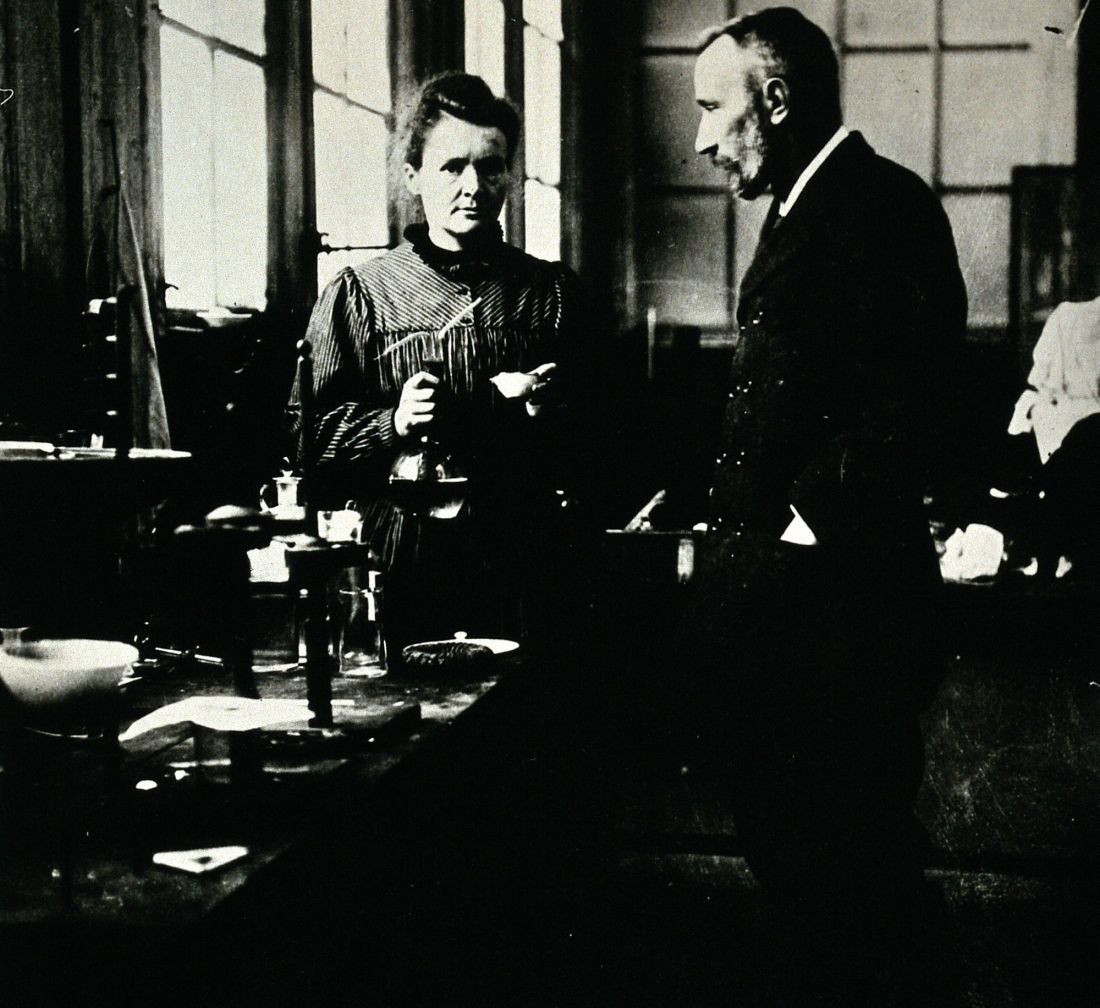
It was after her degrees were completed that Mania went looking for space in Paris where she could continue her research. A fellow scientific researcher named Pierre offered a small space where Mania could begin her work. On meeting each other, they each later reported that a strong attraction was felt. Pierre eventually offered marriage, and, after weighing how much a marriage would have an impact on her research, Mania agreed. The pair was married in 1895. So, Paris brought Mania the education she sought and a life-partner (and research partner) she never knew she wanted or needed.

Of course, Mania was the nickname her family called her. You know her by her married name in France.

Marie Curie.

On a Painter

Vincenzo loved art. Ask anyone who knew the man. He was a fair painter himself as well. Such was his love for fine art that the Italian moved to Paris to study his chosen craft and to be near some of the world’s greatest art exhibitions. He even got a job at the Louvre Museum in order to surround himself with his beloved passion.

Part of what Vincenzo liked about art was that Italy had such a rich and varied history of the arts for hundreds of years. He took great pride in his nation and felt that art was, in some large part, his birthright. He loved all things Italian. Such was his feeling of patriotism for his nation that he did not even wait to be drafted into the Italian Army during World War I–he was one of the first to enlist. But we’re getting ahead of our story.

In Paris, Vincenzo often tried to track down paintings by Italian painters to, in effect, “rescue” them from the foreign French and return them to his native land. In 1911, he managed to lay his hands on a work by one of the great Italian masters. He felt that all Italian art should be displayed in Italy. Returning this painting to its artistic “homeland” would be an act of national pride for Vincenzo. He lamented that works of art by Italian artists had been taken (“looted,” Vincenzo said) during wars in the past and were now on display in other nations. It wasn’t right, he said.

This particular work that Vincenzo managed to get was certainly worth more than it cost him. In his mind, the work should be hanging in the greatest museums in Italy or taken on display around the country. However, when he brought the work to the attention of a museum director in Florence in 1913, his motives began to be questioned. The reason that his intentions began to be scrutinized was that Vincenzo told the director that he felt owed a reward for bringing the work back to the land of its origin. The director said that if he really was interested in returning art to Italy then he should be doing that for free.

The museum director was nonetheless interested in the work Vincenzo presented him, and he asked to be able to inspect the work in order to authenticate it. Vincenzo agreed, and he presented the work to the Uffizi Gallery in Florence. Sure enough, the director was thrilled to announce that, indeed, the work was by one of the great Renaissance Italian masters. He congratulated Vincenzo on the success of bringing this work home to Italy. He then immediately called the police and had Vincenzo arrested.

You see, the painting that Vincenzo Peruggia presented to the Uffizi director had been stolen two years before.

You know it as the Mona Lisa.

On a Military Funeral

Full military funerals are usually only reserved for, well, soldiers who have shown exemplary service to their countries or national heroes and the like. They are rarely given to women. In the case of a particular funeral in 1975, in France, a woman indeed received full military honors—the only time that has happened in French history.

Who was she?

Well, I can tell you that she wasn’t born in France. In fact, this woman was born in St. Louis, Missouri, in 1906. She dropped out of school at age 12. By 13, the girl was practically living on the street, and she found work as a waitress. There, in the restaurant, still at age 13, she met and married a much older man. By the time she reached the ripe old age of 15, she had left that first husband and married a second one.

Yes, I’m sure that this is the woman who received the accolades and appreciation of the French government at her death.

Want to know more? Sure. This woman was accused by newsman Walter Winchell of being an active Communist in the 1950s. She met and became friendly with Cuban dictator Fidel Castro in the 1960s. Clergymen and morality enforcers protested against her. She had public and well-publicized affairs with both men and women across several decades. At the end of her life, she had to rely on the kindness of others for a place to live and for her basic needs.

And this is the woman France chose to honor?

Yes.

Because, as well as those things renumerated above, this amazing woman was also recognized as a hero of the French Republic. She had help to organize and lead French resistance groups against the Nazis in World War II. She’d left the United States and moved to Paris in the mid-1920s, and she fell in love with the country and its people. She worked tirelessly for the downtrodden, the voiceless, and orphans—even adopting several children over the course of her life. As you have guessed, this woman was famous as a singer and performer. She rubbed elbows with the rich and famous across all of Europe and much of the world. She became beloved and much respected, admired, and imitated in France.

Ironically, it was her home country of America that rejected her. She would point to this rejection as a major reason for her decision to move to France in the first place. Yes, the United States would not let her even have a cup of coffee at a lunch counter in a café or enter a hotel through the front door.

That’s because this woman, so lauded and appreciated by her adopted nation of France, was still only a Black woman to American society. Yes, when Josephine Baker died, France showed its appreciation for its adopted daughter, even if her native United States had rejected her.

On an Uncouth Tourist

Americans have a reputation of being some of the most uncouth and self-centered travelers anywhere in the world but particularly in Europe. Perhaps it’s the American educational system that fails to properly prepare people by not providing them a broader view of the world. Maybe it’s that Americans are so self-centered that, if it doesn’t concern us, we simply tend to not care about it. For whatever reason, the reputation of many Americans who travel overseas is not a good one. In fact, you may sometimes hear the phrase “Ugly American” to describe someone from the United States who is unaware or unconcerned with another culture, language, or customs while traveling.

Case in point, a man in his 70s from the United States who visited France. What made this particular tourist noteworthy was that he had some money. He also had some education, so that excuse for his uncouth behavior in Europe doesn’t hold up. What is beyond dispute is that his actions shocked the people he encountered on his trip. For example, in a nation like France that is known for its haute couture, this American eschewed all sartorial convention and chose clothes of a much poorer person. This mystified the French he encountered.

And the wanton behavior! His wealth and business position in the States had caused a rift between him and his wife, and, while they never divorced, they lived separate lives for some time. She had recently died before he left for his France trip, and the man felt that he had the license to enjoy the company of some high-class French prostitutes. So, he did. In fact, he moved one of them into the apartment he rented in a Paris suburb. What made this behavior unseemly, even for the normally licentious French, was that the woman was more than 40 years his junior. And she was by no means not the only one he shared his bed with.

While these antics may seem eccentric in the case of the clothing or harmless in the case of the sexual exploits, it’s what we know of the man’s behavior in London that may be the most shocking of all his European escapades.

We might not have known about this most disturbing side of the man, but, luckily, the house the wealthy older American rented in London was renovated in the 1990s. It was then that the bones were discovered. A worker in the house’s basement unearthed a human thigh bone, and he called the police. Soon, hundreds of human bones were unearthed from the basement. And they could all be traced to the time when the American rented the house.

Was the American a murderer? Why would there be bones buried in the basement?

To this day, we don’t know for sure exactly what Benjamin Franklin had to do with it.

On A Monstrosity

Paris often hosted world fairs in the 19th century. The French prided themselves for being on the cutting edge of engineering, the arts, education, and technology. The world fairs in Paris showcased all these and more to an eager world. The 1889 world‘s fair was no exception.

This time, the event was held in honor of the 100th anniversary of the fall of the Bastille, the seminal event in what would become the French Revolution. France held a nationwide contest for designers to create pavilions and buildings and art that would celebrate this historic event and showcase French ingenuity to the rest of Europe and the world.
A civil engineer named Gustave entered his design for the architecture exhibition. At first blush, Gustave seemed to be out of his depth, somewhat—at least that’s what most people thought. He had built his professional reputation on erecting railroad bridges. True, he had built some railroad stations around the world, but they were not remarkable.
But, in many ways, Gustave was a good representative of France as an international power at that point in the national history. His bridges and buildings were found all over the world; Chile, Vietnam, Venezuela, Romania, Brazil, Spain, Portugal, Peru, and even parts of Africa all had seen Gustave’s works erected. Many of France’s colonies had railroads that ran across bridges built by Gustave.
Gustave found, to his own delight and to some other, more prominent builders’ dismay, that his proposal was awarded the contract, and work began on his project. He only used 200 men to complete his structure, and he pre-fabricated much of the work in his shop. Then, he had it shipped down the Seine River on barges to the worlds fair construction site. One historian recently said that the work was put together much like a modern 3-D puzzle.
When the structure was finished, the public and professional reception came pouring in. And, almost to a person, people hated it. “It’s an embarrassment,“ seemed to be on the mild end of the spectrum, while comments such as “Even the Americans would not build such a thing as gauche as this” occupied more of the middle of the road reviews. Decorum prohibits this blogger from detailing the reviews from some of the more nasty critics of that time.
“Well,” some people reasoned, “this national embarrassment, this public monstrosity, will only be around for a few years, and then it will be torn down. Thank God!“
Yet, Gustave was not to be daunted. He felt that history would treat his creation kindly.
And so it has.
For, you see, Gustave‘s last name was Eiffel. His tower is now probably the foremost symbol of the illustrious French nation