On a Pogrom

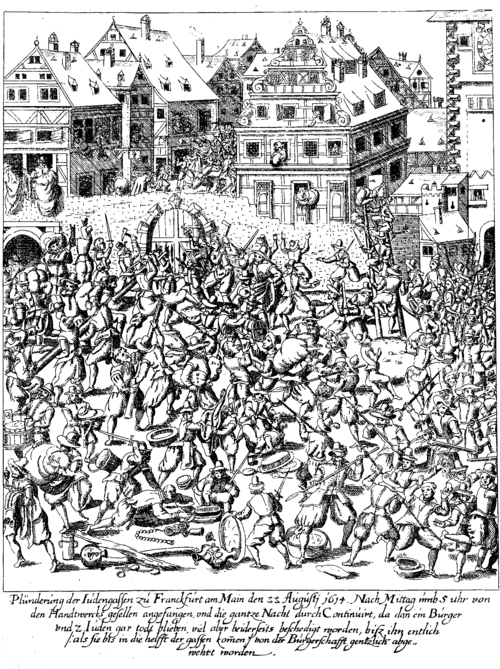
I want to speak about a country where Jews had been persecuted for centuries for being, well, different. Their religion and traditions, their clothing, and their lifestyle; these already marked them in Europe as being the “other” for as long as people could remember. And we know how things go for groups marked as being different. So, when the government of this particular nation ordered that Jews would have to wear a badge signifying their ethnicity and religion, well, in many ways such an order was superfluous. People knew who the Jews were in their community. And, over the years, propaganda spread about Jews being carriers of diseases (but they themselves being immune because they were in league with the Devil, you understand) and being hunters of children for their blood. Jews had been persecuted for being dishonest moneylenders when the Catholic Church condemned them for the charging of interest in lending the money. And so on.

We know that the nation’s history was already littered with accounts of pogroms against Jewish people. In fact, we have records that the houses that had Jewish populations in them were burned in times of plague or famine, because, after all, you have to blame somebody for the bad things that were happening, and who better than the “other” to pin the blame on? Churches preached sermons on blaming Jews for things like floods and earthquakes, saying that these things were happening because God was angry that the Jews had killed Jesus.

But back to this particular period of persecution, specifically how the authorities first marked Jews for persecution. The government, in ordering that the badge be worn, mandated that it be yellow and that it be of specific size and shape. To be a Jew and be caught without wearing the badge in public meant prison or worse. The government decreed that (in fact, promoted the fact that) average citizens could make such accusations. Rewards were offered for turning in Jews who ignored the law. Other laws quickly followed. Of course, one of the first things that the government mandated was that all synagogues were to be immediately shuttered. Then, in an effort to push the Jews out of the economy, extremely heavy taxes were imposed. That shut down several of the smaller businesses immediately. Then, where Jews could travel was limited. What amounted to the establishment of ghettos resulted from laws forcing Jews to live in certain areas of towns. And then, as we know, Jews were systematically rounded up and removed by the authorities.

We should read descriptions like these and redouble our resolve that such events should never happen again. Yet, we see history repeating itself over and over as hatred is allowed to go unchallenged and unchecked. Some people actually deny that these things and others like them ever took place at all. Media even go to great lengths to give credence and platforms for people who actively practice such denial. Many simply say that to deny that these events happened is merely another opinion or even “alternate facts.”

And to think that these events described above occurred in England in the late 1200s makes all of it even more astonishing.
On a Crown Jewel

The coronation of a new monarch in the United Kingdom put me in mind of one of my favorite movies as a child. The film was called The Jokers, and it was about two bored, upper class English brothers in London who decide to steal the Crown Jewels as a prank. For me, a kid from the southern United States, that such a place as “Swinging London” as depicted in this 1967 film existed at all boggled my mind. Added to my interest was that the film showed many of the grand historical sights (and sites) in and about London.

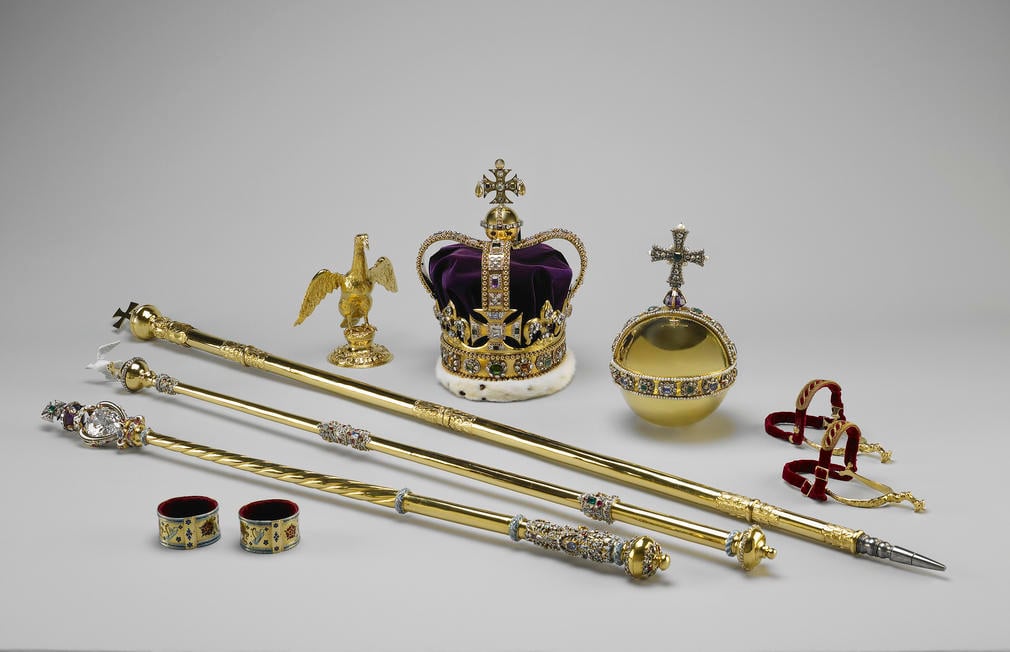
The Crown Jewels are not simply the crown that the monarch wears, or the scepter, or the orb. No, there are many other things that make up this selection of precious things, a group of items called, “a unique collection of sacred and ceremonial objects.” Over 100 items, in fact. 23,000 gemstones adorn the various items. We can’t really put a price or value on these things simply because of their intrinsic and symbolic value to the people of the United Kingdom. They mostly either represent the power and responsibilities of the role of monarch or they are used in the coronations.

One of them, however, stands so distinct and so unique compared to these other bejeweled and “precious things.” In fact, it is the oldest of all the objects so precious and revered by the nation. Records say it was made in the 12th Century for the king. It’s not particularly flashy or overly bejeweled or large like the rest of the objects, and you won’t actually get to see it during the coronation, but it’s used in the ceremony.

Let’s go back a bit. In the 1640s, England stopped being a monarchy. Oliver Cromwell defeated Charles I in a bloody civil war and had him beheaded, and he drove Charles’s son into exile. For roughly a decade, England had no king. The new government, eager to erase the trappings of the monarchy, destroyed or melted down or sold the Crown Jewels. The sale of the jewels attracted a large crowd, even though most of the people in attendance couldn’t afford the items. A man who had been a groom of the wardrobe for the now-deceased Charles I, a man named Mr. Kynnersly, bought this item in question for 16 shillings. In his mind, it would give him something to remember his former employer by.

Fast forward a few years. In 1660, Cromwell and his Commonwealth experiment were gone, and England welcomed back Charles II to restore the monarchy. The problem was that all of those crowns and other trappings of the office were gone. So, they had to be remade. And those are the items that are today stored in the Tower of London when not being used for official functions. And, when Charles II was being crowned, that’s when Mr. Kynnersly stepped forward and presented to the new monarch the only item that survived the Cromwell destruction of the Crown Jewels. So, when you view a coronation, know that all those objects-the crown, the orb, the scepter, the capes, everything-has been recreated since 1660.

Except for one.

It’s the spoon used to anoint the monarch with oil.

On a Real Grinch

Ollie hated Christmas. Well, to be fair, Ollie hated any religious celebration outside of Sunday services. In fact, there was quite a lot that Ollie hated.

He worked hard to make sure laws were passed in his country to insure that not only Christmas, but also Easter and other “saint” days were not observed by the Christian church. And Ollie succeeded.

This was a guy who believed in the dictum, “No more fun of any kind.” Besides his war on Christmas, Ollie worked to outlaw such things as theaters (dens of iniquity, he said), bars (do we need to explain why?), and sports (if you have time for leisure, you have time for work). Even swearing could earn you a lashing in the public square.

It wasn’t enough that he believed Christmas should be ignored; he also initiated the day as a day of fasting in repentance for the previous years of what he perceived as gluttony on a feast day. We have to remember that most poor people in towns didn’t eat meat daily, and that meat meals were sometimes had only on “feast” days–like Christmas. To Ollie, this was an unneeded luxury for people. So, he said that fasts should be observed rather than feasts on December 25th.

You might wonder about Ollie’s justification for this concept, and I’m here to help you with that wondering. Ollie pointed out–rightfully–that the Bible doesn’t actually state when Jesus was born. There is no date stated in the Gospels. The date of December 25th is simply a tradition. Also, the Bible never mandated that the date be observed even if we did know what date Jesus was born. Besides, Ollie, said, Christmas is Catholic, and, if he was anything, he was vehemently anti-Catholic. He was anti-anything that didn’t agree with his incredibly narrow interpretation of God.

Now, to be fair, people still celebrated Christmas–they simply did it much more quietly and secretly. The holiday proved simply too popular to stamp out simply by dictate. And you will find people who said that Ollie had nothing to do with the ban on Christmas but, rather, he merely didn’t stop those who wanted such a ban.

Don’t listen to those people. Nothing happened without his approval while he held power.

And anyone who knew him knew that he was sour, dour, and almost never smiled. Ollie was the original Grinch who Stole Christmas. The only thing he wasn’t was green.

You know him, of course, as Oliver Cromwell.