
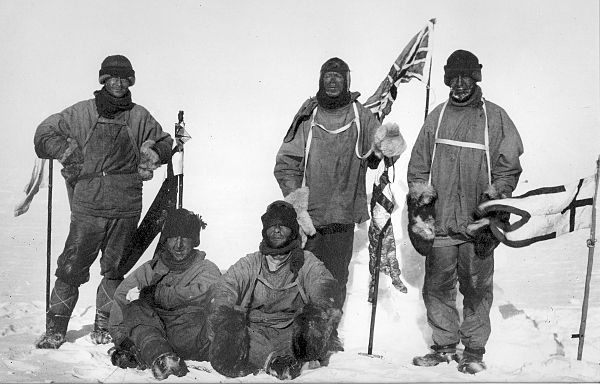
The tale of the British attempt to be the first expedition to reach the South Pole is one of triumph and tragedy. Led by Robert Falcon Scott, the trip that began in 1910, known as the Terra Nova Expedition, is famous in part for ending with the deaths of Scott and the others of his group who attempted the conquest of the pole only a few miles from a cache of food and warming supplies that would have saved their lives. Alas, the elements (unusually harsh snowstorms) and poor planning (see below) doomed the Scott Expedition from the start.
Scott was one of those Edwardian Era Britishers who felt that they could conquer any task the world had to offer. History had proven men like him right, most of the time. The Victorians, as we have seen in other posts, believed in their abilities to conquer nature and the harsh conditions of the planet in the pursuit of knowledge and national pride. Thus, the trip was one of not only attempting to expand the world’s understanding of Antarctica, but it also had strong ties to British nationalism that was part and parcel of that era.
And, to his credit, Scott and his men did reach the South Pole. They simply didn’t live to tell the tale in person.
You see, the British had some rivals in their quest to be the first to the bottom of the globe. A Norwegian team, led by Roald Amundsen, was vying to plant the Norwegian flag at the polar extreme point first. And that really frustrated Scott to no end. First of all, it wasn’t supposed to be a race in his mind. Besides, Scott was not a professional explorer per se. He was a British military man. But that’s what you did back then. Any British man with enough pluck and gumption (and financing) could do and did do incredible things for the time. And he was one of those men. Scott did have some scientific experience in the south polar region, but exploring wasn’t his occupation. He was more of an amateur in the best sense of the word as opposed to someone who explored and profited from it. And that was how Scott saw Amundsen and his party. Those guys were professional explorers, in Scott’s mind, and that rankled him somewhat. While Scott and his crew were interested in the scientific aspects of the trip, he felt that the Norwegians were in it only for the glory and conquest. And that wasn’t entirely untrue to a degree.
Scott’s and Amundsen’s attempts were different in other ways as well. Scott relied primarily on ponies to pull his sledges, while Amundsen used the tried and true method of dog teams exclusively (which doubled as meat when necessary). The Norwegians were made up of a 9 man team, while Scott’s party was only 5 (both groups had a large cadre of support people in place at their bases on the coasts). Scott’s group’s nutrition was sadly lacking in some basic and energy-granting nutrients, while their Norse adversaries ate relatively well and had a good mix of vitamins and minerals. The Norwegians also used skis, while the British eschewed them.
Despite their disadvantages, Scott’s party reached the South Pole early in 1911 even with their scientific experiments and samples that they collected on the way. However, they found that the Norwegian flag was there, and it had been there for over a month–34 days, in fact–since Amundsen beat him there. And, so, Robert Falcon Scott and his team, happy that they reached the pole but crushed that they finished a close second, turned back towards their home base. And it was this return journey that made him and his crew such heroes in the eyes of much of the world.
The going was slow, as I said, because of the spate of incredibly howling winds and driving snow. Their supplies dwindled. They spoke of desperately needing to reach the depot where fresh food and heat would be waiting, and, now on foot and dragging their sledges themselves, they began to falter. Freezing and starving to death, Scott still managed to keep a daily journal of the trip, and that journal was found along with his body and the bodies of most of the others in the group several months after their passing by some of his base camp comrades. And only 11 miles from their next supply camp. (Interestingly, Amundsen and his group actually gained weight during their return trip.)
In his famous journal, Scott spoke of his disappointment in not being first at the pole for Britain, but at the same time he also reveled in the scientific discoveries he and the party had made. He also mentioned that there had been discussions about discarding the samples of materials he and the group had found, jettisoning the weight, so that they could make more time, but that this idea was quickly abandoned in the name of science and knowledge. And, so, when the bodies of Scott and his companions were finally found, along with his diary, there were these samples. And the samples proved that, once upon a time, Antarctica had been a green, fertile, forested continent. The samples were fossils, you see, fossils the group decided to carry with them instead of getting rid of on the way home.
And so Scott and his men thus pulled several pounds of rocks across miles of Antarctica, choosing, perhaps, science over survival.

 The Rest of the Story