On a New American

Some of us are born to citizenship, while others of us choose the nation we come to call home. My grandfather (my father’s father) came to the United States as a teenager in 1907 from Greece. His eventual wife’s family left Denmark only a few years before that to move to New York City. My own son also chose America over a quarter of a century ago to make America his home as well. We are a nation of immigrants. I’m still gobsmacked that people can do that even though my family is rife with immigrants. Imagine emigrating in the late 1800s or early 1900s from Europe to the US, coming to a new place where you know almost no one, didn’t speak the language, and had no job or place to live; how does one do that? The fear of the unknown–as scary as that can be–has to be less than the fear of what one is leaving behind. Yet, that’s what over 12 million people did, first entering the United States through the immigration processing center known as Ellis Island in New York harbor.

One such family was the Beilins. They came from what is now the Siberian steppes of Czarist Russia in 1893. Moses, the dad, an itinerant cantor, and Lena, his wife, and the mother of eight children, came to the US like many other Jewish families did because their lives had simply become untenable in their native land. Isn’t that why many people emigrate? They were processed at Ellis Island, the children put in a pen, separated from their parents, until it could be determined that they had no infectious diseases and were deemed fit to enter. Moses managed to find a couple of rooms in a dank, moldy basement in New York for the family to live in. While Lena worked to make the dark, musty place a home, Moses found basic, honest work in a kosher butcher shop. The children were expected to contribute to the household income, even some of those who were under the age of ten. For example, young Israel, when he reached the age of 8, began selling newspapers to earn a few pennies that would buy food for the family. His sisters wrapped cigars in a factory. One of the brothers made shirts. Every evening, the family would come home deposit their meager earnings into the lap of Lena’s apron as she sat at the small kitchen table.

But in those days before antibiotics, illnesses we can fight off fairly easily today could devastate a family. When Israel (the family called him Izzy) was 13, Moses died. By that time, Izzy had decided that he wanted to be a singer. He had inherited his deceased father’s musical ear, and he managed to get a job as a singing waiter. From that humble start, he began to work with musicians to write songs that other waiters would sing as they served. In an effort to both continue to support the family and take away his mouth to feed, Izzy moved to a boarding room, a “flop house” shared with several other young, immigrant youths. He would later describe the living conditions as something out of a Dickens novel. Izzy also made some coins being an early 20th Century version of a street busker, singing to passersby for a few pennies when he wasn’t at this regular job. And, at other times, Izzy taught himself to play piano after the restaurant and bar he worked at had closed. He never took a lesson, but he learned how to put together a song that people liked. Simple songs, he would say, songs that people could relate to.

And you know those songs well. In fact, Izzy’s songbook makes up much of the modern American canon of national melodies. Songs like Alexander’s Ragtime Band (his first hit), White Christmas, Puttin’ on the Ritz, Cheek to Cheek, Easter Parade, Blue Skies, There’s No Business Like Show Business, God Bless America, and dozens more made him a household name.

Like my grandfather, grandmother, and son, Izzy changed his name when he came to America. It’s a place for a fresh start, a new beginning, and the chance that, if you work hard, you can be anything you want to be. That has been America’s genius from the beginning, to a large extent. It’s not that the Statue of Liberty, which immigrants to Ellis Island would pass as they entered New York Harbor, represents freedom–even though it does.

No, to immigrants like my grandparents, my son, and songwriter Irving “Izzy” Berlin, Lady Liberty represented something more: Opportunity.

On a Train Ride West

Charlie was a historian of sorts a hundred and fifty years ago. More often, Charlie wrote for newspapers along the upper Eastern Seaboard of the United States. As a young reporter, Charlie covered local stories that pleased the readership of the papers he wrote for. His tales garnered so much attention in the towns and villages in the upper east that the young man decided to compile some of his favorite local stories into book form. The book proved so popular that a big city paper hired the young man in 1877 to write for it because his prose made the local places and events come alive for readers. That’s how Charlie made the transition from reporter to some sort of local historian.

Charlie combined thorough research and good interviews to weave his tales. For example, on a story about some local cloth mills, Charlie gave an overview of the history of not only mills in New England but also of the use of cloth over the past several centuries. Such depth of coverage made him respected and made his writing popular. So, when a group of businessmen wanted someone to provide publicity for an investment they were making in some silver mines out west, they hired Charlie to take a train trip with them to document what was happening both on the trip and in the process of the mining of the silver. It was the investors’ idea that Charlie’s stories would bring in more investment money to their mining venture.

It took the group over four days by rail to reach Colorado, the place where the silver mine was located. Along with the investors, there were some geologists, lawmakers, and some other business types who made the journey as well. And Charlie milled among them all on the train, spending time with them in the dining car, interviewing them in the bar and smoker car, playing cards with them in the poker room, and so forth. And what Charlie learned as he rode the rails with some of the richest men in the nation, well, it was as if the young reporter had been to the best business school in the country. The way Charlie told the story to the papers, and the way the investors used what Charlie wrote, was that the young man wrote a series of “letters back home” as it were, letters that were really news stories that told of what he had learned and saw.

In these letters, later collected into a pamphlet called The Leadville Letters (after the famous silver mine the trip was traveling to), Charlie told of how capitalism had developed, how these men were doing things with their money, things that were changing the face of the nation. Sure, in one way, what Charlie wrote was propaganda, but what he wrote was also true. These men were changing the economy of America, using their investment money to get even more riches that they then turned into things like oil, steel, railroads, and other modern technology that was indeed changing the world itself.

And the trip also changed Charlie. He decided to report on business from that point on. Joining forces with a young college dropout named Ed, the pair opened their own reporting agency that focused on New York’s financial markets. Their reporting was accurate, well-researched, and well-written. And they could neither be bribed nor bought, nor would they allow their reporting to be swayed by market forces. Their daily reporting on the financial markets included a look at several key companies, mostly railroads, some banks, and the Western Union Telegraph Company. Charlie and Ed felt that these businesses were good indicators of how those financial markets were doing. That daily report on those businesses as an economic indicator is well known today. And their success was due in large part to that train trip Charlie took out west a few years earlier.

You see, it was Charlie Dow and Edward Jones who created the Dow-Jones Industrial Average.

On A Feminist

On June 3, 1968, a woman approached two police officers in Times Square, New York City. “Here,” she said, reaching into a bag she carried. She brought out two pistols, one a .32 semi-automatic and one a .22 revolver, and handed them over to the shocked uniformed men. “I shot him,” she confessed. “He had too much control over my life.”

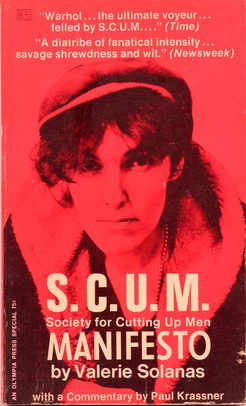
Valerie Solanas had a difficult past with men, apparently. Born in the 1930s, Valerie suffered abuse at the hands of her father. After her parents divorce, Valerie became an incredibly rebellious girl. Her mother had her removed from the household, sending her to live with her grandparents. However, the grandfather was a drunk, and he beat her often. Valerie had suffered enough. At age 15, she left the home and took to the streets. Sometimes during the 1950s, she had a child with a married man, but she gave up the child, a boy, for adoption and never saw him again. At that point, Valerie managed to complete a high school education and enter college. She received a degree in psychology from the University of Maryland, graduating with honors. That was followed by some graduate courses at the University of Minnesota and some a Cal Berkeley. It was during her graduate work that Valerie began writing a document that came to be known as the SCUM Manifesto.

Now, you can imagine what the document said. By this time in her life Valerie was a committed feminist. Rumor had it that SCUM stood for the “Society for Cutting Up Men.” The work was a satire against the patriarchy. Valerie’s writings advocated for the elimination of men in the world, stating that the world would be a better place without them. And, even though the writing was satire with a definite tongue-in-cheek tone to it, given Valerie’s background, it’s easy to see that there was a good bit of truth to what she wrote. Men had abused and used her for as long as she could remember. So, the manifesto gave voice to her feelings of helplessness in the face of the abuse she suffered. The work has been translated into many languages and is often included in lists of feminist must-reads.

Valerie also wrote a play about a street-wise, man hating prostitute who ends up killing one of her customers. Apparently, much of the play is autobiographical. She gave it to a friend, an influential artist, who promised he would he would read the manuscript and see what he could do to help her get it produced. After some time, Valerie followed up with the man to see what progress had been made on the script. The man said that, sadly, he had misplaced or lost the manuscript, and he was unable to help her. Valerie became understandably furious. Here was another example, she felt, of men using her and lying to her. She reportedly told a friend that she was going to shoot the artist and then, she felt, the publicity over the shooting would cause the play to be produced.

So, that brings us back to June 3, 1968, and the surrender of Valerie’s guns and herself to the two policemen in Times Square. It turns out that Valerie’s victim was shot outside of his building, two of her bullets ripping through several internal organs. He flatlined before doctors were barely able to revive him. The man would suffer from the effects of the shooting for the rest of his life, dying at age 58. Of course, the year Valerie shot him, 1968, assassinations and attempted assassinations filled the news. Martin Luther King, Jr., was shot in Memphis that April. Bobby Kennedy was killed in Los Angeles only two days after Valerie shot her victim. Therefore it’s easy to forget that on the 3rd, Valerie Solanas shot and almost killed the most famous artist in the world at that time.

Andy Warhol.

On A Wall

The Dutch really wanted to protect their town, so they built a wall. Now, settlements throughout history have built walls of protection. That’s nothing new. Walls seem to have three general purposes: One is to keep people out of a place. Two is to keep people in a place–like the kind you’ll find in a prison or, for animals, in pens or fences. And three is to act as support for some other structure. The wall the Dutch built was the first kind. Well, to be fair, the citizens of the town allowed their animals to graze on the other side of the wall because it kept the animals from coming into the town itself and bringing waste to the streets and alleyways, which means maybe the wall was 90% defensive and 10% keeping animals out.

You see, the Dutch were worried about other people–particularly the English–encroaching on their town, but only from one side. They didn’t worry so much about the other three sides of the town because, like many Dutch towns, it was built on the water front. The only place they felt the town was vulnerable was from the land and that was only on one side. So that’s why they built their defensive and protective wall there. The structure started out as a simple wooden demarcation line, but it soon grew to become a true defensive wall over 12 feet (3.7 meters) high. The Dutch called this defensive line Het Cingel–The Belt or The Ring–even though it wasn’t a true “ring” and only stretched across one side of the town. And, as the town guards walked along Het Cingel, the path they trod in the grass became a walkaway for townsfolks and, eventually, a street on its own. But the purpose was purely defensive.

Well, you can imagine what happened. When the Dutch were attacked, they were attacked from the sea. And the English who did the attacking with their superior navy took the town fairly easily. So the wall proved to be largely ineffective, despite the Dutch attempts at keeping people out by building it, and the English managed to secure the town for themselves.

Now, today, if you go to that particular town built by the Dutch today, you can still see the remnants of the wall or at least the places where the support posts were in the ground where the wall used to be. That line where the wall used to be is actually more famous today, even though there is no wall there.

Today, it’s in the part of the old Dutch town that has a lot of financial businesses affiliated with it over the years. When it was built, it was still legal in many parts of the Europe and the Americas for the buying and selling of people. One of the markets that facilitated this practice was located along this wall. So when you go to New York City, a place that used to be known as New Amsterdam when the Dutch owned it, you can see remnants of the Het Cingel built there, almost three hundred fifty years ago.

You know it as Wall Street.

On Grant’s Tomb

In the 1950s, Groucho Marx hosted a game show called You Bet Your Life. The show was a vehicle for the famous comedian to interact with simple American citizens and riff on their interactions, and all of it was built around a question and answer format. Sometimes, Marx and the producers found that, when faced with the lights and TV cameras and the studio audience (not to mention the larger than life persona of Groucho himself), some contestants on the show would freeze up and not be able to answer the show’s questions. That’s when Groucho would resort to a simple question in an effort to get the people to open up and begin to relax: Who’s buried in Grant’s Tomb? Well, the obvious answer that Groucho wanted was, of course, “Grant.” However, that answer both is and isn’t correct. Allow me to explain.

We today forget that Ulysses S. Grant (the “S” stood for nothing–it was only an initial) was seen in his day as one of the saviors of the Union. After almost four years of trying one commanding general after another as head of the Union Army, President Abraham Lincoln found in Grant a man who wasn’t afraid to engage with Robert E. Lee’s rebel army in the field. “I can’t spare Grant,” Lincoln said, “he fights!” Grant fought the insurrectionists to the point that they surrendered in April, 1865. And, in the 1868 election, the next election after the war’s end, Grant was elected President of the United States in a landslide as a sign of how popular he was despite the fact that he had no political experience and was the youngest president elected to that date. Think Dwight D. Eisenhower but almost one hundred years earlier. Grant was re-elected four years later, again, with a good majority of the vote. Sadly, almost a decade after his last term, Grant died of cancer.

However, at that point, much of the nation was divided over Grant’s legacy. Obviously, the people of the rebelling states thought of him as a butcher, the man who forced the Confederacy to be defeated by attrition. They had no use for him. And then, even in the north and west, there were Grant detractors because of what had happened during his eight years as president. You see, those two terms were some of the most corrupt in American History. Several of Grant’s appointees and administration officials were convicted of fraud and of bribery. While Grant himself wasn’t involved, the taint of the corruption had colored how many people viewed him. And, upon his death, the nation was torn as to how to remember this important–even if he was divisive–person.

And those who revered Grant wanted him to have a tomb fitting of the national hero they saw him to be. A fundraising campaign was begun to raise money to build a fitting tomb for the former general, but, after a good and fast start, it quickly fell flat. And land was found along the western side of upper Manhattan Island in New York City for the site of the memorial and grave. Now, Grant was from Ohio originally and had lived in Illinois for a time, but it was New York City that he called home after his presidency and where he was when he died. Also, it was where his wife, Julia, wanted the tomb to be located. She, of course, wished to be buried with her husband when she passed away. That request is why Grant wasn’t buried at West Point (no women allowed at that time) or other military cemeteries. Finally, after a direct appeal by Julia Grant to the soldiers who had fought with her husband in the war, enough money was collected to begin construction.

Now, even the building itself was controversial. The amount initially set aside for the task wouldn’t build a monument grand enough for those who loved Grant, but they felt that, as time wore on, they had to erect something on the selected spot. Finally, a cornerstone was laid in 1892, a full seven years after Grant’s death. And the final structure didn’t get finished until 1897–twelve years after the great man died. Julia died in Washington, D.C., in 1902.

And, to be clear, when the bodies of President Grant and his wife, Julia, were added to the memorial, they were not interred. Instead, the bodies lie above ground, sealed in a red marble sarcophagus. And that fact leads us back to Groucho’s question, the answer to which isn’t as easy as it seemed at the time.

Thus, the real answer to the question as to who is buried in Grant’s Tomb is, actually, nobody.

On a Pet Policy

As a former pet owner, I have traveled with my bulldogs on out of town trips before. And, as I would make my plans, those plans would always have to include finding accommodation that would allow me to have my dogs in the rooms with me. That concept of a pet policy isn’t that new in American History, but it has been pretty much the right of the wealthier classes in the United States to not only afford family pets but also to travel with them.

The Hotel Belleclaire in New York City has been declared a historical landmark and a building of cultural and architectural importance. The hotel of over 250 rooms was designed and built in the early 1900s on New York’s Upper West Side between Central Park and the Hudson River. While today it is a mix of long-term, rent controlled apartments and some nightly accommodations, when it was built, it was one of the city’s premier hostelries. People like Mark Twain, the acting Barrymore family, Babe Ruth, and Maxim Gorky all stayed there in the early days the hotel was opened.

And the Belleclaire was one of the first hotels of its kind to allow pets, although discreetly. The original newspaper stories about the establishment boasted that the staff knew how to be discreet regarding the needs of a sophisticated (i.e., wealthier) clientele. That meant learning to put up with pampered pups and cuddled cats for the guests at the hotel.

But that discretion had its limits, it turns out. A hotel staff is only expected to go so far. It seems that the kerfuffle began with a hotel guest who checked in under the name of T.R. Zann in 1920. Zann let it be known that he was a well-respected and widely-praised musician on the continent. He made the unusual request that his piano be shipped to him and brought by the maintenance department to his room on the 7th floor. And that’s what happened. The large, heavy crate was hoisted into the service elevator and brought to Zann’s room by an army of service workers and bellhops.

And then the story took a strange turn.

The manager received a phone call from the kitchen. It seems that Zann had made an incredibly odd request from room service. The kitchen asked the manager to discreetly verify the order with the guest before it filled it and sent it on its way to the 7th floor.

It seems that the musician wanted steak. Lots of steak. Fifteen pounds worth. And all of it rare.

The manager called Zann. The musician confirmed the order. When it was ready, the manager accompanied the waiter and his cart as the raw meat was taken up to the waiting man. When their knock at the door was answered with Zann’s brusque, “Come in,” the pair of hotel employees almost suffered a cardiac arrest because of the pet that stood before them in the center of the room.

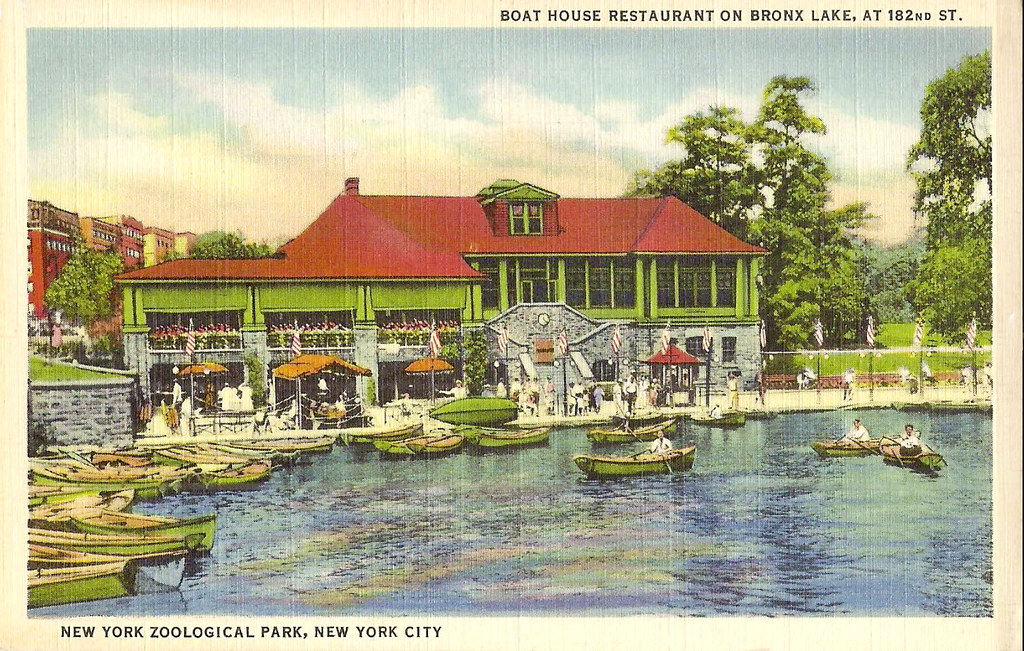
The manager beat a hasty retreat to his office where he immediately called the police. They arrived and with them a horde of reporters in tow. Zann was removed from the premises, and the pet was taken into “custody” by the Bronx Zoo.

But, there was another catch. You see, Zann was not actually Zann at all. No, he was actually a Hollywood publicity agent named Harry Reichenbach. He was in New York to drum up buzz for the studio’s next big picture: The otherwise completely forgettable Revenge of Tarzan.

It’s why he registered under the name T.R. Zann, and it’s why he had a lion smuggled into the Hotel Belleclaire.

On a Zoological Exhibit

Today, for many people, the ethical or moral justification for zoos is tenuous at best. While it is true that zoological collections can and do serve to preserve endangered species (and have seen some success at re-establishing such species in the wild), it is generally accepted by many that zoos and even aquariums can often do more harm than good to and for the animals in their care.

Take the case of one exhibit in New York in 1906. A man named Madison Grant (you know he’s rich because he has a last name as a first name), a person who served as the head of the New York Zoological Society, pressured the New York Zoo (known as the Bronx Zoo today) to create an exhibit that featured several species of primates. The highlights of the exhibit were the chimpanzees and an orangutan named Dohong. Grant also had zoo director William Hornaday add a primate from the Congo called Oto Benga and asked Hornaday to label the exhibit as an example of evolutionary science since several types of primates were shown in it.

Well, as you can imagine, the ministers of several churches in the New York area flew into paroxysms of indignation over the exhibit. How dare such a display be shown to the public, they screamed. How could the city expose children to the terrible lesson the zoo seemed to be teaching? They demanded that the zoo close the exhibit immediately and staged a protest against it.

On the other hand, the public flocked to the zoo. The old expression that any publicity is good publicity came into play here, perhaps. People who might not have heard about this “evolution exhibit” were made aware of it due to the ministers’ protest against it. Lines formed around the block to get tickets. Grant was thrilled by the public’s reception of it, and he saw the huge ticket sales as validation and vindication that his vision was right.

However, the exhibit closed soon after it opened. It seems that Ota Benga was less than cooperative. He would throw things at the onlookers and even made threatening motions with sticks at the viewers of the exhibit. Hornaday tried to give Ota Benga some leeway by letting him out of his cage during parts of the day where he docilly followed the zookeeper around the park grounds. But the fear that he might hurt some zoo patron overrode the desire for ticket sales, and the zoo decided to end the display.

Now, you should know that there were several other “evolution” type displays in the United States and around western Europe during this time. They, too, showed the so-called evolution of apes by having several “specimens” of lesser and greater apes on display. Like the New York exhibit, they, too, often featured natives from the Congo.

And, like Ota Benga, these Congolese were the feature exhibits in human zoos.