On a Perfectionist

One of the best bosses I have had across my various jobs was a woman named Kay Tyler. She taught me two valuable lessons. One was to thing things through. What will happen each step of process? What effect will those things have on all involved and on the pursuit of the goal? The other lesson was to have not only a Plan B but also at least have an idea of Plans C-F or so. Those lessons have stayed with me and helped me be a better administrator and even a better person. Ms. Kay was a perfectionist, and she was one of those who backed up what she taught with a lifestyle to match. Another such perfectionist who is about the same age as Kay Tyler is a programmer and code writer named Margaret Hamilton.

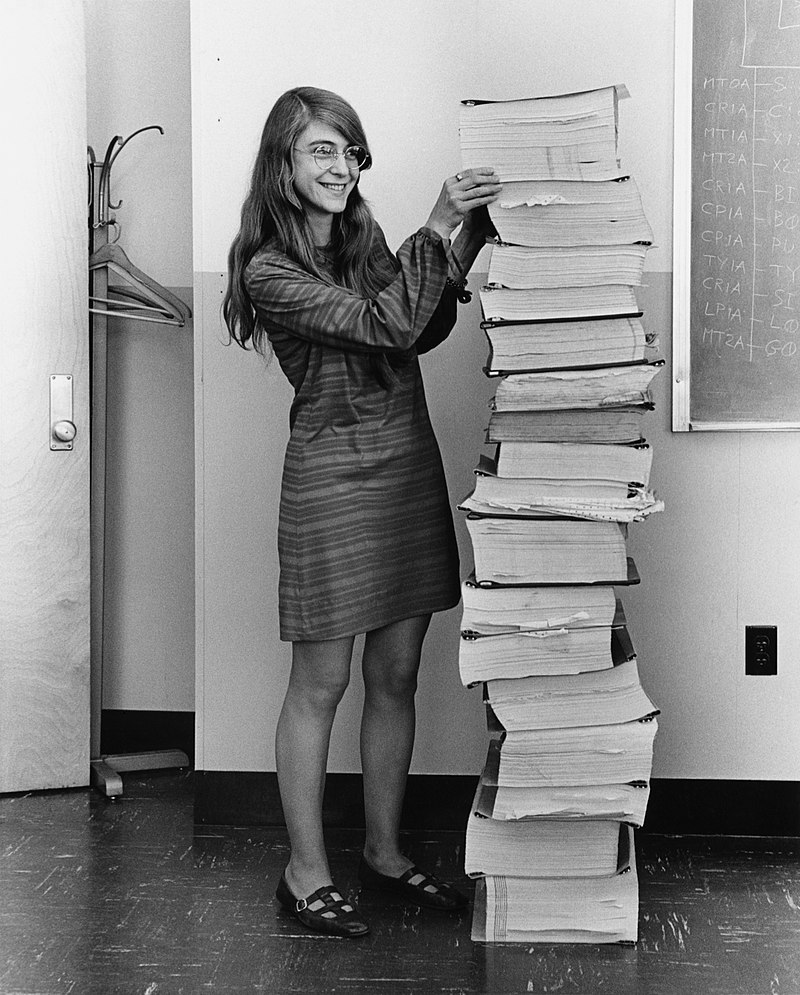
Margaret wrote computer code for M.I.T. back in the days when writing code was literal writing–by hand–each line of code on paper. Those codes told the computer what function to do next in a process. Like Kay Tyler’s advice, Margaret also had to think things through, and she definitely had multiple back up plans just in case. People would ask her, “In case of what?” Margaret would smile and answer, “Exactly!” In her capacity as a code writer, people’s lives were on the line; the decisions her code made could make the difference between life and death for some. There’s a story that, one night during a work party, it struck Margaret that one line of her code was incorrect. With her apologies, she rushed out of the soiree and returned to her office. Sure enough, one small part of a line of code was in error. Margaret realized that even something so small could make a world of difference in the right situation. So, Margaret became a perfectionist out of a sense of responsibility and ownership of her work–concepts that are becoming more and more foreign to some in the workplace today.

And remember that, during the 1950s and ’60s, it was rare for women to be in the workplace compared with today. And Margaret was also a mother. People at the time would ask her nosy questions like, “How can you work and have a child?” and “Don’t you love your family?” Yes, those were the types of things people thought about working mothers 60 years ago (not that some don’t still feel that way). Yet, despite knowing that her work was important, Margaret still felt some societal pressure to conform to the middle-class expectations of a woman being a wife and mother first.

So, often, Margaret would bring her daughter to work at M.I.T. with her. And that seemingly little thing led to something amazing. One night, while her daughter was with her in the office, Margaret allowed the child to play with one of the machines she had written the code for. The child, in her innocence, tasked the machine to perform a function for which Margaret had not written code. That piqued Margaret’s attention. What would happen, she wondered, thinking things through, what would happen if someone using her code would accidently make the same input that he daughter had done? Would that cause a catastrophic failure of the system? Should she write code that would keep the machine from even performing that operation at all, even it would be accidental? Better safe than sorry, she reasoned. So, Margaret wrote the code.

Turns out that when the code was finally used in the real world, someone indeed accidently made the same input that Margaret’s daughter had done. However, because of her sense of perfectionism, Margaret was ready for it. And, in the final analysis, it was that mentality that perhaps saved lives.

What you don’t know, most likely, is that Margaret Hamilton wrote code that produced the modern coding systems we use today. In the same way that the invention of the telegraph led to modern cell phones, Margaret’s code is the grandparent of the code used on the device you’re using to read this blog right now. At the time, of course, Margaret’s code was groundbreaking and revolutionary. And, it’s true, her code saved people’s lives.

You see, Margaret wrote all the code for NASA that sent humans to the moon.
On Lunar Trash Bags

Did you realize that there’s an experiment that was left on the moon that is still ongoing? It’s true.

The United States made six successful trips to the moon with humans onboard. Those journeys, from July of 1969 to December 1972 (Apollo 11 to Apollo 17), were summed up (somewhat grammatically awkwardly) by Neil Armstrong when he said that stepping onto the surface of the satellite was a small step in one way but a giant leap for mankind in another sense. And he was right. Those six landings captivated the world and still do to this day.

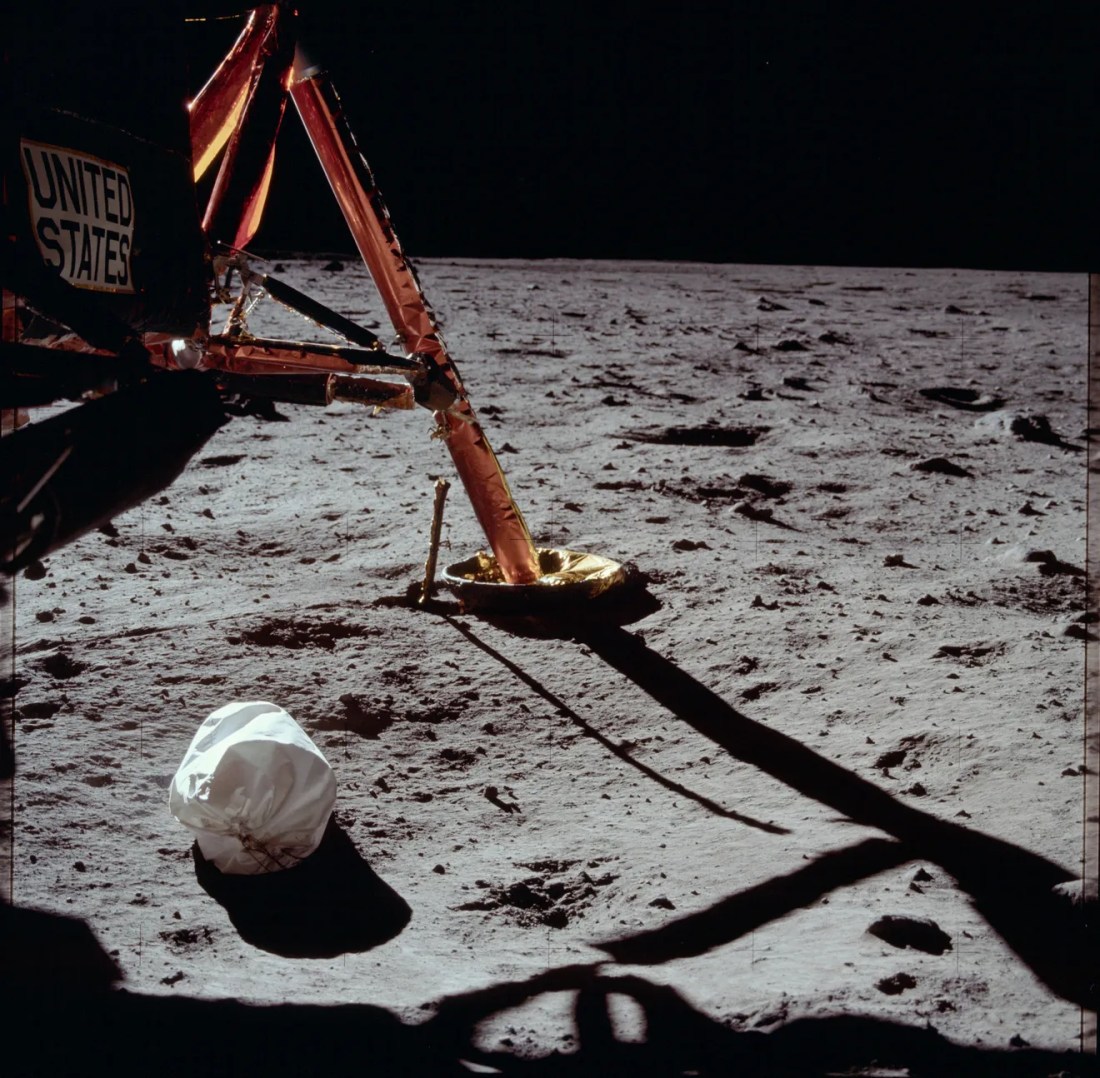
However, wherever mankind goes, trash goes with mankind. That’s certainly true of the moon as well. And besides the mechanical stuff that the astronauts left, things like the lunar rover, the landing “gear” that the modules took off from, various tools, and the now-bleached out flags and poles, there is another classification of garbage that the humans left that particularly interests scientists today, more than 50 years after humans last visited the moon.

The astronauts left this type of garbage on purpose. And this garbage is in 96 bags. They knew when they left it on the moon’s surface that the composition of the bags was teeming with life. Over 1,000 different types of microbes and species of bacteria are in those bags according to scientists. And it’s possible that fungi could have formed in the microbial bags. Thus, these 96 bags represent an interesting experiment in how living things can–or even if they can–live in an environment as sterile as the moon’s surface.

The extreme temperatures of the moon are a great test tube for this experiment. And, to be fair, the likelihood of anything surviving is slim. However, if the microbes can survive on the moon, well, they could be a signal that we can send things like seedlings or the basic building blocks of life long distances in space. Microbes can survive in the most unlikely places and in ultra-extreme conditions. This experiment might help us understand if we can maybe send life to planets that could be somehow “greened” or made habitable over time. This entire enterprise makes astro-microbiologists (yes, that’s a thing) really excited about the possibilities here on earth and the beginnings of life on our own planet. And the lunar experiment is still waiting for mankind to return to the moon to see how–and if–the microbes and bacteria survived in these bags.

And to think, all of this excitement over 96 bags of human poop.

On a Whim

The Abraham Family had left India and immigrated to the United States. There, they embraced the new nation and its culture, history, and heroes. One day, the husband and wife, with the wife’s mother and infant daughter in tow, decided to do one of the most American things you can do–take a road trip.

This was November 1969, and the nation was in the middle of social unrest and upheaval. The 1960s had been a kidney stone of a decade. The decade had seen assassinations and wars. It amplified much of what had separated the disparate parts of America, putting us against each other in tribes of youth verses establishment, black against white, immigrant against native-born, and pro-war against anti-war. Yet, that is part of what made the Abrahams want to see America’s heartland, to seek out what made their newly adopted nation tick. So, they went to Ohio.

Wapakoneta, Ohio, probably doesn’t rank high on most people’s travel destination lists, but the Abrahams thought it was the perfect American place to see. So, they stopped in the town that today boasts less than 10,000 souls and rests between Toledo and Dayton. Anisha, the infant child, doesn’t remember the trip, but she talks about that visit to Wapakoneta to this day. You see, the reason she talks about that trip is that her family–both adult women wearing saris–decided to knock on the door of one of the houses in the small Ohio burg.

The older couple who lived there were named Stephen and Viola. Now, most people wouldn’t open the door to strangers in a small town, especially obviously foreign strangers. But Stephen and Viola did. Not only did they open the door, they welcomed the newly minted American multi-generational family into their home, the family who knocked on their door on a whim.

There’s a photograph that Anisha Abraham cherishes of that day. Standing on the front porch of Stephen and Viola’s house in that small Ohio town, we can see the three Abrahams, we see Anisha’s grandmother, and we see the welcoming Ohio couple who chose to open their house and hearts to this family. Viola, wearing a coat against the November chill, holds little Anisha. The men wear ties against white shirts. In many ways, it’s an odd composition, but it represents much of what is wonderful and good about the American Experiment: A spirit of camaraderie, a unity that brings disparate backgrounds and races and beliefs together and somehow makes them all, well, American.

Oh, and the photo was taken by Stephen and Viola’s 39 year old son, who just happened to be home visiting his parents that day. On one hand, it would have been great to have had a photo with him in it, but, in a way, it’s ok that it didn’t.

Still, not every immigrant family to America has proof that they knocked on the door of Neil Armstrong’s house on a whim.

On a Wheelman

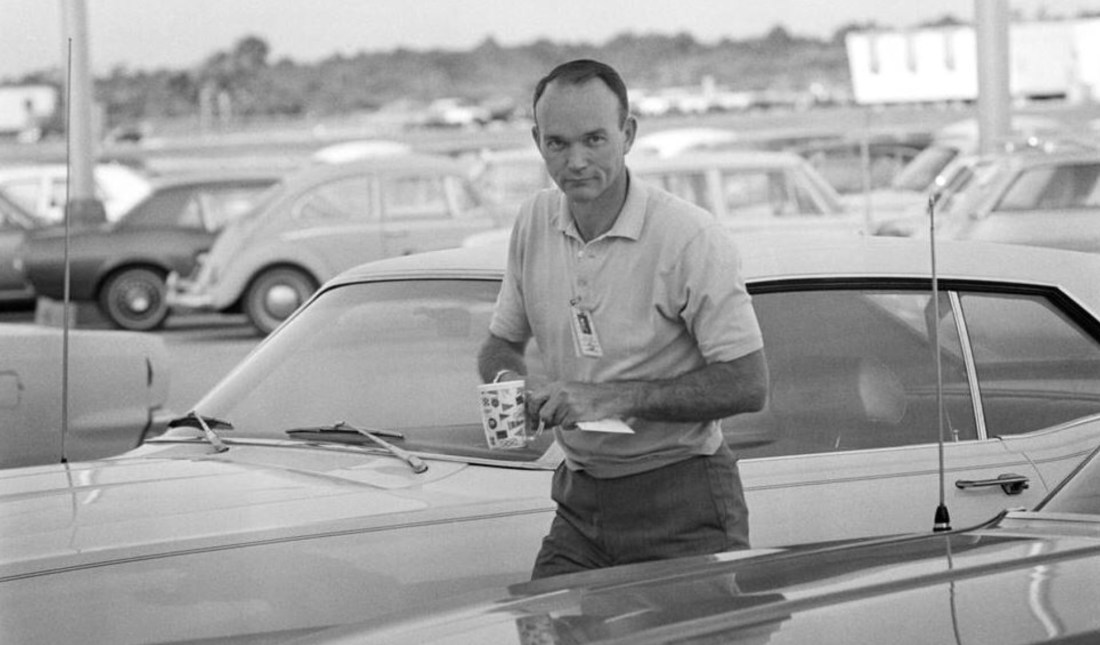
Mike sat in the vehicle alone. His two compadres were doing the job while he manned the “getaway car.” As his chums busied themselves, hurriedly gathering their loot and carrying out their tasks, Mike circled,  running all the worst case scenarios through his head. What if there was trouble? What if they got stuck? What if they couldn’t get out? He tried not to think about it. His buddies were counting on him to be there when they were done. But waiting by himself in the getaway vehicle made him feel, as he said later, more alone than anyone has been since Adam.

The three had practiced and practiced and practiced for every possible scenario. They had spent years working through the job. The idea was that more preparation meant a better chance of success. The trio had not simply gone through practice runs until they got it right; they had practiced until they could not get it wrong. Like Danny Ocean in the movies, they even worked on mockups of the scene. Each man knew his role. They had experience. No, this wasn’t their first time doing this.

And, so, Mike brought the vehicle right around one more time and waited. “What will I tell their families if they don’t make it out?“ He thought. “I don’t want to be the guy, the only guy who lives through this.“ Again, he circled.  No sign of them.  It shouldn’t be taking this long. They should be back by now. He even contemplated going to get them directly, but that wasn’t part of the plan.  Stick to the plan, Mike told himself. Stick to the plan.

Thirty times Mike circled.

You might think that, by this time, the average wheelman would begin to give up and try to make good his own escape. But not Mike. No, in fact, he felt a heightened, “awareness, anticipation, satisfaction, confidence, almost exultation.”  Suddenly, on the final pass, he saw them. Mike’s two pals we’re coming towards him as quickly as they could.  Just as they had planned it, Mike did not even have to stop to let his buddies enter the vehicle.

Mike tried to hide his relief and excitement once his buddies were inside. As he steered away, he asked calmly, “How did it go?“ His buddy Neil gave him a thumbs up while other member of the trio, Buzz, grinned broadly.

That’s when Commander Michael Collins radioed Houston that Apollo 11 was returning to earth.