On a Perfectionist

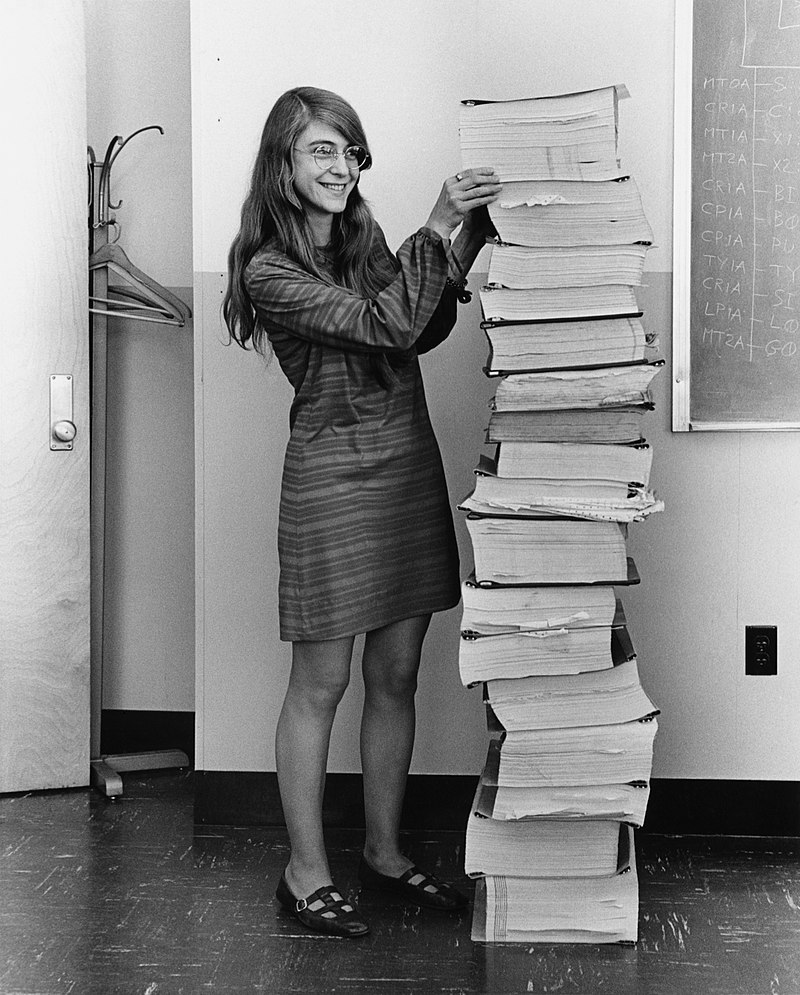
One of the best bosses I have had across my various jobs was a woman named Kay Tyler. She taught me two valuable lessons. One was to thing things through. What will happen each step of process? What effect will those things have on all involved and on the pursuit of the goal? The other lesson was to have not only a Plan B but also at least have an idea of Plans C-F or so. Those lessons have stayed with me and helped me be a better administrator and even a better person. Ms. Kay was a perfectionist, and she was one of those who backed up what she taught with a lifestyle to match. Another such perfectionist who is about the same age as Kay Tyler is a programmer and code writer named Margaret Hamilton.

Margaret wrote computer code for M.I.T. back in the days when writing code was literal writing–by hand–each line of code on paper. Those codes told the computer what function to do next in a process. Like Kay Tyler’s advice, Margaret also had to think things through, and she definitely had multiple back up plans just in case. People would ask her, “In case of what?” Margaret would smile and answer, “Exactly!” In her capacity as a code writer, people’s lives were on the line; the decisions her code made could make the difference between life and death for some. There’s a story that, one night during a work party, it struck Margaret that one line of her code was incorrect. With her apologies, she rushed out of the soiree and returned to her office. Sure enough, one small part of a line of code was in error. Margaret realized that even something so small could make a world of difference in the right situation. So, Margaret became a perfectionist out of a sense of responsibility and ownership of her work–concepts that are becoming more and more foreign to some in the workplace today.

And remember that, during the 1950s and ’60s, it was rare for women to be in the workplace compared with today. And Margaret was also a mother. People at the time would ask her nosy questions like, “How can you work and have a child?” and “Don’t you love your family?” Yes, those were the types of things people thought about working mothers 60 years ago (not that some don’t still feel that way). Yet, despite knowing that her work was important, Margaret still felt some societal pressure to conform to the middle-class expectations of a woman being a wife and mother first.

So, often, Margaret would bring her daughter to work at M.I.T. with her. And that seemingly little thing led to something amazing. One night, while her daughter was with her in the office, Margaret allowed the child to play with one of the machines she had written the code for. The child, in her innocence, tasked the machine to perform a function for which Margaret had not written code. That piqued Margaret’s attention. What would happen, she wondered, thinking things through, what would happen if someone using her code would accidently make the same input that he daughter had done? Would that cause a catastrophic failure of the system? Should she write code that would keep the machine from even performing that operation at all, even it would be accidental? Better safe than sorry, she reasoned. So, Margaret wrote the code.

Turns out that when the code was finally used in the real world, someone indeed accidently made the same input that Margaret’s daughter had done. However, because of her sense of perfectionism, Margaret was ready for it. And, in the final analysis, it was that mentality that perhaps saved lives.

What you don’t know, most likely, is that Margaret Hamilton wrote code that produced the modern coding systems we use today. In the same way that the invention of the telegraph led to modern cell phones, Margaret’s code is the grandparent of the code used on the device you’re using to read this blog right now. At the time, of course, Margaret’s code was groundbreaking and revolutionary. And, it’s true, her code saved people’s lives.

You see, Margaret wrote all the code for NASA that sent humans to the moon.

On Scientific Trash

Our world is filled with garbage. The scientific community shows videos of floating islands of trash in the Pacific Ocean that has an area larger than some nations. You can’t drive down the highway without seeing the mounds of aluminum, plastic, paper, and other assorted garbage that has been thrown from vehicles or fallen off of trucks. And no one seems to mind it, much. It’s only another of the prices we pay for life in the modern age. Oh, sure; some of those “earth lovers” decry the trashing of the planet, but, by and large, most people on the planet seem to not care about how much garbage is actually out there.

Then there’s the trash that the scientific community itself produces. Right now, there are hundreds of tons of garbage that endanger people every day, and this trash is a direct result of the so-called progress of the modern world that our best scientific minds have produced in the past 65 years. There are dozens of videos and websites devoted to showing the public this debris, if you know where to look. Yet, most of the public knows nothing about this potential danger to them that this garbage poses, hanging like an unseen or recognized Sword of Damocles over the heads of the population.

In fact, let’s get specific. There are over 130,000,000 pieces of trash that the world’s scientists have produced that have the potential to cause harm to us right this minute. Now, to be fair, the overwhelming number of these pieces are relatively small, but they can still do damage enough to harm us at least indirectly. More on that in a moment. But what’s even more unusual about this scientific trash is that the scientific community knows exactly where they are. In fact, there is an office set up to monitor the trash.

This accounting of the trash began the moment the first bit of junk was thrown away. Yet, the scientists are loathe to do anything to start cleaning up this large amount of trash; they say that they either lack the funding to clean up the trash or they lack the technology to do so. Some point to political reasons for not cleaning up the scientific trash. They invariably shrug and bemoan the fact that the trash exists. But that doesn’t stop them from continuing to add to the amount of garbage they produce every year as they watch the number and the tonnage of junk increase.

However, there is a new movement in some scientific corners calling for a halt to the pollution. One of the interesting things about this junk is that, these people say, if left alone for about 40 years, the junk will sort of “clean itself up” in a way. The theory goes that if no new garbage is produced, then, eventually, it will sort of simply go away. The reason for some of these scientists calling for a halt to the increase in this garbage is that the levels of trash has reached a critical point, they say. The likelihood of that trash causing a major catastrophe is increasing, they say.

And what exactly is this stuff?

Well, as you’d expect, there are garbage bags of trash, surely. Paint. Pliers. A camera. A blanket. Some toothbrushes. And that’s only some of the small stuff. The real threat is the bigger stuff. The fear is that some of that bigger stuff–some left over satellites, for example–will collide with existing objects orbiting earth, causing them to fall into the atmosphere and then crash onto populated areas of the planet.

Because there’s simply that much space junk orbiting earth right now.

On an Unusual Pacifist

Conrad Haas should not have been a pacifist. Given his position in the Austrian Army’s artillery corps, Haas spent most of his adult life figuring out how to best use gun and cannon fire to kill large numbers of troops. And, during the time that Haas lived, artillery killed more soldiers than any other type of weapon did.

Haas was born in Vienna and raised in a middle-class family. He studied artillery in college, and became an army officer in charge of munitions for the entire Austrian Army soon. When it came to artillery, Haas was somewhat of a savant. He not only could calculate distance and elevation of the weapons to fire accurately, but he also knew how to best conserve fire and make it effective when it counted most in battle. Such skill soon made him known throughout Europe, and he was invited to Romania to teach in an army artillery school there.

Now, you’d think that a person who knew about how to effectively cause death and destruction through artillery wouldn’t have many qualms about his job, but Haas did. In fact, he began to see that his job was that of a sort of artillery grim reaper, a person who sowed disaster and mayhem. And that made him become a pacifist while he was still in the employ of the military.

He began to tinker with the artillery and the calculations needed to shoot projectiles long distances. And this led him to try to see another possible application for artillery than that of death. What Haas came up with was revolutionary for his time. In addition, he began writing treatises about disbanding and disarming the military. “Mankind should pursue peace and not war,” he wrote. “The day will come when the powder will stay dry, the leaders will keep their money, and the young men will not die.” You can imagine that these types of writings made him some powerful enemies.

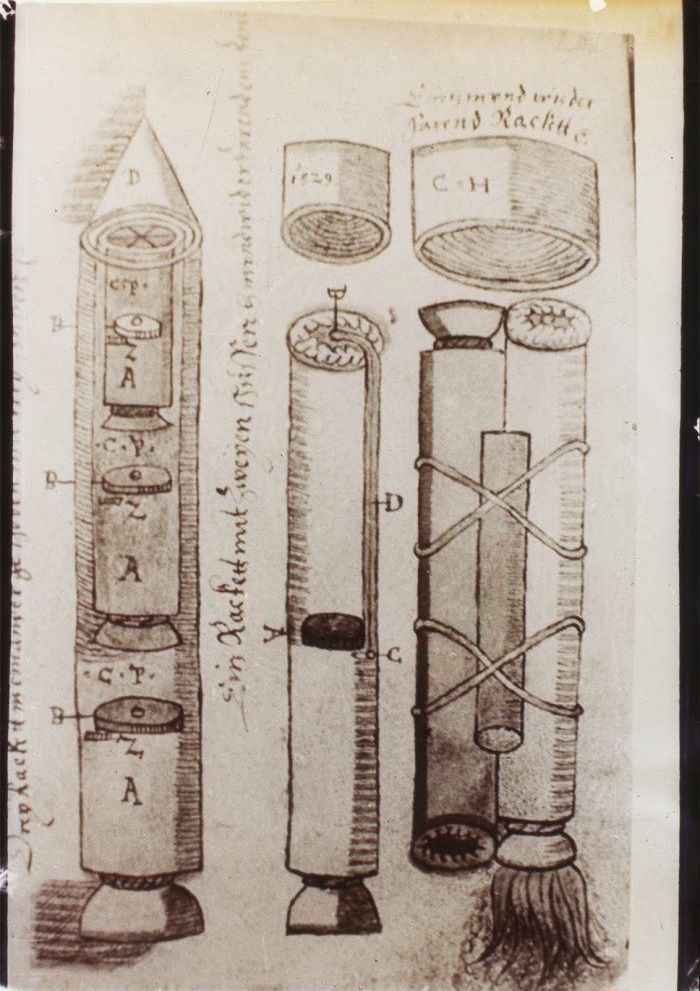
And those enemies would have done something about this artillery officer cum peacenik if what Haas proposed to do with artillery didn’t interest them so. You see, it was Conrad Haas who first came up with idea of launching not an artillery projectile, but, rather, a rocket into space. His concept was a three-stage rocket made up of a combination of solid and liquid fuels that would help the rocket break the earth’s gravity and cause the projectile to soar into the upper atmosphere.

He also came up with what is called a delta-shaped fin (the types we see on rockets today) and even a cone-shaped exhaust that would focus the power more directly and in a less diffused manner. And we can imagine that armies certainly liked the military capabilities that Haas’s ideas brought. So, his pacifism was ignored.

Of course, when Haas thought of all this, the practical application for such technology was years away.

After all, it was the 1550s.

On a Solo Trip

Valentina was 26 years old when the Soviet Union chose her to take a trip alone for the first time. The girl was known in her town for her confidence and her perseverance. Born in Russia in 1936, she lost her father in the first year of World War 2 and was raised by her mother along with two sisters.

The hardship that family of women faced is difficult for us to imagine today. We think today of having a wide range of opportunities and choices, but those multiple options weren’t readily available to Valentina. No, the young girl determined that she would have to work to make any opportunities in life.

And so she did. Without telling anyone, the teen took classes, training, and even got a job her mother didn’t even know about. At her regular school, Valentina excelled at almost every subject. She finished her primary and secondary education in only 7 years. Besides, working, schooling, and training, Valentina enrolled in correspondence courses in a technical school and received a diploma there as well.

But Valentina had other secrets as well. The biggest one was that she learned to skydive. Her love of that sport led her to enter skydiving competitions in the area around their town. And she was good at it. Her sense of competition and her drive to excel attracted the notice of the local communist party leadership. Like most of the young people in her area, Valentina joined the communist party, signing up in 1962. The local party big-wigs sent messages to Moscow about the determined, smart, and competitive Valentina, the hard-working girl who secretly learned to parachute, and they recommended her for higher things in the party.

That led Valentina to be sent on the trip alone at age 26 for the first time. The trip involved a parachute jump, and that’s why the party chose her. Another girl was also chosen to go, but it was decided at the last that only Valentina should travel and make the jump. So, on the morning of June 16, 1963, Valentina said goodbye to her friends and family and left on her trip.

She was gone for three days by herself.

When she came home, she told people that the journey had made her a little sick and that the jump was one of the most difficult she’d ever experienced. She’d felt nauseated and had to fight a strong wind on the descent. But everyone said she’d done so well despite the conditions. Her training and her determination saw her through.

Yes, as Valentina Tereshkova parachuted out of the Vostok space capsule four miles above the earth’s surface, she returned home a hero as having been the first woman in space.

On Three Dream Careers

Most kids play “What do I wanna be when I grow up” games. These usually take the form of some glamorous profession (I was going to star in the NBA then fall back on an Indiana Jones-like career making amazing archaeological discoveries in my retirement from the league). Here are three examples of these types of what-I-want-to-be-when-I-grow-up dream careers coming true.

  1. Soldier-Jonathan wanted to be a soldier beginning in his early teens. He dreamed of being a US Navy Seal, the toughest of the tough. Towards that end, he began training at age 16 for the difficult indoctrination required for that role. He enlisted in 2002, completed his Seal training, and was sent to the Middle East on over 100 covert missions during the Iraq War. There, he became a hero, rescuing wounded comrades and winning the Bronze Star and the Silver Star. Over the past 20+ years, Jonathan completed Officer Candidate School and had risen to the rank of Lieutenant Commander in the Navy.
  2. Doctor-Young had exemplary grades in high school. Advanced Placement classes were easy for him. In addition, he was on the swimming water polo teams. After an undergraduate degree from the University of San Diego in 2012, Young was admitted to the prestigious Harvard Medical School where he also excelled. From anything in the medical profession to choose, Young decided to specialize in Emergency Medical Care, and, after his internship at Massachusetts General Hospital (I wonder if he met Dr. Charles E. Winchester, III?), Young finished his medical education. His supervisor during his time as an intern and the head of the hospital ER, Dr. David Brown, said about Young, “He is absolutely fearless–which a good ER doctor needs to be–a remarkable young man, fiercely committed.”
  3. Astronaut-Kim remembers being the shy kid growing up who lacked the confidence he saw in others. However, he dreamed big. He majored in mathematics in college and received his degree. After his college career, Kim took a chance and applied to NASA’s astronaut program. But he knew that he would have to also learn to fly, so he took flying lessons and completed his solo flight in the late 2010s. Out of 18,000 applicants, he was chosen for astronaut training. He entered NASA’s program in August 2017. Kim completed two years of training (training in technical and operational instruction in International Space Station systems, Extravehicular Activities (EVA) Operations, T-38 flight training, robotics, physiological training, expeditionary training, field geology, water and wilderness survival training, and Russian language proficiency training) in 2019. He will be one of the astronauts going to the moon later this decade. 

Dream jobs and career paths, right?

Most people never follow their dreams, much less follow such amazing career paths such as these three descriptions.

Would it surprise you if I told you that the three people described to you came from the same Korean immigrant family in the United States?

And would you believe me if I said that all three of these descriptions are of the same person–39 year old Jonathan “Jonny” Young Kim?

On an Famous Golf Shot

The Masters Tournament in Augusta, Georgia, has always been a marker for spring for me. The beautifully manicured greens and fairways, the gorgeous azaleas in full flower, and the pageantry of the donning of the famous Green Jacket by the winner represent the popularity of the sport of golf in the United States and around the world. In 1971, a man named Charles Coody recorded his only career major tournament win by besting Jack Nicklaus and Johnny Miller for the victory by two strokes.

In an ordinary year, that would have been the major golf news of the year, but a golfing amateur upstaged Coody in February that year. This amateur’s name was Alan, and his impact on golf is still celebrated today. We may not remember much about that 1971 Masters Tournament, but we certainly remember what Alan did that year. In fact, it is said that Alan hit the most famous golf shot ever made.

The shot Alan made was with a 6-iron, a club that was made by the sporting goods company Wilson and the style of club was called a Dynapower. And that’s part of the story. You see, it wasn’t that Alan made a golf shot that was accurate or that defied the laws of physics or bounced around and settled in the hole or even that he made a hole-in-one. No, Alan’s 6-iron golf shot is significant because of the distance he hit the golf ball with that 6-iron.

Now, most amateurs would hit a 6-iron about 150 yards on a good day. Not Alan. After a couple of practice swings, Alan addressed the ball and took a rather unorthodox swing at the ball; he hit it one-handed. Please know that the average golf shot with a driver (the larger clubs) stays in the air for about 6 or 7 seconds. Alan’s ball took off…and was airborne for over 30 seconds. In fact, the shot Alan took was measured by one scientist as having traveled one mile.

Yes. One mile.

Alan passed away in 1998, but, before he died, he donated the 6-iron with which he hit his famous shot to the United States Golf Association Museum in Liberty Corner, N.J. The club can be seen there today, and it is one of the most popular exhibits at the museum. People want to see the club that made the most famous shot in history.

After all, it’s not everyday you see a golf club that astronaut Alan Shepard used to hit a ball on the moon.

On a Test Animal

The scientists named her Barker.

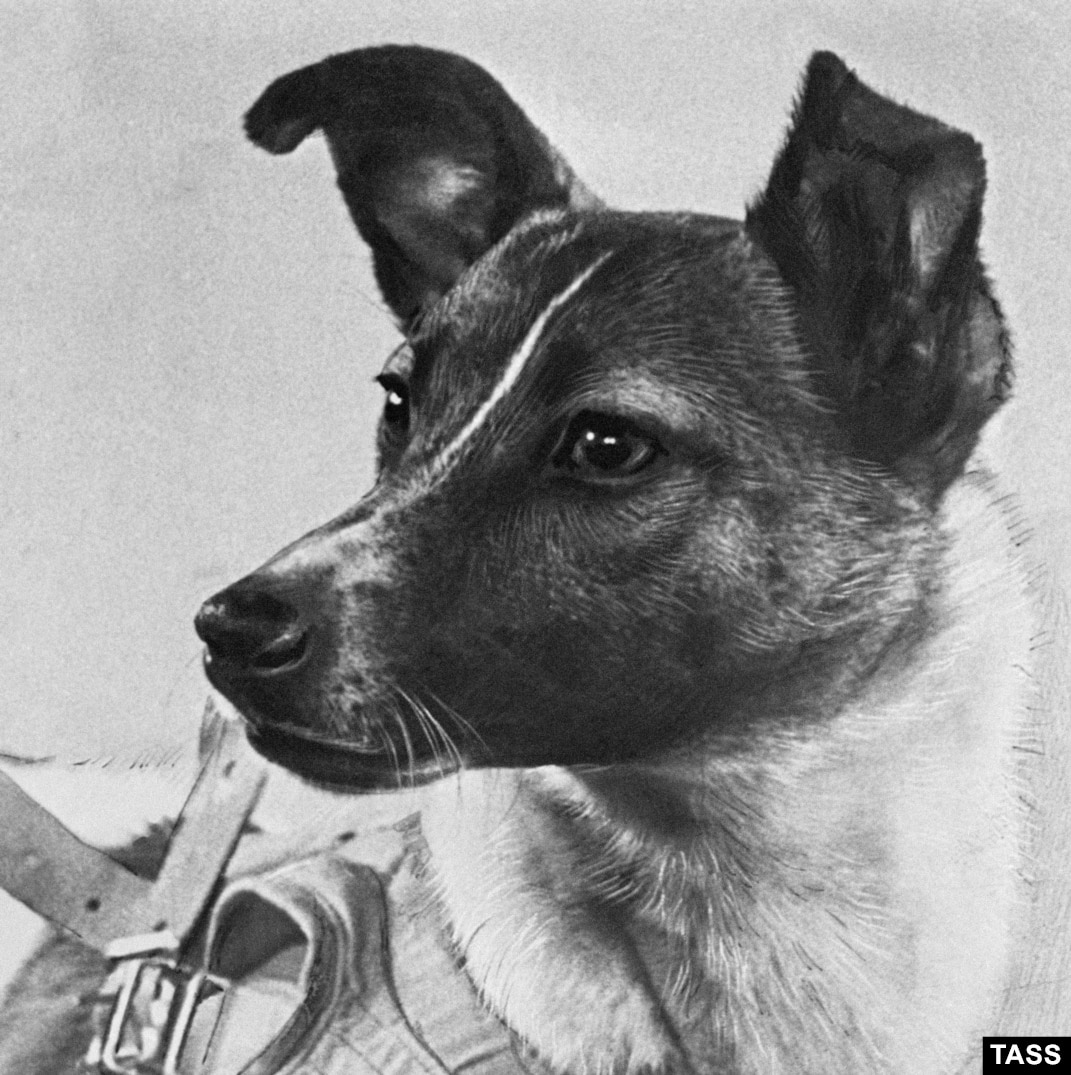
She was found wandering the streets of the city and was quite obviously a stray. She was also quite obviously a mutt. Oh, she had some physical characteristics of a Samoyed, and some of a Husky, and there was definitely a bit of Terrier in there as well. Ah, but she was a tiny thing. She weighed only about 12 pounds.

And that’s why it was somewhat comical that such loud barking yelps came from a girl this small. Of course, they had to name her Barker. The best that the scientists could determine, Barker was about three years old. Her ears stood straight up, except at the top tips which folded down. Ah, she was a real cutie.

The scientists liked using stray dogs from the city streets because they felt that those dogs had been conditioned to extremes of temperature and of hunger. Their experiments needed dogs that could withstand both. Now, as an animal lover, I will go on record as being against the use of animals in scientific experiments on principle. However, this was the mid-1950s, and the use of animals in scientific experimentation was commonplace. Sadly, the experiments that were being performed on the street dogs would end up killing them.

One of the scientists who was conducting the experiments developed a soft spot for Barker. He would scratch her ears and whisper to her so that the other scientists could not hear his sweet nothings. He would put his head on hers and quietly say that, in another life, he would love to have her at his house to play with his children, and to watch her grow up with them. In fact, on the evening before the experiment that would lead to her death, he did, indeed, take Barker home. She and the kids had a wonderful time, running and playing throughout the house. Of course, the kids were giggling, and Barker was, well, barking. “She was so charming,“ he would say later. Knowing her fate, the scientist wanted to do something nice for her.

I wish this story had a happier ending. It is true that all stories involving dogs end sadly. When you bring a puppy into your life, the result is going to be heartache because nothing is forever.

The next day, Barker began the experiment that would take her life. And because of that experiment, she would go down in history. Or, in this case, perhaps, up.

You see, Barker is what her name is in English.

You know her better by her Russian name, Laika, and as the first animal from earth to go into space.

On a Field Trip

In the late 1960s, I was in the first years of elementary school in north Alabama. The school system of our city was top-notch; the high school offered advanced placement courses (even courses on anatomy for students who wanted to pursue medicine) and the board of education was always erecting new facilities every few years. Field trips were part and parcel of the curriculum as teachers sought to expand our minds by making our classrooms not confined by the halls of the buildings but designed to include the wider world.

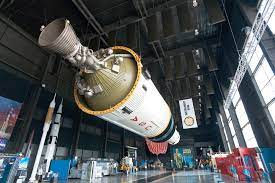
Thus, in 1970, the kids at East Elementary School in Cullman, Alabama, boarded buses and traveled about an hour north to Huntsville to see the newly opened NASA Space Flight Center. As a child of the ’60s, I remember growing up with the marvel of space travel on TV and in the news magazines and newspapers. As a 7 year old, I distinctly remember seeing the live feed from the moon. And, as Armstrong made his “giant leap,” I leapt with him.

NASA’s operations in Huntsville brought the world to north Alabama. Scientists and engineers from across the globe came there and made the city their hometown. It remains one of the state’s most diverse and forward-thinking cities because of this influx of talent and international perspective.

The museum there remains one of my favorites. For the young and impressionable me, to see the massive Saturn V rockets, to interact with some of the artifacts and displays there made me feel great pride in the accomplishments not only of my country but also of my species. As I grew older, one of my regrets is that my family moved from that area before I could go to Space Camp there.

We all have vignettes from our past that stick out to us about an event or a situation that probably should not be in our long-term memories but yet are there, fixed, and often recalled and mused over for the rest of our lives. There is one such strong memory of that day that stands above the others for some reason.

You see, as we excitedly filed off the buses and began to make our way into the large museum facility, the door was held open by a nice older gentleman in a suit who had a neatly combed head of hair. As he did so, the thing that has stuck with me for over fifty years is how he greeted us as we entered.

“Welcome, children,” Wernher von Braun said, smilingly.

On a Wheelman

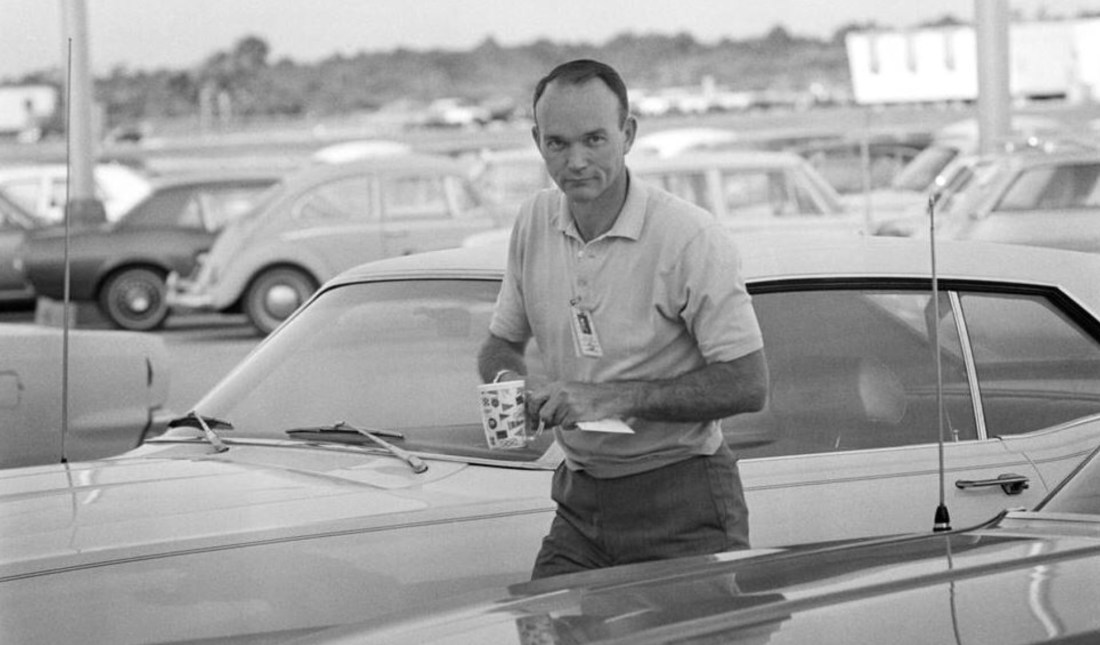
Mike sat in the vehicle alone. His two compadres were doing the job while he manned the “getaway car.” As his chums busied themselves, hurriedly gathering their loot and carrying out their tasks, Mike circled,  running all the worst case scenarios through his head. What if there was trouble? What if they got stuck? What if they couldn’t get out? He tried not to think about it. His buddies were counting on him to be there when they were done. But waiting by himself in the getaway vehicle made him feel, as he said later, more alone than anyone has been since Adam.

The three had practiced and practiced and practiced for every possible scenario. They had spent years working through the job. The idea was that more preparation meant a better chance of success. The trio had not simply gone through practice runs until they got it right; they had practiced until they could not get it wrong. Like Danny Ocean in the movies, they even worked on mockups of the scene. Each man knew his role. They had experience. No, this wasn’t their first time doing this.

And, so, Mike brought the vehicle right around one more time and waited. “What will I tell their families if they don’t make it out?“ He thought. “I don’t want to be the guy, the only guy who lives through this.“ Again, he circled.  No sign of them.  It shouldn’t be taking this long. They should be back by now. He even contemplated going to get them directly, but that wasn’t part of the plan.  Stick to the plan, Mike told himself. Stick to the plan.

Thirty times Mike circled.

You might think that, by this time, the average wheelman would begin to give up and try to make good his own escape. But not Mike. No, in fact, he felt a heightened, “awareness, anticipation, satisfaction, confidence, almost exultation.”  Suddenly, on the final pass, he saw them. Mike’s two pals we’re coming towards him as quickly as they could.  Just as they had planned it, Mike did not even have to stop to let his buddies enter the vehicle.

Mike tried to hide his relief and excitement once his buddies were inside. As he steered away, he asked calmly, “How did it go?“ His buddy Neil gave him a thumbs up while other member of the trio, Buzz, grinned broadly.

That’s when Commander Michael Collins radioed Houston that Apollo 11 was returning to earth.