
It’s difficult for us today to realize the impact the French Revolution and then the Napoleonic Wars had on Europe, North America, and the trade around the entire globe. These wars that raged almost constantly from the late 1700s to almost the 1820s saw most of the world’s major powers take part in what could arguably be called a true World War because of how wide-ranging it was. As we know, the French side lost, Napoleon was exiled, and the British-led coalition emerged victorious.
One of the major heroes of that series of wars for Britain was Admiral Lord Horatio Nelson. While Nelson had won several victories in the wars, his major naval victory over Napoleon’s forces at the Battle of Trafalgar in 1805 was one of the most important turning points in the defeat of the French leader. Nelson died from a French gunshot that pierced his lung and back during the battle onboard his flagship, the HMS Victory. A wave of memorials to the fallen hero were constructed across Britain.
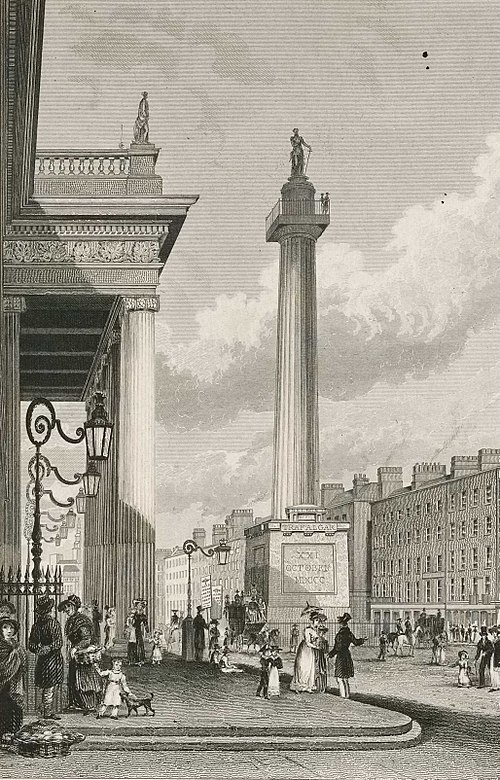
One of the most prominent monuments to be build was named Nelson’s Pillar. Commissioned shortly after the battle and completed four years later, the pillar stood on O’Connell Street downtown. The combined height of the pillar and the monumental statue that stood atop it was over 135 feet. The base was so large that people could climb to the top of the statue using a spiral staircase that wound its way through the pillar. When tourists or visitors would come to the city, it became practically a requirement that they would climb Nelson’s Pillar.
People in the city at the time of the monument’s construction were proud of what Nelson had accomplished. As much as 20% of Nelson’s sailors in the famous battle were either from the city or from the surrounding area. The citizens’ hearts swelled with patriotism when news of the victory came. Funding the monument wasn’t a problem at the time. The pillar stood in its prominent place and became a city landmark, a source of local pride.
But, then, in 1966, a man named Liam Sutcliffe climbed the stairway inside the pillar one evening as it was about to close. Liam left a package there. During the night, the package exploded and destroyed Nelson’s Pillar. All that was left was about half of the shaft of the pillar.
And no one seemed to mind too much.
Liam was never charged by the authorities for blowing up the monument. He even went on a radio station and bragged about his deed, even mentioning two accomplices who aided his act of blatant public vandalism. In fact, most people in the city and the nation applauded this act, this destruction of a monument dedicated to a great hero of British military history.
And they would, wouldn’t they?
The pillar was in Dublin, Ireland, after all.
 The Rest of the Story