On A Returning God

Sometimes in history, the stars align and everything works out exactly right according to one person’s perspective. On the other hand, the same alignment of heavenly bodies bring doom and destruction to the next person. This is a tale of an example of the latter type. You see, it pertains to the prophecy that the god was going to return to a certain group of people. And that returning god, at least in this case, brought with him certain death and the eradication of the group that believed in him.

What happens when you expectantly look for your god to return in the fulfillment of prophecy, but then, when he does return, you are not only disappointed, but you are also destroyed?

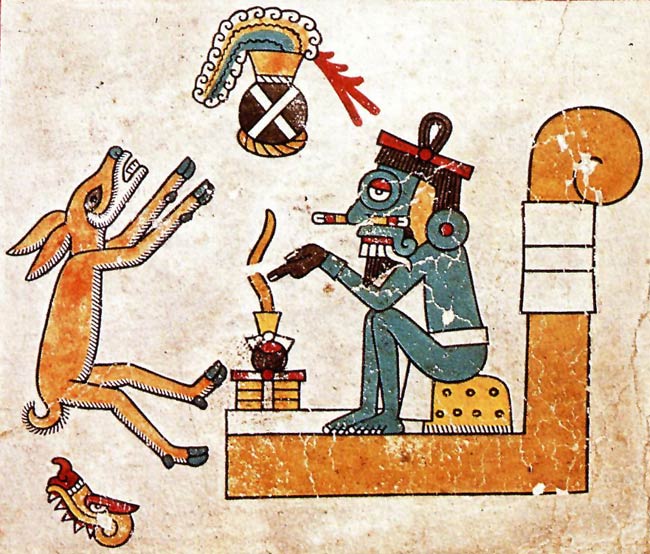
To understand the prophecy clearly, we have to travel to the ancient past, when the first stories of this god appeared. It seems that the god had been banished by other gods from the homeland of the people for reasons that had become shrouded in mystery over the centuries. Most stories centered around his having to perform a series of Herculean tasks and the travel far and wide across the earth before being allowed to return to his homeland. The prophecy said that he was destined to return one day–that much was certain. Then, fast-forwarding to the 16th Century, it seemed to the people that their god had finally finished his sojourn and decided to return to his people.

That’s because all the stories of the traveling god–his appearance and where he came from and even the time of year he would return–all converged into one major event that happened to this group of extremely religious people. The prophecies said he would come from the east. They said that he would be wearing feathers. The further said that the god would have a beard, a feature that the genetics of this particular group of people didn’t have. He would bring with him mythical animals they had never seen, either. Additionally, the god was predicted to return in the Year of the Reed, and that’s when the god did appear. Finally, the god was said to return to the homeland on a boat unlike any the people had seen or imagined, a boat that featured metal on its sides like a porcupine.

Within two years, this god not only destroyed the capital city of this culture, a city that had approximately 250,000 citizens in it, but he and his small group of fewer than 500 seemingly minor deities completely eradicated the society itself. While it seems to be a work of fiction, I assure you this was the case. How did this happen? Well, when the god arrived in what is now Mexico, he completely ignorantly and inadvertently fulfilled the Aztec prophecies. He came from the east, certainly, but he also sported a feathered helmet, he sat astride a creature we call a horse, he happened to arrive in the correct time frame, and his warship bristled with cannons on its sides.

And that’s why Montezuma, the Aztec Emperor welcomed the Spanish conquistador Hernando Cortes and his soldiers into the capital city without putting up any fight.

After all, wouldn’t you let god come into your home?

On a Transatlantic Flight

As a kid, Werner Doehner had loved to travel. He was born in Germany, but his family moved to Mexico when he was a young man. As a result, the family made several trips back-and-forth between Mexico and their German homeland. And every time they traveled, the young man was excited, as excited as he was the first time he ever flew across the Atlantic. One particular trip especially stuck out in Werner’s mind, although he didn’t talk about it until he was an old man. It would be the last trip the five members of his family would take as a group.

Werner’s dad was a pharmaceutical executive for a large German drug firm in Mexico, and he had accumulated great wealth over the course of his career. That allowed the family to travel in style, and that is also what appealed to young Werner when the family made trips back and forth “home” to Germany. It’s always a great way to travel when you can afford to sleep in comfy beds at the nicest hotels, dine at the swankiest restaurants, and luxuriate in the extra large seats on the flights. And that’s the level of luxury that Werner and the family enjoyed on that last transatlantic flight they took together. But there was more. In an effort to make the trip into a true adventure, the Doehner family had booked first-class train travel that would take them on down to Mexico once they had arrived on the flight from Germany into the New York City area. The kids were especially excited over that part of the trip–Werner, his brother, and his sister.

Years later, Werner would talk about that last trip the family made, but it wasn’t until he was an old man and was prodded to talk about the trip by his son. Up until then, Werner didn’t talk much about that flight. As he grew up, he went to a prestigious university in Mexico, majoring in electrical engineering. On another trip back to Germany, he met and fell in love with a woman named Ellin. The couple got married in her hometown of Essen. The young pair moved back to Mexico City, but they eventually immigrated to Massachusetts where Werner made a career with the New England Electrical System before retiring. He and Ellin were married over 50 years. It was shortly before he died in 2019 that he began to open up to his son about the events of several decades before.

Werner finally told his son all about it after keeping it to himself for all those years. He finally spoke of that horrendous fire, the flames that seemed to come on all of them so suddenly. He recalled that his mother first threw his brother out of a window, then she grabbed 8 year old Werner and threw him out before leaping to the ground herself. In doing so, his mother broke her hip. All three of them suffered severe burns. Sadly, both Werner’s father and his sister didn’t survive the fire. And Werner carried the scars he got in the fire for the rest of his life. But the emotional scars were just as real and were the deeper marks of what had happened to him and his family at the end of that flight.

You see, Werner Doehner was the last survivor of the 1937 burning and crash of the LZ-129 Zeppelin, better known to you as the Hindenburg.

On A Trip to Mexico

The bullet bedecked gentleman in the photo above is Pancho Villa. During the decade from 1910 to 1920, Mr. Villa participated in the Mexican Revolution. Needing supplies, money, and weapons to fight in this effort, the resourceful Mr. Villa and his band of merry men turned to a handy and plentiful source of these items: The United States.

However, their methods for procuring these items caused no little consternation among the Americans. You see, Mr. Villa and his comrades simply crossed the US/Mexico border and helped themselves to the supplies. By 1916, their repeated  little forays into US territory from the Mexican state of Chihuahua not only resulted in stolen, lost, and destroyed property, but these raids also caused the deaths of dozens of Americans.

If such incidents occurred today, one can imagine the uproar among the Americans in the press, the public, and among the politicians. One hundred years ago, the reaction was much the same. Calls for punitive military action against the Mexican revolutionaries rose from every corner of the land. President Woodrow Wilson, who had a hand in the early days of the revolution by lending support to the anti-government forces, now decried the activities of Villa and his cronies. He ordered General John Pershing to the border with a large contingent of US troops, including air support (one of the first times airplanes were used in American military history), and he gave Pershing a specific directive: Bring Villa to justice.

Pershing failed to do so. However, he and the American troops fought a few skirmishes with Villa’s crew, and their efforts caused Villa to eventually seek elsewhere for supplies for his part of the revolution. Personally, Pershing declared the expedition a success even if his Commander in Chief didn’t.

One of Pershing’s aides, a young second lieutenant, obtained particular notoriety for an incident involving one of the Villa’s right hand men. It seems that this brash second lieutenant deployed three open Dodge motorcars full of 15 American soldiers and scouts and rode these mechanized “horses“ into a ranch compound in Mexico, guns a-blazing. When the smoke literally cleared, three of Pancho Villa’s men were dead, and no American was as much as scratched.

The lieutenant ordered that the three bodies would be strapped to the bumper and hood of his car and taken back to Pershing‘s headquarters for identification. He then reportedly carved three notches in his expensive pistol handles to mark the three men his part of the operation killed. Pershing, suitably impressed, nicknamed the young man, “Bandito.”

A year later, United States would declare war on Germany and officially enter World War I on the side of the Allies. The Pershing Expedition had served as a small dress rehearsal for the war that America now found itself in. Wilson tapped Pershing to be the leader of the American expeditionary force in France despite the fact the General didn’t capture Villa. “Black Jack” Pershing won international fame and admiration for his part in the Great War.

Wilson, who had  campaigned for reelection  in 1916 on a slogan that reminded voters that he had kept America out of the European entanglement, labeled himself as the savior of western civilization against the evil of war in general and German aggression specifically. His  plan for the peace after the war, called the 14 Points, became the basis for the League of Nations, a weak and ineffective forerunner to the United Nations.  A stroke in 1919 limited Wilson’s effectiveness in rallying America to ratify the Versailles Treaty ending the war; America eventually signed a separate peace treaty with Germany much later and never entered the League.

And that impetuous Second Looey?

He liked the idea of having mechanized infantry strike rapidly at an enemy as he had shown in Mexico. He liked it so much that he entered the tank corps. While he made a decent impression during his service in World War I, we probably remember him best for his accomplishments in the war after the War to End All Wars.

Pershing knew him as Bandito.

You know him as George S. Patton.