
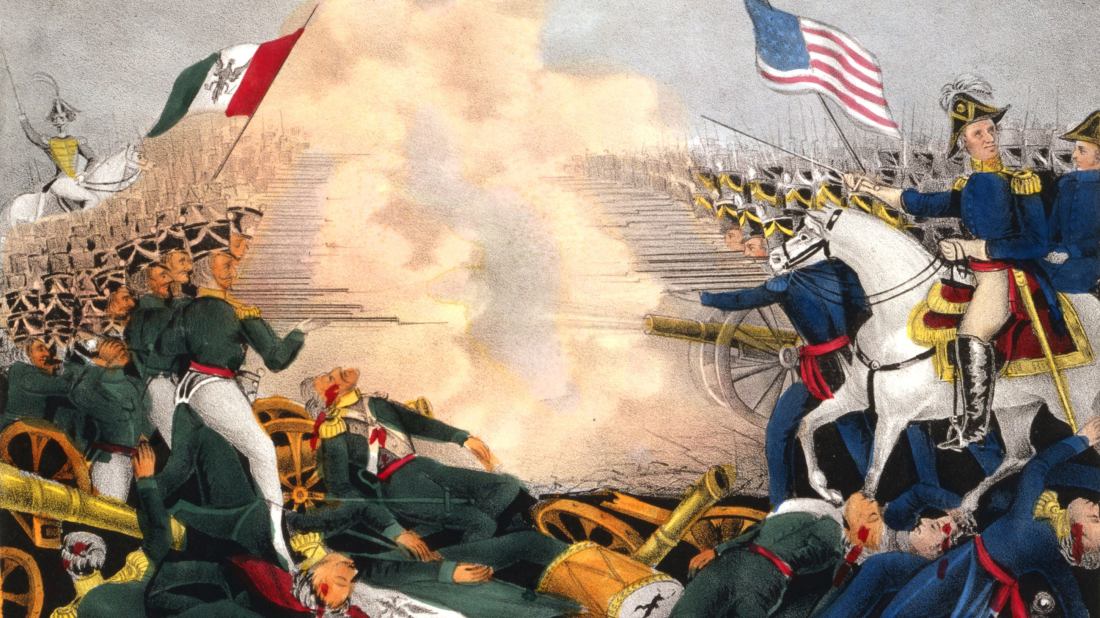
The United States has fought in several wars over the nation’s 250 year history. The war that probably gets the least amount of print in history texts or even mentions in the public mind is the Mexican War, which was fought from 1846-1848, not quite two full years. The war was a resounding victory for the still-fledging United States, with the US Army easily conquering the entire country and entering Mexico City as conquerors. About 18,000 American military personnel were either killed, wounded, or missing from the fight, while Mexico’s military casualties were about twice that. At the war’s end, the United States kept everything from Texas to the Pacific and gave the rest back to a more amenable Mexican government.
For the next decade, men like the heroes General Zachary Taylor (who was later elected president) and General Winfield Scott (and others) dominated not only the American military but also much of American politics. Another of the main results of the war was that it provided what would become most of the officer class on both sides of the American Civil War which began a short 12 years later. Some historians have called that war “the training ground” for the experience it provided the soldiers who would lead both sides in the next war. Men who were junior officers in Mexico would become colonels and generals when the Southern States would rebel beginning in 1860. That meant that men who fought together to a victory over Mexico would fight against each other when the Confederacy took up arms against the United States.
A chance interaction between two officers during the Mexican War bears repeating. The story is told that a young American lieutenant named Sam, his regiment’s quartermaster officer, had been out foraging on horseback in the Mexican countryside for food and supplies. He was returning one hot afternoon to the army’s encampment not too far outside Mexico City as the American were preparing to take the city in the next several weeks. Sam was tired, sweaty, and dirty. His uniform front was unbuttoned because of the heat. Now, Sam was a good horseman, but keeping his uniform in regular “army condition” was never a priority for him despite the fact that he had graduated from West Point a few years before. At any rate, here he came, riding back into camp looking like a tramp in an army tunic.
As Sam was dismounting, a colonel came up to him quickly. Sam noticed that the man had a bushy mustache, an immaculate uniform, and spoke to him with a distinct southern accent. The colonel upbraided Sam for his slovenly appearance. Sam was somewhat taken aback, but he knew better than to dispute with the older and higher-ranked officer. Sam buttoned his tunic, wiped the grime from his cheeks, and saluted the colonel. The officer returned Sam’s salute, turned, and walked away.
Now, such a short encounter would probably not be remembered by most men, but Sam kept the meeting in his mind. In 1865, as the Civil War was ending, Sam ran across that very same colonel as the Southern troops were surrendering. The two men met once again in the front room of a house on one of the battlefields. In an effort to be jovial to the defeated rebel, Sam reminded him that they had met years earlier in the Mexican War. Sam recounted that first meeting, but the former colonel looked puzzled. The man who had been the colonel back then told Sam that, yes, he vaguely remembered the incident but that he didn’t exactly remember that it had been Sam whom he had reprimanded that day. The two men, veterans of two wars–one in which they had been comrades and one in which they had been enemies–reminisced about better days for a moment. But the moment of reflection passed.
It was then that General Robert E. Lee of the Confederate Army reminded the commander of the Union troops, Ulysses S. Grant, known as Sam to his friends, that they had better get on with the surrender of Lee’s troops and end the Civil War.
 The Rest of the Story