
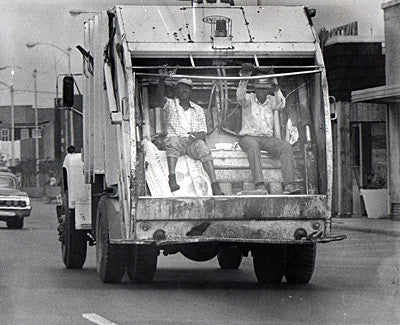
In spring, 1968, and only six weeks into his new administration, Memphis, Tennessee Mayor Henry Loeb came face-to-face with a problem that divided his city along social lines and racial lines. The black garbage men of Memphis walked off the job in order to call attention to poor working conditions and poor wages. The strikers also asked for city recognition of a sanitation workers union.
For the 47-year-old Mayor Loeb, the issue was a simple one. The strikers, as government employees, stood on shaky legal ground he believed. In 1965, the Tennessee State Supreme Court ruled that, as essential workers, government employees could not strike. The mayor spoke of this ruling as his primary reason for opposing the strike. In his mind, he was simply following the court’s decision regardless of how he felt about the issue as an individual.
For his constituency, which consisted of at least 87% white at the time, there were other, more pressing issues involved in the situation. Attempts to set up a labor union by the black sanitation workers in Memphis touched off deeply rooted feelings of hatred among Loeb’s mostly white, Anglo-Saxon/Protestant, deeply southern constituency. These feelings are reflected in a letter of support the mayor received in the weeks of that winter and early spring 1968, a letter from a woman named Pauline Johnson. She wrote, “I sleep better knowing you are our loyal mayor [and] I’m praying that you will be blessed as you stand tall and big in your job.” The word big was underscored. “Thank God for men like you,” she says in her conclusion. That letter was typical of the support Loeb received from not only local letters but also from people all across the south as news of the garbage strike spread.
Different people wrote to call the strikers anarchists, a goon squad, and a bunch of hoodlums. The word communists was used often in the letters, and some even called the union organizers “satanic.” They made reference to Lucifer as well. Some saw Loeb’s stance against the strikers as being god-inspired work. Typical of these more strident letters is the one by a man named R H. Koons who said he was 76 years old. He begged Loeb to “please stand firm and don’t give in.” He tells the mayor that all the problems of Memphis was the union’s fault. “Most of the union heads are Catholic,” Koons advised, showing that some Loeb supporters were anti-Catholic as well as anti-union and racist. And Koons also invoked the Bible. “Anyone who understands the New Testament in the Bible can prove that [nowhere] Jesus ever told his followers to disregard the law.” Like many other letter writers, Koons used language that was both apocalyptic and millennial. He used racist rhetoric against the strikers. And many others wrote letters like Koons did.
Loeb felt the letters expressed the will of the people who had elected him. It would have made sense that his natural inclinations would be to support the unions, but he didn’t. Loeb was a staunch segregationist, which is somewhat surprising given his background And, besides, he felt duty-bound to support the court system. Loeb came from a Jewish family in Memphis, a city with a large middle-class Jewish community. Both of his father’s parents had immigrated to the United States from Germany one hundred years before. His grandparents knew what racial and social discrimination was like.
Loeb, however, bowed to the pressure of the white community and opposed the strikers, refusing to bow to their demands as the garbage began piling up on the streets of the city he led. The strike went on for over two months. Violent clashes began to be waged in various Memphis neighborhoods. Loeb ordered the police to break up any marches or demonstrations, using violence if needed. In a previous role for the city as the Public Works Commissioner, Loeb had overseen the sanitation department, and, in that capacity, had done nothing to improve the plight of the garbagemen. He didn’t allow overtime, there were no sick days allowed, and outdated equipment that was dangerous and unsafe was not replaced. As mayor, Loeb again refused to take action to make their jobs better. That’s when the almost 1,500 minority members of the sanitation department went on strike.
One letter Loeb received stands out from the majority. It came from a garbageman named John Jones. Jones sent a poem along with a letter to the mayor. The poem said, in part, that it was “not by her houses neat/not in her well built walls/not yet again/neither by her docks or streets/a city stands or falls by her men.” Jones was calling for the mayor to do the right thing, the American thing, the moral thing, and support the improvement in the working conditions. But Loeb wouldn’t budge. The atmosphere was ripe for violence to continue because of Loeb’s staunch segregationist inaction.
And a man not from Memphis but who strongly supported the union came to stand with the strikers and march with them, even if it meant facing that violence to achieve the needed changes to the garbagemen’s working conditions. His plan was to combat the strong-arm tactics of Loeb with peaceful non-violence. Sadly, that man would face violence on April 4, 1968. That’s when, while leaving his motel in Memphis to attend a strikers’ meeting, Martin Luther King, Jr., would be shot and killed.


 The Rest of the Story