
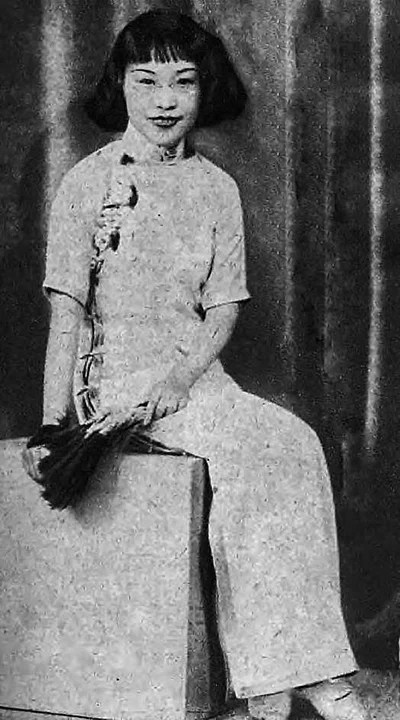
Chen Xiaocui (A reminder to the readers in the west that Chen is the family name) was a Chinese woman who worked as a translator and made a great reputation in China and around the world as a poet. She lived from 1902 to 1967, a period that saw great upheaval in not only Chinese society but also in the world. Born in a rural area to what would now be considered a somewhat middle class family of literary people, Xiaocui and her family moved to Shanghai when she was quite young. Her father, an author in his own right, opened a publishing company there in the days before the Second World War.
Xiaocui had a penchant for language from an early age. Her mother was responsible for much of her schooling, but the poetry, the poetry was a gift. Her literary father steered her into studying the classical Chinese poets and also introduced her to the poets that were famous from around the world. Her early published poems helped support her family in the years before her marriage in 1927 to a son of a high-ranking administrator in the Republic of China government. The marriage produced a daughter, and then the couple separated. It seems that Xiaocui was more dedicated to her work than to the relationship, and that makes sense given her innate talent in language and poetry. She took up painting as well, using the traditional Chinese methods to produce lovely works that were highly praised.
Throughout her life, Xiaocui also helped her father’s publishing business. She became his chief translator in the business. The firm’s name was Sanren Gongsi, translated as Three People because the firm really was her father, her older brother, and herself. Within a few years, Xiaocui managed to produce translations for over 70 novels of famous western authors into Chinese. The most famous of these translations and the ones that produced the most income for Three People were the ones that made up the entire canon of Sir Arthur Conan Doyle’s Sherlock Holmes stories. They became bestsellers in China because of her translation, and that helped the firm become somewhat successful.
In the years before the war, she spearheaded efforts to promote the writing of poetry and the painting of works both in classical Chinese styles within the Chinese school system. It was her belief that if children could be shown poetry at a young age, as she had been done, that it would nourish their imaginations and intellectual growth. She also worked with women’s artists and writers groups in the 1930s to promote more of the visual and literary arts among Chinese women. She taught in universities, urging her young women students to work on crafting their voices in art and literature. After the war ended and the Communists took over in China, Xiaocui had a chance to leave the country for Taiwan, but she chose to remain. He daughter managed to get out of China in the 1950s and make it to France where she, too, became a painter of some renown.
As you might imagine, someone working to create intellectual curiosity through artistic expression in Communist China would invariably run afoul of the authorities, and that’s exactly what happened to Xiaocui. She was removed from her teaching posts and lost her house. Realizing that her situation was growing dangerous, she tried to escape the country, but she was caught and tortured by the state police. Allowed to go free temporarily, she decided that it was better to take her own life rather than allow the communists to take it from her. Her poetry is only now being appreciated more and more in the west, almost sixty years after her death. What we forget about Chen Xiaocui is that she was such a prodigy. Her ability at such a young age can be seen not only in her early poems and paintings but also in those translations she did.
Remember those over fifty Sherlock Holmes stories she translated so well from English into Chinese?
You see, she translated them before she was 15.


 The Rest of the Story