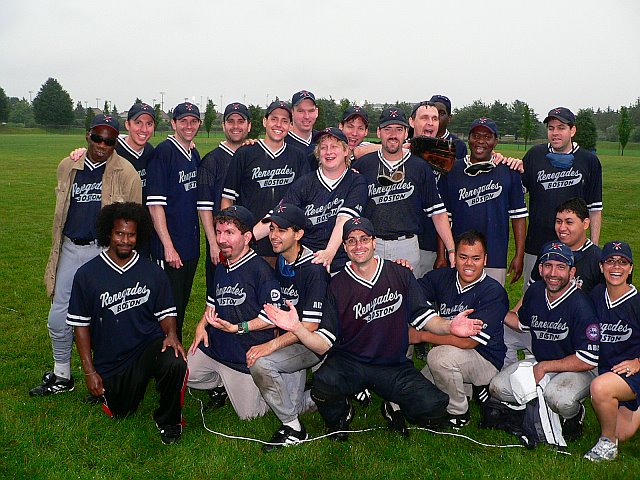
On a Baseball League

It’s October, the time when the (former) National Pastime plays its annual fall classic. I played two years of Little League in Alabama when I must have been 10 or 11. The first team was the McGriff Tire Indians (McGriff Tire was the local sponsor of the team), and we wore green. The next year, I was put on the Orioles, with black and orange colors, but I can’t remember the sponsor that year. The thing was, kids used to play baseball all the time. We played in school, then, we dreamt of summer when we could be on the diamond as much as we could during the long days. None of us was any good, but we had fun. And that’s what baseball should be about for the majority of players.

Take the NBBA, a league that is growing in popularity in the US and worldwide these days. It got started in 1976 mainly for adults to play, but today the age of the players varies widely. The league allows players as young as 12 and as old as 70. And the game as played by the NBBA has some quirky rules to it.

First of all, a game is only six innings instead of the usuals nine. And there are only six fielders on each side. The pitcher and catcher come from the other team; that means that the team that is hitting has a teammate throwing the pitch to them–the best possible pitch to hit. Oh, and each team has a spotter. More on that position in a moment. In addition, the ball is an oversized softball. The bases are blue, and they stand almost five feet tall and are made of a soft foam. Oh, and there is only first and third base. No second.

As for each inning, the batting team gets four strikes before the batter is considered out. If the batter hits the ball, it must travel at least 40 feet (even in play) or it will be considered a strike. If the ball is hit more than 40 feet, and the batter reaches either first or third base before a fielder touches the ball, a run is considered to have been scored. If a fielder catches the hit ball in midair, the side is immediately retired and the fielders come in to take a turn at bat. It’s almost as if the NBBA is a cross between baseball and cricket, but it’s not really that, either.

An invitational tournament is held yearly, and, sometimes, international teams play in it. The winner of the tournament is crowned World Champion. More than 200 teams are in the NBBA in the US alone, and teams are cropping up all across the globe as the game catches on. Cities like the usual major league towns are of course represented, but other towns like Austin, Wichita, and Stockton field teams as well. Teams with names like the Scrappers, the Sluggers, the Lightning, the Reapers, and the Comets have all seen action in the league.

Oh, and the spotter position I mentioned earlier? That’s a key ingredient to the game. When a ball is hit, the spotter identifies which of the six fielders’ position or area the ball is coming to. That’s all the spotter is allowed to do–identify an area from 1 to 6. It helps, also, that the ball that is used emits a beeping noise. That beep really helps the fielders do their jobs.

That’s because all members of the National Beep Baseball Association are blind.

On a Plate Appearance

As we make our way towards October, the end of the baseball season nears. What used to be the National Pastime has been shoved unceremoniously aside brusquely by American football. Yet, it is the history of baseball, the tradition, that still enthralls a hard-core group of fans across the globe. Part of the appeal of baseball for many is that the sport is made up of statistics, and those statistics are finite and fixed and documented. We can re-create entire games based on a scorecard or a box score, for example, as far back as there are records. For some baseball aficionados, the more arcane, the more obscure the statistic, the more interesting it is.

Take, for example, the stories of Major League Baseball players who played only one game in the majors. Even more specifically, let’s look at players that had only one at bat but never actually played in the field. And, to bore down even more into specific stats, let’s focus on those one at bat players who reached base successfully. That’s a pretty small and select group. Only five such players can be found in the entire history of baseball. And one of those players, a man named Eddie Gaedel, stands head and shoulders above the rest. In fact, his autograph is worth more than that of the titan of the sport, Babe Ruth.

Eddie was born in 1925 in Chicago. His father, Carl, had immigrated to the US from what is now Lithuania. Helen, his mother, took care of Eddie and his siblings. From a young age, Eddie was a baseball fan, but, then, so were most American boys of that era. He worked during World War 2 as a riveter as a teenager, doing his part to help the war effort despite being too young to be drafted. For many reasons, Eddie’s start in pro baseball got off to a late start. In fact, it wasn’t until he was 26 that he signed his first pro contract with the St. Louis Browns (a team that is now known as the Baltimore Orioles).

On August 15, 1951, Eddie made his debut–and only appearance–in a MLB game. It was against the Detroit Tigers, the second game of a double-header. The fact that the Browns began the game by pulling the leadoff man (the first batter) and substituting Eddie was quite unusual. Fans and even sportswriters and broadcasters were left scrambling for information about the last-minute substitute. They found him on the roster as a last-minute addition, and he was listed as batting right handed but throwing left handed. Eddie confidently strode to the batter’s box and took the traditional stance next to the plate–a stance that bore a striking resemblance to that of baseball great Joe DiMaggio.

The Detroit pitcher, a man named Bob Cain, looked at his catcher, another man named Bob (Swift), and shrugged. The catcher went down into his crouch, and the umpire yelled, “Play ball!” Cain’s first two pitches to Eddie were serious attempts at a strike, but both, interestingly, sailed over his head. The last two pitches by Cain were no more than lobs, with the pitcher almost laughing as he tossed the ball to Swift. The ump yelled, “Ball four!” and Eddie trotted triumphantly to first base. The Browns’ manager, Zach Taylor, called for time, and a pinch runner came into the game, replacing Eddie at the first base bag. In the style of a major leaguer–because he was, at that point–Eddie smacked his replacement on the backside and trotted into the dugout. The crowd of over 18,000 in St. Louis went wild with cheers. It would be his only appearance in a game. His on base percentage remains a perfect 1.000.

Now, you may wonder why this remarkably short professional baseball career merits our time. In the large scheme of things, it’s not even a blip on the baseball radar. There should be no reason why a four-pitch walk should cause Eddie Gaedel’s autograph to bring more than Babe Ruth’s.

That is, until you realize that Eddie Gaedel stood 3′ 7″ (109 cm) tall and weighed only 60 pounds.