
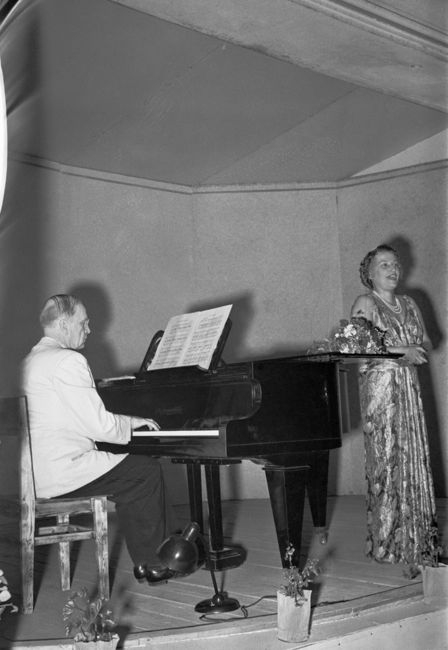
Kosti Vehanen was a pianist and composer from Finland. Eighty years ago, most people who followed classical music knew Kosti as one of the premier musical accompanists in the world. At age 18, he entered one of the best performing arts academies in Europe (now known as the Sebelius Academ) and there excelled at both performance and composition.
You may wonder why a musician you’ve never heard of merits a few minutes of your time. Well, Kosti Vehanen wasn’t your typical accompanying musician. Many of the major classical singers of that day preferred the Finn’s delicate and sensitive and almost anticipatory playing as they performed. He found himself on stages all over the world in the first half of the 20th Century, both as an accompanist and as a featured player with symphony orchestras. Remember that this was the days when radio was almost omnipresent in most homes of the western world, and people tuned in regularly to hear Kosti play with this singer or that orchestra.
What made him even more special in his day was that Kosti did not play favorites and did not discriminate. The 1920s and 1930s saw a rise in the public expression of racism around the world. The Nazis, the KKK, and other racist and fascist groups grew in number and in the expression of their hate. Kosti ignored the hate, and he performed with people of all races and religions.
In fact, it was 84 years ago that Kosti Vehanen played piano outdoors in Washington, D.C., before a crowd of 75,000 live listeners and millions who tuned in on several radio networks to hear him. One thing that made this outdoor concert even more special is that, when the racial hatred of Europe was about to burst into war within the next five months, Kosti played in front of the Lincoln Memorial, a monument dedicated to a man who fought for equal rights in his day. When he was asked to play that day, Kosti accepted the invitation without any hesitation. In fact, his schedule had suddenly become clear because one of his performances had been cancelled.
You see, Kosti and the singer he was going to accompany that day had been scheduled to perform in the largest concert hall in Washington, Constitution Hall. The problem was that the hall was owned by an American racist organization, the Daughters of the American Revolution. Posing as a patriotic group of women, the DAR openly discriminated against minorities and religious groups they deemed as being un-American. To them, that meant anyone who was not white, Anglo-Saxon, and protestant.
We think of Germany and Italy and Japan as being jingoistic and racist in the 1930s, but we forget that organizations not that much different than the fascists operated openly in both the United States and in the United Kingdom during the same period. The DAR cancelled the concert at Constitution Hall because not only was it to have an integrated audience listening to the performance, but they cancelled it also because the featured performer was a black woman.
That’s why Kosti Vehanen, with his sensitive and delicate style and his strong convictions that all people are created equal, moved his performance from the 3,700 seat Constitution Hall to the open spaces of the Mall in front of the Lincoln Memorial. It was there on April 9, 1939 that this talented Finnish man accompanied Marian Anderson as she sang to the American people.

 The Rest of the Story