On a Bad First Impression

First impressions are hard to get over for good or ill. Sometimes, when you meet a person, something about that person bothers you or makes you feel uncomfortable; that person somehow sets off alarm bells in your psyche. That’s what happened in September, 1918, at a dinner in London, England. World War 1 was winding down; the Allies, led by the United States, Britain, and France, were pushing Germany back on the Western Front after over four years of stalemate in the trenches. By November 11, 1918, the war would be over.

A young American government administrator in the Department of the Navy had come across the Atlantic to assist in the final preparations for the end of the war. He had taken a tour of the areas in England where staging bases were located. Then, donning a steel helmet, he was given a tour of the areas behind the constantly moving front lines near Verdun, in France. There, he saw the huge piles of ammunition, bombs, materiel, and food supplies–and also the piles and piles of coffins and dead bodies produced by the war. While he never came under fire, he got enough of an idea of the logistical nightmare that not only prosecuting the war was but also how difficult ending it would be.

He had been sent there on orders of the White House. President Woodrow Wilson needed someone to be his eyes and ears in Europe, someone he trusted. And the young administrator had put together quite the dossier of what it would take for the demobilization of the war effort and the re-establishment of peacetime order and daily life (later on, a man named Herbert Hoover would be in charge of one part of this post-war plan by organizing food relief for Europe after years of having almost no farm harvests because of the war).

Upon his return to London after his tour of the front, this American official had been staying at one of the city’s swankiest hotels, the Ritz. Among the meetings that had been scheduled for him there were appointments with the head of the British Navy and even had some time with King George V, a meeting at which he expressed President Wilson’s admiration for the king. One of the last meetings on the administrator’s agenda before returning to the United States was to meet with one of Britain’s chief war administrators, another navy appointee like himself. The meeting was to be conducted over a supper at the famous Grey’s Inn in London.

The dinner didn’t go well. To begin with the Englishman was late. When he finally arrived for the meeting and supper, it appeared that he had been drinking. The American was underwhelmed. In a diary entry, he later wrote that the Englishman was, in his words, “a stinker…[who] was lording over all of us.” The Englishman seemed to give the impression that the Americans, and this American in particular, were somehow beneath him. And that chagrined the American no end.

So, it’s important what first impressions can do to relationships. Funny, that. In this case the two men later became close friends. The American man later told the Englishman, “You know, I didn’t like you at all when we first met.” That surprised the Englishman because his first impression of the American wasn’t negative.

In fact, years later, Winston Churchill told Franklin Roosevelt that he didn’t remember the meeting at all.
On a British Spy

I love a good British spy story. Tinker, Tailor, Soldier, Spy is one of my favorite films for this reason. There’s something about the spycraft of it all, the casual business-like calm, the, well, Britishness of spying that makes those types of stories interesting to me. Take the story of one such spy recruited by Britain during World War I.

Many people don’t know that the British Government spy agency, commonly known as MI-5 (short for Military Intelligence, Section 5) got its start before World War 1, in 1909. Britain could read the tea leaves, so to speak, and knew that war with the aggressive regime of Kaiser Wilhelm II in Germany was going to happen sometime in the near future. Therefore, the British planned ahead. MI-5 was set up to identify and monitor possible German spy activity in Britain in the buildup to the war. The head of the agency, a General Vernon Kell (known only in the agency as “K,” of course), also knew that, when war came, it would be vital to have British agents in the nations that could help Britain win the war. So, he planned to plant British spies in nations like Romania (whose king was a relative of Britain’s George V, as were most European monarchs), Denmark, and Italy.

Italy was especially important to Britain because of their large navy in the Mediterranean Sea and the fact that they bordered Austria-Hungary on their eastern side, a nation that most assuredly would side with Germany during the war. And General Kell sought out Italians who weren’t in the miliary to be his spies; he felt that people with “normal” jobs would draw less attention in their intelligence gathering than would people who would be obvious candidates for spying. On the other hand, the occupation of these people should give them access to people, places, and events that would prove to be valuable sources of information if and when the need arose. Teachers made good spies. Transportation administrators did as well. Art dealers, book publishers, and reporters were also on the list.

Thus, one of the spies MI-5 supported during World War I in Italy was a journalist. In his capacity as a British agent, this guy could not only have access to important people but he would also be able to help sway public opinion in favor of the Allied cause. Of the several dozen spies in Italy during the war, this one was a particularly good investment. Records show the man was paid well by the British every week to provide information and also help mold the opinions of the Italian people into supporting the Allies. In fact, payments made to this journalist at the time equaled about $8,000 per week in today’s money.

As Italy’s government began fighting for the Allies, the work this spy performed made a difference in keeping Italian morale up and providing actionable information for his minders. As the war ended in November, 1918, the need for such spies also ended. Kell saw MI-5’s budget cut drastically after the war, going from hundreds of staff members to only a handful. However, the onrush of World War II brought the agency it back to life as the original Axis of Evil (Germany, Japan, and Italy) threatened the world.

Of course, Italy’s threat to Britain in the 1930s might not have been so great had it not been for the rise of the Black Shirts of the Fascist Party in the 1920s. And you know the man who led that political movement, right?

The same journalist the British paid so well to be a spy during the previous war: Benito Mussolini.

On a Horse Race

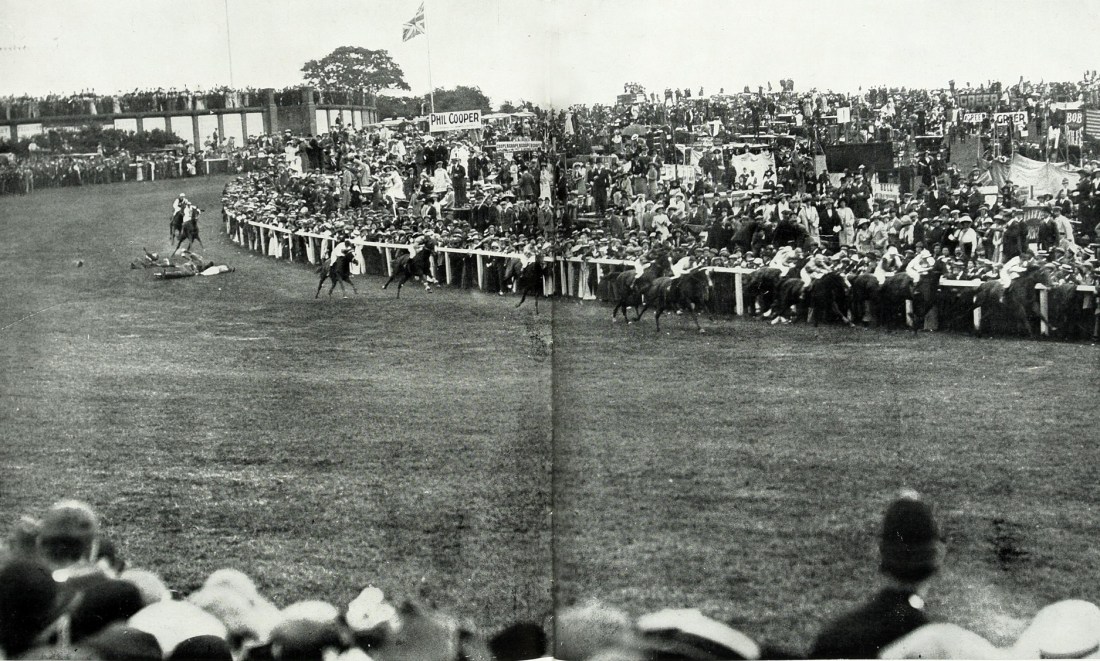
June 4, 1913, was the day of the famous Derby Race held in Epsom, Surrey. The 1 1/2 mile race is the premier thoroughbred horserace in the United Kingdom. That day, the Derby was won by a 100-1 long shot named Aboyeur, although he was not the first horse to cross the finish line. Another horse crossed first, but, unusually, that horse was disqualified because the horse and rider had committed several fouls along the race course. That’s why Aboyeur ended up in the winner’s circle that day. However, we don’t remember the 1913 Derby because a long shot won that day.

Jockey Herbert Jones is one reason we remember that particular race so well. That day, Jones was astride a steed named Anmer, and Anmer was owned by none other than King George V. Now, Jones was one of the best-known riders of his day. Jockeys were celebrities like pro athletes are today, even gracing the fronts of collectors cards (like a horseracing version of baseball cards). Jones won Britain’s version of the Triple Crown, and he had been astride other colts owned by royalty before. Some said he was one of the favorite jockeys of Edward VII, a king known for his love of the ponies and racing and betting.

But this was not Jones’s day. Anmer broke late and never had a chance to move up to challenge the leading pack that day. In fact, Anmer didn’t finish the race at all. You see, an obstruction was on the race course, and Anmer struck the obstruction, falling, and throwing Jones off his back. He summersaulted and landed on top of Jones. The jockey was knocked unconscious and later was determined to have had a concussion. He also had to have an arm in a sling. King George was most disappointed. He noted in his diary for that day, “Herbert Jones and Anmer had been sent flying” by the obstruction and that it was “a most disappointing day” all around. Luckily, Anmer wasn’t badly injured, and Jones even managed to ride the horse in races again not to much later after he recovered from his injuries.

But, what exactly was this obstruction?

Well, it happened at turn four as the race was about to enter the home stretch. Something ran out onto the racecourse in the direct path of Jones and the king’s horse. Newsreels of the day captured the moment it happened, and you can see it on the internet today. The obstruction–the object that ran out in front of a mounted horse running about 35 miles per hour–was a woman.

It seems Emily Davidson, a 39 year old suffragette from London, crossed under the barricade and moved alongside Anmer and Jones as they sped towards her. The newsreel footage seems to show that she was trying to attach some sort of suffragette pennant to the horse’s tackle or bridle as it flew past. The horse struck her—and killed her almost instantly.

Davidson’s dramatic death is said to have led to the public outcry that would give women in the UK the vote only 5 years later.