
On Some Invented Words

She and I, former friends, found ourselves in a pickle. Our relationship had seen better days, that’s for sure. That when the green-eyed monster, jealousy, had raised its bedazzled head. The cold-blooded and hard-hearted rant it started came out of my mouth without my even realizing it. True, I was wearing my heart on my sleeve in that moment.

Oh, it was absolutely character assassination, no doubt about it. Did she deserve it? Arguably not; some would say that it was baseless, but my ranting had a certain feeling of vindication to it even though it was at the same time obscene. Someone who saw it might say I was rather sanctimonious and that my behavior was laughable.

The thing is, once you start publicly shaming someone, it becomes like an addiction. It feels so cleansing, so cathartic. Oh, some might label you zany for critically and verbally assaulting someone like that. And the object of your castigation, your verbal attack might see you as an arch-villain.

And if you happen to be an eyewitness to such an eventful tirade, if you happen so see such a sorry sight, you won’t soon forget it. The inaudible terror that flashes on people’s faces when they hear your screed is also something to behold. It can make your hair stand on end.

It’s even more terrifying when it happens in the workplace, as when a manager berates a worker. You feel for the employee as the manager swaggers over them publicly and verbally, knowing that the whole place has been made uncomfortable by the scene. If the person gets fired, then sometimes, you have the embarrassing scene of the watching the disheartened worker realize that the game is up. You see them gathering their belongings in a hurry and beating an inauspicious retreat.

You’re probably wondering what all this means, well, wonder no more. You see, all those words and phrases–and dozens more–were created by one man some 400 years ago. We use them today without a second thought.

But we wouldn’t have any of them without the majestic genius of the auspicious William Shakespeare.
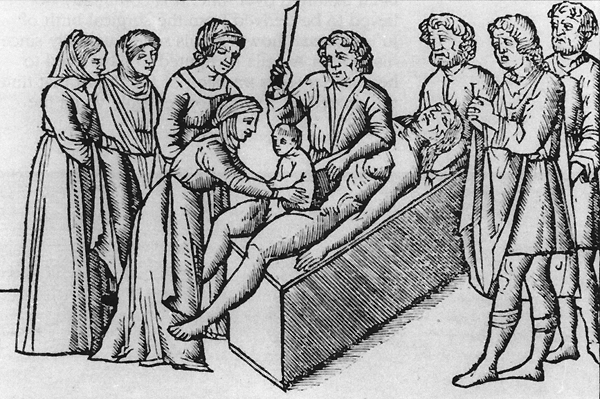
On a Cesarean

Men have no idea how difficult pregnancy is on both mother and child. The miracle of gestation and the wonderful but incredibly uncomfortable 9 months of the development of the fetus isn’t usually discussed in polite society, but it should be. And that doesn’t even factor in the emotional issues associated with the flood of hormones produced by the pregnant woman. Then, all of that culminates in the indescribable pain associated with the birth itself. Carol Burnett famously described it as pulling your bottom lip over your head. Modern medicine has made the process somewhat more safe and less painful to a degree, but, again, that is only in the modern era. For births in antiquity, every event was fraught with potential disaster to both mother and child.

Take a birth that occurred in Rome approximately 100 years before the Christian Era. At that time, physicians knew relatively little how the process of birth happened. In this case, the pregnancy had been a difficult one on top of the usual issues that come along with becoming pregnant. The doctor on duty for the birth realized that the birth would be difficult as well, possibly endangering the lives of both mother and child.

Now, at the time, Cesarean sections were employed only in cases where the mother was dead or dying in an attempt to possibly save the child. Sometimes, the doctors would perform the operation on the deceased mother in order to extract the child if it were dead so it, too, could receive a proper burial. It wouldn’t be until within the past 150 years that C-sections were employed to save the life of the mother rather than only to save the child. There were anecdotal evidence of the rare case when the mother would recover after the child was taken by C-section. These stories were so rare that many historians today doubt their veracity. By the way, the verb “to cut” in Latin is caedere, and cutting out of the child–that’s where the idea of the Cesarean section came from.

I say all that to point out that his particular physician was preparing for the worst. In his mind, if the mother was unable to give birth and began to succumb, he was ready to do what was needed to extract the child–even if the child, too, passed away. Such was the primitive methods and mindset of birth 2100 years ago.

Yet, in this case, despite the difficult pregnancy, the birth was relatively uneventful. In fact, a thoroughly healthy boy was born to a wealthy family, to the mother, Aurelia, and her husband, Gaius. Their family name, by the way, is said to have come from the fact that one of the ancestors of Gaius had indeed been taken from his dead mother surgically.

That’s why this healthy boy, a boy who was not born by C-section after all, was named Julius Caesar.