
The relationship between the United States and the Soviet Union between the end of World War 2 and the beginning of the Cold War changed exponentially. Allies during the war against Germany, the two nations became bitter enemies once the war was over. However, that transition from friend to foe didn’t happen overnight. Both nations mistrusted each other for years but saw the relationship as being necessary to defeat the Nazis. However, that doesn’t mean that, at times, friendly gestures were exchanged while the two countries were allies.
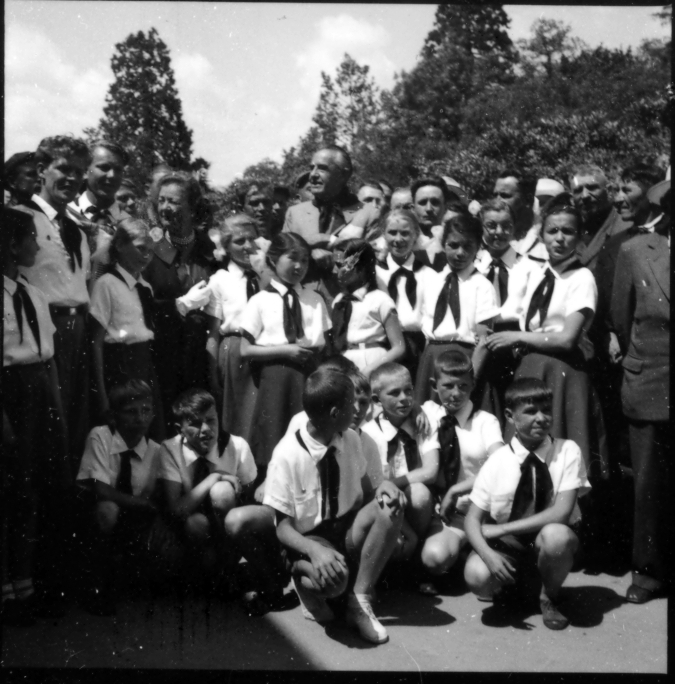
Take the gift that was given to the US Ambassador to the Soviet Union, Averell Harriman, in 1945. The gift was a hand-carved wooden replica of the Great Seal of the United States. And the gift was formally presented to the ambassador by a large contingent of the Soviet Union’s young person’s organization, the Young Pioneers. The Pioneers were much like a politicized version of the Boy or Girl Scouts in the west, but in the case of the USSR, membership wasn’t optional. However, the presentation of the gift was reported in the press as a wonderful gesture of gratitude on the part of the young people to their vital ally in the Great Patriotic War against Nazi Germany.
You see, when Hitler decided to invade the Soviet Union in 1941, the United States had not yet entered World War 2. The country was desperate to find the weapons and materiel to fight the war against the invaders. The United States arranged to begin supplying Russia with armaments and some products needed to fight. It’s safe to say that, without the aid of the United States, the USSR’s ability to defend itself against Germany would have been severely hampered. So, as the war was nearing the end in the summer of 1945, the giving of a gift to the US representative in Russia seemed more than appropriate.
At the presentation ceremony, Harriman, surrounded by the boys and girls in their red Pioneer scarves, graciously accepted the large wooden plaque on behalf of the United States. He ordered the plaque placed in the US Embassy in Moscow. It occupied a place of honor behind the large desk in the ambassador’s office and hung there for the next seven years.
Then, in 1951, something odd happened. A communications officer in the British Embassy in Moscow as sitting at a radio in his office one day when he suddenly heard something unusual on his set. What he heard was American voices coming over the air, bleeding through a Russian military broadcast he was monitoring. The communications guy couldn’t understand how that could be; the nearest American radio station that could be broadcasting was several hundred miles away in Western Europe. He continued to listen, then, it dawned on him what he was hearing. He jumped up and ran down the hall to the office of the British Ambassador.
It was then that the world found out, after seven years, that the beautiful carved wooden plaque that the Pioneers had presented to the Americans wasn’t what it seemed.
The gift, given by the Soviets to the Americans in the pretense of friendship, was actually a listening device.

 The Rest of the Story